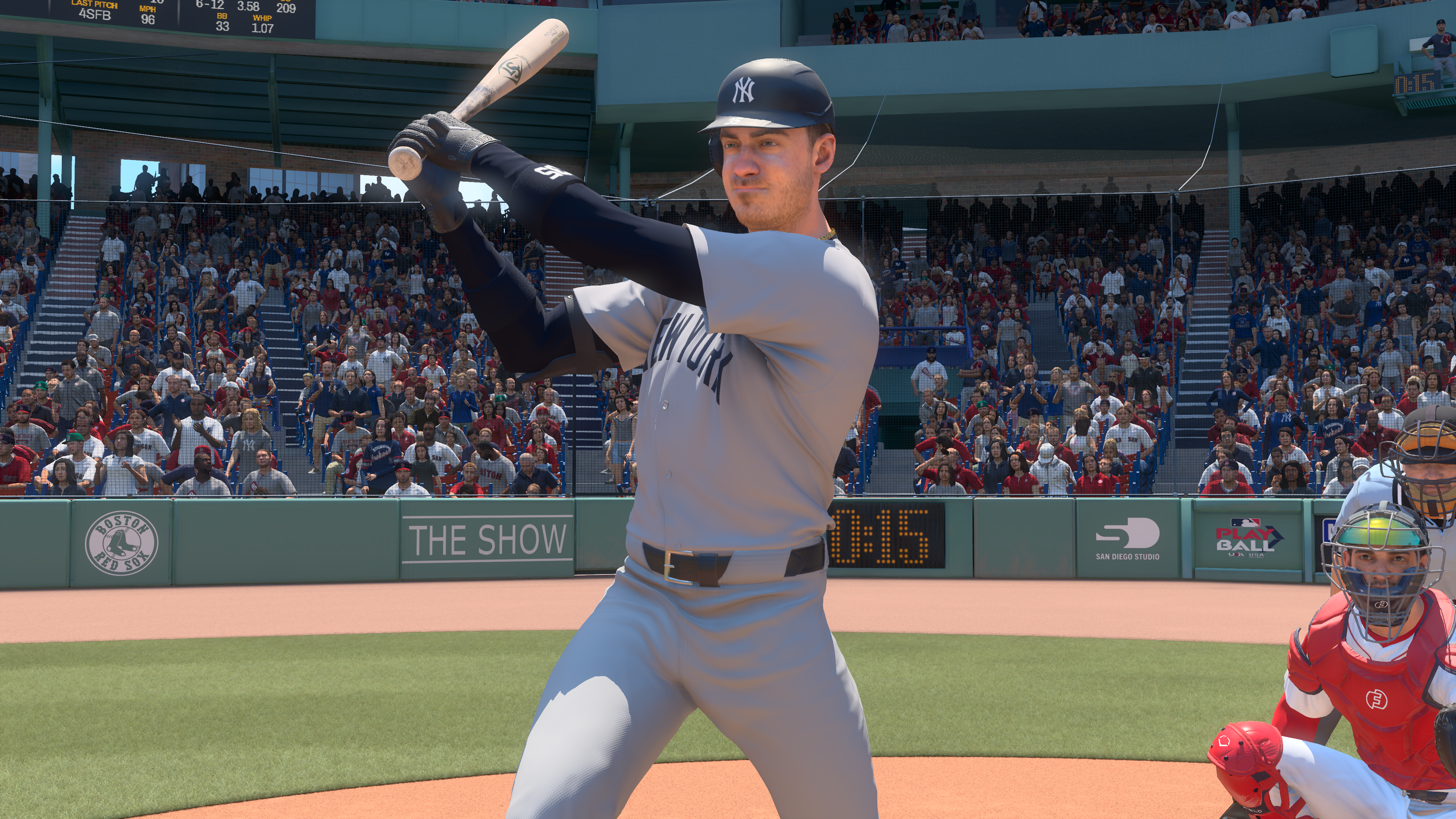

You can’t recreate Kyle Tucker’s 60 million dollar a year deal in MLB The Show 25?!?! Good! The Dodgers gave a ridiculous contract out to the former Astros and Cubs outfielder, giving him an eye-watering 240 million dollars over four years, and it’s been noted by us at Operation Sports and others that this contract (along with the Shohei Ohtani and Juan Soto contracts of years prior) cannot be replicated by MLB The Show 25. Which, in my humble opinion, is a feature, not a bug, in the premier baseball game of our era. Realism be damned, this little break from sports reality is ultimately for the greater good, and could be a spark of hope that could cascade out of the confines of our consoles and into reality.
When Shohei Ohtani (700 million over 10 years for 70 million AAV) and Juan Soto (765 million over 15 years for 51 million AAV) got their bags, I applauded. I even recommended MLB The Show update their salary cap rules to accommodate these massive contracts, but this Kyle Tucker contract simply goes too far.
I cannot sit idly by while the basic principles of economics and sports burn down, and common sense falls to the wayside. We, as sports gamers, must be the last bastion of sanity and demand that this economic rot from within baseball does not reach our sanctuary of escapism. And with this rebellion of simulated sports enterprise, we will model a better world, a world where money actually matters and where athletic performance is fairly assessed! This is my decree.


Operation Sports App
Your ultimate companion for sports gaming. Access in-depth coverage, thoughtful discussion, and a community built around the games—and sports—you love.
Your ultimate sports gaming companion.
If MLB isn’t going to police its own league and rein in spending chaos, that doesn’t mean MLB The Show needs to suffer the same dysfunction. The Show has a good thing going with its $ 45 million-a-year cap; it certainly doesn’t need to eliminate it, and I would argue that increasing that cap would be unnecessary and vile. Should organizations such as a professional baseball team, already on shaky economic footing with an uncertain future, be spending upwards of $50 million on employees, even in a simulation meant for entertainment? Of course not, it’s common sense, it shouldn’t be an option in the game, just like it shouldn’t be an option in real life. There is no universe, real or fictional, where a player like Kyle Tucker (no disrespect to him) should be paid 60 million dollars a year. If you still aren’t convinced, let me break it down.
Kyle Tucker Is No Shohei Or Soto
When the Dodgers paid Shohei Ohtani $ 70 million a year over 10 years, the outcry from baseball fans wasn’t about the numbers but about unusual accounting (deferring $680 million of that salary until after the contract is over). When Soto got 51 million a year from the Mets, the outcry wasn’t the numbers but rather the fact that it was the Mets, and that Steve Cohen was spending hand over fist to miss the playoffs embarrassingly this season. With Tucker, however, the outcry is all about the numbers. 60 million dollars a year for a guy who’s never hit over a .300 average or over 30 home runs in a single season. A guy who’s only hit a .900+ OPS once in a full season and has never been known for having an elite glove.
Don’t get me wrong, Tucker is a beast; there was a reason he was a 93 overall last year, but at the same time, there was also a reason 14 players were rated above him in the game. Kyle Tucker is the epitome of an all-around gem and a five-tool player. He’s above average in basically every aspect of the game, but he isn’t a star, not on paper, not on the diamond, and not in the media. His numbers don’t get him in the MVP conversation consistently, he’s not the best player at his position, he’s never been the best player on his team, and he’s not all that memorable in style or substance. Tucker is a fantastic player, but he lacks the qualities that make a star a star.
With Ohtani, he is a reincarnation of Babe Ruth, the only player ever to have success both pitching and batting. He’s quintessentially unique in what he does on and off the field; he represents an entire country of baseball-obsessed fanatics that fuel his popularity to international heights. With Soto, you also have that international intrigue as he represents an equally passionate fan base in the Dominican Republic that arguably makes up the third point in the international trinity of baseball, along with Japan and the U.S. Soto is also a perennial MVP contender and is (along with Judge) one of the best pure hitters of this century.
Both Ohtani and Soto bring unique skill sets and vast popularity amongst critical demographics to justify a huge investment, but does Kyle Tucker? It doesn’t seem like anybody outside the Dodgers organization believes he does, and for good reason.
Economics 101
As much as we may want our sports insulated from the scary outside world of economics and politics, they very much aren’t. The economy touches everything, and in this day and age, everything it touches turns to mold. With inflation destroying family budgets, recession worries killing investment, and private equity destroying businesses, nothing in the economic world seems to make sense. Gone are the days of “common sense” economics you would learn in Econ 101 class. Just look at the stock market, and you’ll see companies with net negative profits and billions in debt topping the markets every day. Business leaders today, especially in the world of sports, aren’t as concerned with ideas like “fiscal responsibility” or “prudent decision making.” These billionaire owners who run these teams care about ego, status, hype, and power. Things like profits, revenues, and bottom lines can take a backseat.
Of course, certain teams like the Athletics and the Marlins will always prioritize profits, even above a quality product, in this case, a quality team capable of winning more than 70 games. This leaves MLB with two distinct types of organizations, the winners and the losers, each playing two completely different games.
The winners buy up players at ridiculously high prices to assemble rosters with 300-, 400-, and 500-million-dollar payrolls, hoping to win World Series after World Series, dueling the owners’ egos and the valuation of the team. Of course, the owner loses millions per year under the league’s revenue-sharing agreement, but the accolades and trophies help the team look more valuable to others seeking influence and power. The more a team wins, the more money an owner can get when selling a percentage or two of the team.
The losers cut payrolls down to just a meager 10 to 20 percent of the winner’s payroll. They have rolling cycles of young players they help develop, hoping to squeeze a year or two out of them before their contracts become too expensive and they have to trade them to a winner for their next set of prospects. These teams go through three or four terrible seasons for one season of hope before starting the cycle all over again. They keep their payrolls under the MLB revenue share amount, guaranteeing a hefty profit for their owners.
These two strategies are the same side of a rotten coin, and that coin represents MLB’s current policy, which is why the game is in a perpetual death spiral it can’t get out of. If we want baseball to ever make a comeback in America, we need a change, and that change isn’t going to come by itself.
Be The Change You Want To See
If we want better baseball, we will first need to see better baseball in action. MLB The Show may seem like a small part of a big sports entertainment industry, and we fans may seem like an even smaller part of that, but we are some of the most faithful fans and consumers of the sport. Engaged enough to simulate our own version of the product we see on the TV and in stadiums across the country.
We can demand that this video game, which has always strived to reach a one-to-one representation of MLB baseball, put its foot down and not fall victim to the same corrupt system that has plagued the real sport. For MLB The Show to offer its fans the paradise of a simulation insulated from the dysfunctional MLB owner economy, its winners and losers, and its disastrous effects. In doing so, MLB The Show can offer a new way forward for fans and perhaps the league.
Kyle Tucker may have gotten a ridiculous contract for reasons outside of the ballpark, but that doesn’t mean that has to happen in MLB The Show or baseball as a whole going forward.