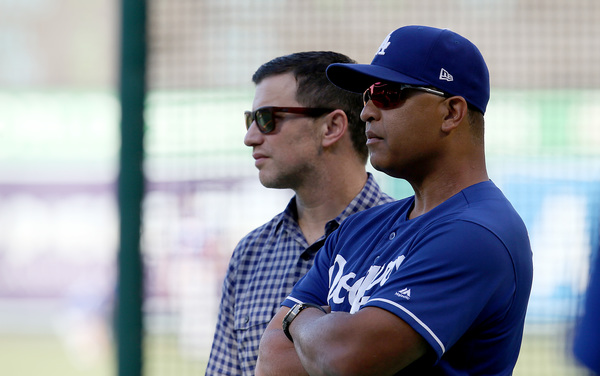
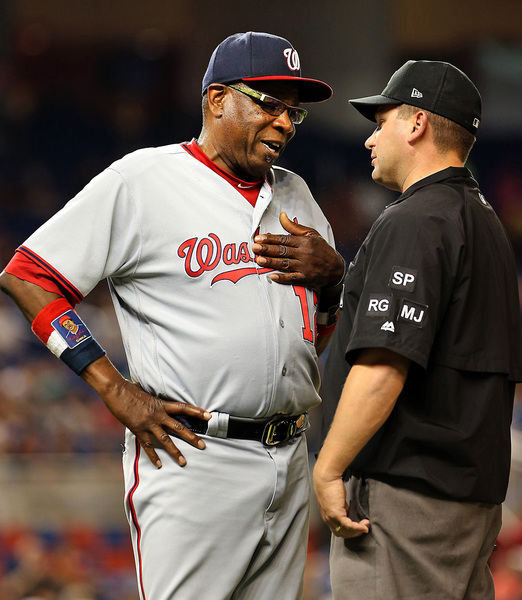
Dave Roberts' Los Angeles Dodgers have steamrolled everyone since mid-May. Dusty Baker's Washington Nationals, with a revamped bullpen and roster full of All-Stars, are running away with their division. Both teams will make the playoffs and could meet in the National League Championship Series.
Such a matchup could bring further attention to a disparity that has the attention of Major League Baseball's commissioner's office as well as coaches and executives: In a game where 42.5 percent of players are non-white, Roberts and Baker are two of only three minority managers out of 30 major league teams. Only four teams have a minority general manager or president.
"I think it really stalls your development, overall, in the organization with players," Pirates pro scouting supervisor Steve Williams, the president of the Buck O'Neil Professional Baseball Scouts & Coaches Association, said of the disconnect between the players and those managing or acquiring them. "All players like to see people that look like them, whether you're Latin, white, African-American, Japanese, whatever. They want to have someone that they can dialogue with, that understands what they're going through. When you only see it from one side, you don't totally understand what some of the players are going through."
Williams co-founded the association, named after the first black coach in the majors and one of the first full-time black scouts, in 2001. There were seven minority managers then. That increased to 10 in 2002 and '09 but dropped to two in 2015. Rick Renteria of the Chicago White Sox is the only other current minority manager. Four men in charge of baseball operations departments _ Michael Hill in Miami, Farhan Zaidi with the Dodgers, Al Avila in Detroit and Kenny Williams with the White Sox _ are minorities.
Coaches and executives identified some of the reasons behind the disparity. They mentioned the change in the type of people hired to run baseball operations, the lack of minorities in lower-level positions (and the lack of a proactive approach to attracting them) and a reliance on the old boy network by those doing the hiring. They have also identified solutions, both at the Major League Baseball and club level, but no quick fix exists.
"I think one of the issues that we've had in the game in the past as an industry collectively, we have not done a very good job of recruitment," Pirates assistant GM Kevan Graves said. "... I think it's in large part because we haven't had to. We have an incredibly large pool of talented, hungry, motivated folks who approach clubs, Pirates included, unprompted. As you divide your efforts and your energy and your time, I don't think a lot of resources have been committed."
The Pirates are changing that. They run a scout school for interns and players, and employ a mentoring program. The organization, Steve Williams said, devotes resources to developing its personnel and preparing its staff for career advancement.
"As long as Neal (Huntington) and those guys are here, I'm here," Williams said. "I've never seen an organization dive into their people, their development, as well as we do."