

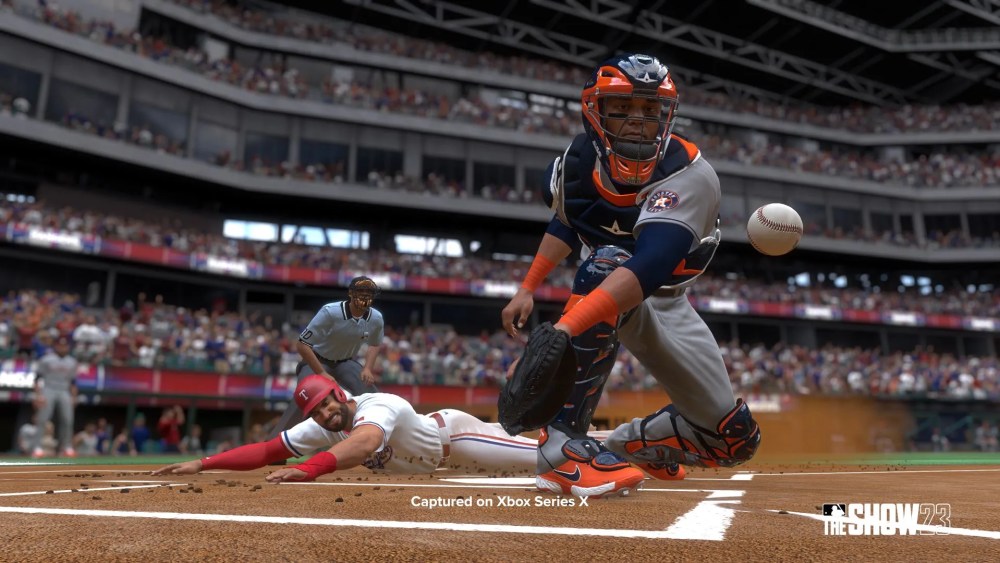
The MLB The Show line of baseball games is often among the most acclaimed annual releases each year, having long since claimed the crown as king of baseball games. The market for baseball games was once a competitive one; however, with multiple series vying for gamers’ attention, and only The Show was restricted to a single console brand.
So, how did the series at a reach disadvantage become the winner of the baseball monopoly race? By putting on a show.
The Story Of San Diego Studio


Operation Sports App
Your ultimate companion for sports gaming. Access in-depth coverage, thoughtful discussion, and a community built around the games—and sports—you love.
Your ultimate sports gaming companion.
Amazingly enough, for a game that would go down as the start of the most successful franchise in baseball gaming history, MLB 06: The Show was the first game released under the name of a new developer, San Diego Studio. Before The Show, the line of games had been published by 989 Studios, a subsidiary of Sony Computer Entertainment.
At the time, baseball games had not yet become a one-horse town, with sports game mega-publisher EA Sports also having its own line in the form of MVP Baseball, which debuted in 2003. The advantage that MVP Baseball has going for it is its status as an all-systems game. While 989 Studios’ role as part of Sony meant it was a PlayStation 2 and PSP exclusive, MVP Baseball was released for PlayStation consoles as well as the Xbox and PC releases. What 989’s MLB series had going for it was being the superior baseball game in the eyes of fans.
While the team at 989 was still working on the MLB series, a team of developers who left the studio had formed their own San Diego-based development company, Red Zone Interactive, with the company still working with 989 Studios in publishing its NFL Gameday series at a time when the NFL video game market was much fuller and more competitive. In 2001, the company was reacquired by and merged with the popular 989 Studios, with the company ultimately shifting the MLB brand over to San Diego Studio for its 2006 edition.
The Arrival Of The Show

 25_20250801155636
In video game development, when it comes to new ideas that work, there are lots of good ideas that have made franchises better by adding new features and gameplay modes for players to enjoy. There are not many that do so to such resounding success that the new mode eventually becomes the branding around which the entire franchise is named. That is what San Diego Studio managed with the introduction of the titular The Show mode.
In today’s modern sports games, a career mode is basically seen as an expected part of any annual release. Sure as you can find a season or GM-mode and an online card-based mode, you’ll have the option to play through the career of an individual player, controlling them and them alone, not the entire team on the court, field, or pitch.
In 2006, this was not the case, and The Show still represented a massive step forward in the genre. While not quite the originator of the concept, with Madden having released its own career mode in its 2006 edition, which, because most sports franchises release the year ahead of their number like a new car, hit game shelves six months before The Show.
What The Show was, however, was still a massive shake-up in the baseball game market, and a game which stands out even from its predecessor and followers in the years to come. This is because the unique nature of baseball and its expansive minor league system, which dwarfs any other US sports, even the NHL and its multiple levels of minors.
When you started a career in The Show, you didn’t start as the star pitcher of a team primed to win the World Series on the back of your user-controlled dominance. Instead, you started your career, like nearly every pro ball player begins their career in real life: by playing in the minors. Only by performing well at the Double-A level could you earn the call-up to Triple-A, and only with success at Triple-A would you get your shot at a major league roster.
This sense of progression was a massive hit with fans. While career and season modes can sometimes suffer from falling into a pattern of familiarity, this progression ensured you had plenty of fun before you’d even hit what would become your eventual long-term mode of Major League play. Throw in how getting call-ups made you feel like a real pro, earning your shot and celebrating when your good play is rewarded, and you had a smash hit mode to build a goliath around.
Doing The Little Things Right
It is undeniable that The Show is the feature attraction of the game and the hub around which its success, and the future success of the franchise was built, but it wasn’t all that the game was bringing to the table. A sports game is only as good as the sports simulation it feels, and fortunately for gamers, the studio nailed that, too.
MLB 06: The Show featured enjoyable gameplay that players found fun and engaging. Outside of The Show mode, the game also succeeded with its additional gameplay options. Season mode was available for players looking for a streamlined season-long play, or Franchise mode let you take over more complete control of operations at your ballclub. Like other Franchise modes at the time, this included some minute details to monitor, should that be your preference.
Capped off with a couple of fun minigame modes, MLB 06: The Show provided plenty for fans to enjoy beyond the ground-breaking new mode.
The Arrival Of A Baseball Monarchy

In today’s sports video game landscape, monopolies are the norm. With decades of annual sports games released now, nearly every sport has seen one series carve off more and more of the market share until ultimately facing little to no competition. In the aughts, however, there was still plenty of competition, and the idea that a console-exclusive game would win out over cross-platform series would have seemed unlikely.
The Show series never looked back from its big debut. MVP Baseball was already out of the pro ball market, having lost the license and moved to college ball. Sports game giants 2K would hold on until 2013, after which RBI Baseball came back for nearly a decade before calling it a wrap after 2021.
Now, when it comes to baseball games looking to simulate playing real baseball, not arcade-style games or management sims, it’s all The Show, all the time. One big mode may not have single-handedly carried the franchise, but it sure did a lot of the lifting.