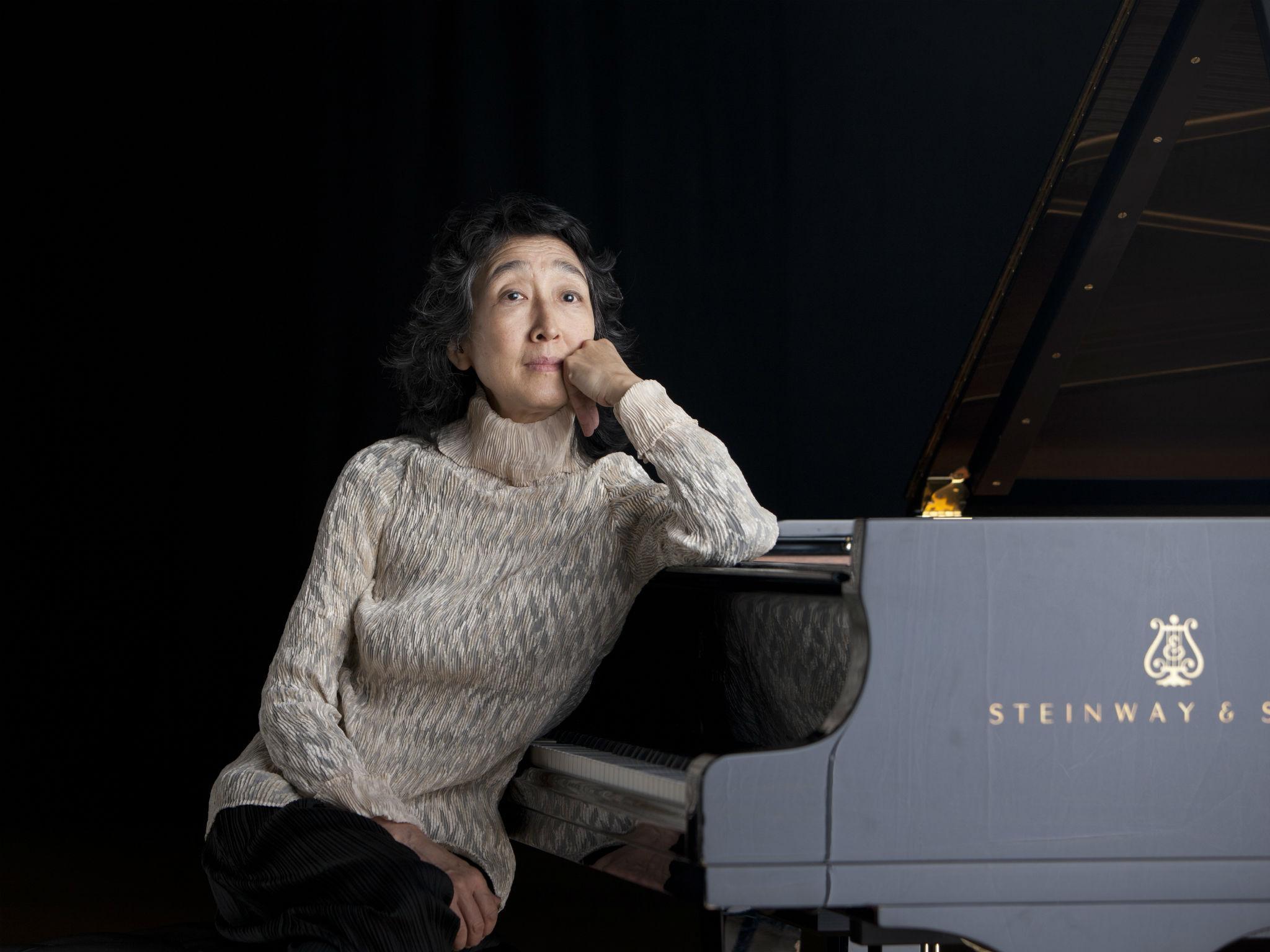
“Schubert’s music is between life and death; he dreams, with his eyes on the far horizon.” With these words emblazoned over her programme, this is how Mitsuko Uchida wishes us to listen to her Schubert sonatas, and this is how they now come over.
She’s seventy, and has played them in public for fifty years; listen to her recordings from even twenty years ago and you will see how her interpretations have changed. Then she was emotionally up-front, with the music in bold close-up: now her playing has an inward quality, as though it is being heard in a dream.
She made her usual entrance on Saturday, giving an athletic bow so low that her hair almost touched the floor, then settling in her trademark silks with silver shoes and right wrist flashing with diamonds like a diaphanous butterfly, and she dived straight into the furious octave flourish which opens the middle-period A minor sonata.
That fury was quickly tempered with gentle lyricism, the two modes contending for dominance until the movement’s truce-like conclusion; the Allegretto with its sly key-changes became an absorbing journey, and the finale flashed fire.
Next she played the unfinished and rarely-performed ‘Relique’ sonata, turning the seeming diffidence of its two movements into a richly suggestive tapestry. The repeated, starkly-dissonant chords which punctuated the Moderato, coupled with major-minor key-shifts, intensified the questioning mood; at times the left-hand figurations were barely a murmur.
The Lied-like Andante emerged from the shadows to lead the argument on – further musical questions being delivered like breaths of wind - before receding into the shadows once more.
After the interval came the B flat major sonata, Schubert’s great valediction. The opening theme came as though from far away, as did the growled bass trill, and the first movement’s labyrinthine course was plotted as an exercise in implied distances, now in close-up, now on the edge of audibility.
I’ve seldom heard the slow movement sound so pure, and so beautiful; in this reading, the comedy of the syncopated Scherzo and the hard-won triumph of the Rondo felt like a progressive dream-resolution to life’s problems. If only: Schubert’s terminal illness didn’t allow him to hear it.