
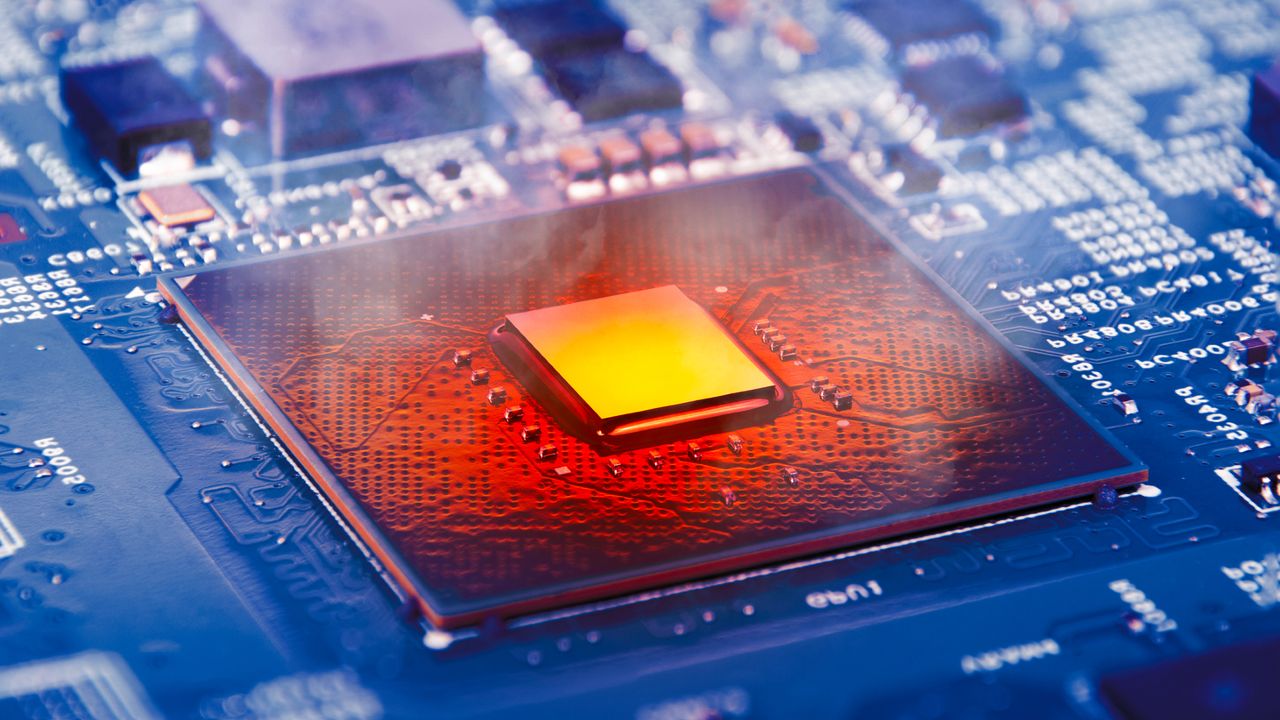
Scientists at MIT have published a proof of concept for new analog computing components that could allow electronic devices to process data using the heat they generate.
In a study published Jan. 29 in the journal Physical Review Applied, the researchers designed microscopic silicon structures that precisely control how heat spreads across the surface of a chip.
The structures, which are entirely passive and contain no electronics, use the natural laws of heat conduction to redistribute thermal energy toward points where it can be encoded as data.
The approach represents a form of analog computing, in which continuous physical values — in this case, temperature and the flow of heat — are used to process information instead of binary 1s and 0s.
The technique could be used to detect heat sources and measure temperature changes in electronics without increasing energy consumption. This would also eliminate the need for multiple temperature sensors that take up space on a chip, the researchers said.
Provided the design can be scaled, the team hopes it could one day be embedded into microelectronic systems to make high-power computing tasks, such as artificial intelligence (AI) workloads, more energy-efficient.
"Most of the time, when you are performing computations in an electronic device, heat is the waste product. You often want to get rid of as much heat as you can. But here, we've taken the opposite approach by using heat as a form of information itself and showing that computing with heat is possible," lead study author, Caio Silva, a physics student at MIT, said in a statement.
The work builds on MIT research from 2022 on the design of nanostructured materials capable of controlling heat flow.
Hot chip
As heat flows through the silicon from hotter regions to cooler ones, the structures' internal geometry determines how much heat reaches each output point.
The thermal output at these points can be measured and converted into a standard electrical signal using conventional on-chip sensors. The resulting signal can then be handled by other parts of a system, the scientists explained.
In simulations, the structures performed simple matrix-vector multiplication with more than 99% accuracy, the team said in the study.
Matrix multiplication underpins many machine learning and signal-processing tasks, though the team noted that scaling this approach to large language models (LLMs) would require millions of the linked silicon structures working together.
The team next wants to explore applications in thermal management, heat-source detection and temperature-gradient monitoring in microelectronics, where the new structures could prevent chips from being damaged without requiring additional power.
Study co-author Giuseppe Romano, a research scientist at MIT's Institute for Soldier Nanotechnologies, added in the statement: "We could directly detect such heat sources with these structures, and we can just plug them in without needing any digital components."