A number of mistranslations have been found in the foreign-language versions of information posted on the health ministry's website amid the spread of the new strain of coronavirus in Japan.
The content includes ways to prevent infection, but instead of informing foreign nationals as intended, it has confused many. The mistranslations stem from the insufficient accuracy of an automatic translation system being used by the Health, Labor and Welfare Ministry, and experts are calling for the government to take steps to verify the information.
Looking at the information posted by the ministry in English earlier this month, a 24-year-old Australian visiting central Tokyo wondered what "implementation in the restroom" meant. The original Japanese sentence meant "[To prevent infection,] it is extremely important to do such things as wash one's hands," but the AI translation put up an inaccurate English version.
The mistake was caused by the fact that the Japanese word "te-arai" can be translated into English either as the action of "wash one's hands' or the location of a "restroom."
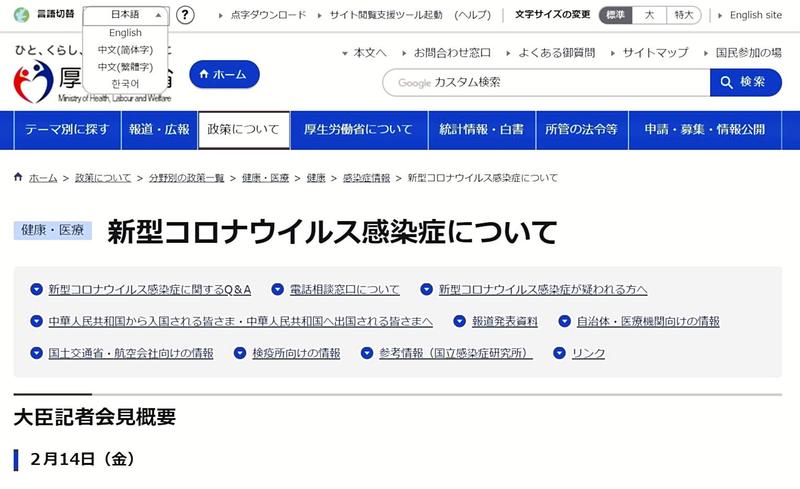
A special section was created on the ministry's website on Jan. 10 under the title "regarding the infectious disease of a new type of coronavirus." It carries such information as characteristics of the new virus, which can be transmitted through coughing or sneezing, and the current situation. Information has been updated as necessary, and users can choose the language they prefer, such as English, Chinese or Korean.
Other translation errors have included "taizai-reki" (stay history), which was mistranslated into English as "stay reki" (reki means history in Japanese), and "mizugiwa-taisaku" (border control), which was translated on the Chinese version as "waterside measures."
The Australian traveler called for more accuracy, saying that such translations can be vital for foreigners.
A 22-year-old Chinese student at Senshu University who has lived in Japan for four years said: "Generally, the sentences are written in a way that is hard for me to understand, so I don't feel like reading them. I'm thankful for the provision of information, but we can't trust it unless it's transmitted carefully."
Health ministry officials and other staff sometimes translate Japanese information into English and post it, but this can often delay updates. The ministry therefore introduced an automatic translation system for its website in July 2018.
The foreign-language versions of the special section on the new coronavirus contain a proviso stating that 100 percent accuracy is not guaranteed. However, the health ministry said, "Mistranslations have been frequently pointed out, so we will consider better ways to transmit information related to the new type of coronavirus."
Anxiety among foreign visitors to Japan and others has been growing as the virus has spread. As of Feb. 13, the Japan National Tourism Organization had received about 600 inquiries by phone. Many have been questions about whether there are hospitals that can deal with patients in languages other than Japanese.
In response, the JNTO, while confirming updated information from the health ministry's website, has its officials translate information posted in Japanese into English and Chinese. It then disseminates the translated information via its own website and such media as Weibo, a Chinese version of Twitter.
The Council of Local Authorities for International Relations (CLAIR) also has data about the characteristics of the new coronavirus and measures to prevent infection translated into five foreign languages, including English and Thai, on its website.
The council, which is a general incorporated foundation, plans to post information in 10 other foreign languages in the future.
Read more from The Japan News at https://japannews.yomiuri.co.jp/