Members of the government-initiated Local Vitalization Cooperator (see below) project dispatched to regional areas have been leaving their missions in growing numbers after finding their actual jobs to be different from what they expected.
Under the project led by the Internal Affairs and Communications Ministry, mainly young members living in urban areas move to underpopulated areas to engage in missions for the purpose of regional development.
A total of 601 members left the missions in the middle of their tenure in 2017, up by 60 percent from the previous year. One in six said the jobs given to them were different from what they had expected, underlining a mismatch in the content of the activities.
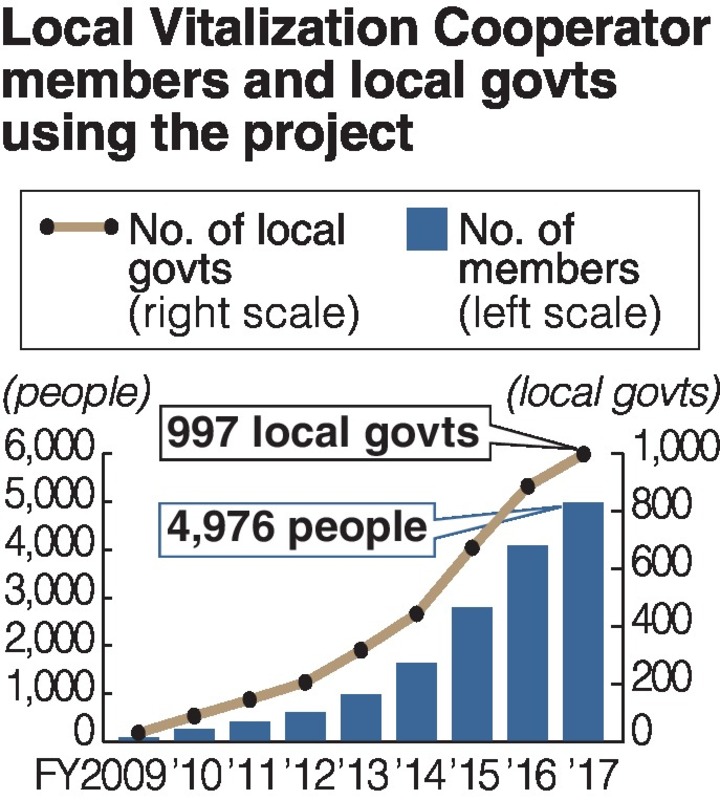
The ministry is aware that some members are treated simply as laborers and plans to expand a system to support them. According to the ministry, the project began in fiscal 2009 with 31 local governments and 89 members. It had expanded to 997 local governments with 4,976 members by the end of fiscal 2017. Seventy percent of the members are in their 20s and 30s.
In response to an increasing number of members taking part in the project, the ministry in September 2016 started a consultation service in which experienced members listen to and give advice on the worries and problems of active members. Complaints from active members include "The job is not what I expected" and "I am forced to work for so many hours that I don't have any time of my own."
Taking note of the problem, the ministry for the first time in 2016 inquired into the number of members who left the project in the middle of their terms and the reasons why. It continued the same survey in the following year.
It found that 365 members quit their jobs in 2016, while 601 did so in 2017. Of the 601 people who left the project in 2017, there were 477 members, or 80 percent, who quit after less than two years.
Asked for reasons, the largest group, 284 people, said they decided to start their own business or found a different job, but a significant 109 people answered that they found the actual project activities different from what they expected.
These were followed by 98 people who answered they quit for family reasons, such as getting married or looking after parents.
From the complaints by active members, the ministry became aware of some cases in which members were forced to engage in simple tasks in areas suffering from a labor shortage. The ministry came to regard the situation as a problem.
A ministry official in charge of the project said, "Project members are not servants of local areas."
In 2017, the ministry compiled a new brochure aimed at local governments to promote the proper use of the project and its members and cautioned them by inserting the admonitory phrase, "Do you see our project members as a means of covering your labor shortage?"
To avoid mismatched missions, the ministry is considering introducing a system in which members experience an area's local lifestyle for a certain period before they actually start serving in the project there.
In Okayama Prefecture, former members who had completed their terms held a training session for local government officials. The ministry hopes to expand such efforts nationwide.
"There has been a case where a new industry was generated as a result of inviting a motivated member, highlighting the project as an effective system for regional development," said Taro Taguchi, an associate professor at Tokushima University.
"However, in some cases, members are overworked and neglected. Members start a completely new lifestyle from their previous one, thus I want those accepting new members to support them in a way parents would do," Taguchi added.
'Means to solve labor shortage'
A former member of the Local Vitalization Cooperator project recalled the days of activities in a city in the Hokuriku region as a mere repetition of chores.
"It was a life only to do chores. Now I believe that I was used only as a means of solving a labor shortage," said the member, who started the term in summer 2016, but quit after about a year.
Responding to an advertisement by the city, which was looking for a person who could lead work to reinvigorate the regional farming industry, the former member, now in their late 20s, was hoping to settle down in the city as a farmer after completing the term.
However, having been dispatched to a local community hall as a fixed-term employee, the person was mainly engaged in such jobs as preparing recreational meetings for the elderly and setting up tents for festivals.
The former member asked for agriculture-related jobs, but it did not happen. Thinking that "it would be difficult to become independent as a farmer after the project term," the former member decided to leave the job and called for "the government to act on the project so members will not be treated differently depending on local governments."
Meanwhile, a female member in her 30s who started serving in a town in western Japan about five years ago was diagnosed with depression due to a heavy workload. She left the job in her second year.
As a temporary worker of the municipal government, she helped collect vegetables and sold surplus ones in a public square.
"I became friendly with the local elderly people and found the job worthwhile," she said.
However, she rarely had days off and worked overtime everyday. Once she was taken to a hospital for stomach trouble.
"Trying to fit in with the locals, I couldn't say no to job requests and ended up working too hard. I wanted the municipality to reduce the amount of work [that needed to be done]," she recalled.
-- Local Vitalization Cooperator
Municipalities in underpopulated areas recruit and invite members from urban areas to promote regional development. Members are employed by the inviting municipalities and engage in the development of local products and farming, among other missions. The term is three years in principle. The central government grants up to 4 million yen per member to local governments. The ministry aims to increase the number of members to 8,000 people in fiscal 2024.
Read more from The Japan News at https://japannews.yomiuri.co.jp/