One of the UK's most senior police officers has said she does not want to see misogyny and misandry classed as hate crimes.
Chief Constable Sara Thornton, chair of the National Police Chiefs' Council (NPCC), called for a return to “core policing” amid a nationwide rise in recorded crime and violence.
“We are however asked to provide more and more bespoke services that are all desirable – but the simple fact is there are too many desirable and deserving issues,” she said.
“For example, treating misogyny as a hate crime is a concern for some well-organised campaigning organisations.
“In July, chiefs debated whether we should record such allegations even when no crime has been committed.
“It was argued that this information might be useful to highlight the issue, send a message about acceptable standards of behaviour or to put pressure on government. But we just do not have the resources to do everything that is desirable and deserving.”
Speaking to a joint conference of the NPCC and Association of Police and Crime Commissioners (APCC) in Westminster, Chief Constable Thornton said the public rightly expected an effective response to serious and organised crime, online offences, the terror threat and targeting vulnerable people.
“But they also expect the basics - responding to emergencies, investigating and solving crime and neighbourhood policing,” she added, saying the response was “seriously stretched”.
“I want us to solve more burglaries and bear down on violence before we make more records of incidents that are not crimes. I hope that the Law Commission’s review on hate crime takes account of the pressure on forces before suggesting the law is changed.”
The Law Commission's review, announced earlier this month, is considering whether crimes motivated by hostility towards women and men should be brought under hate crime laws.
It is to identify any gaps in current offences, look at how to make them more effective and “consider if there should be additional protected characteristics, such as misogyny and age”.
Its recommendations will be considered by the government, which could draw up legislation to change the law.
Chief Constable Thornton said historical investigations were also taking resources away from dealing with current offences.
“While I understand those who have been harmed seek answers, I remain unconvinced that it is appropriate to commit significant resources to investigating allegations against those who have died,” she added, following the high-profile investigations into child abuse allegations against figures including the late Lord Janner.
“Neither investigating gender-based hate crime nor investigating allegations against those who have died are bad things to do necessarily - I just argue that they just cannot be priorities for a service that is over-stretched.”
More than 20,000 police officers have been lost since 2010 amid years of government cuts to police budgets, which are now starting to reverse.
Last week, the Home Affairs Committee warned of “dire consequences for public safety and criminal justice” if the government did not increase funding for struggling British police forces.
Sajid Javid has vowed to fight for more money in a government-wide spending review, but officers were angered by a lack of funding for general policing in the budget.
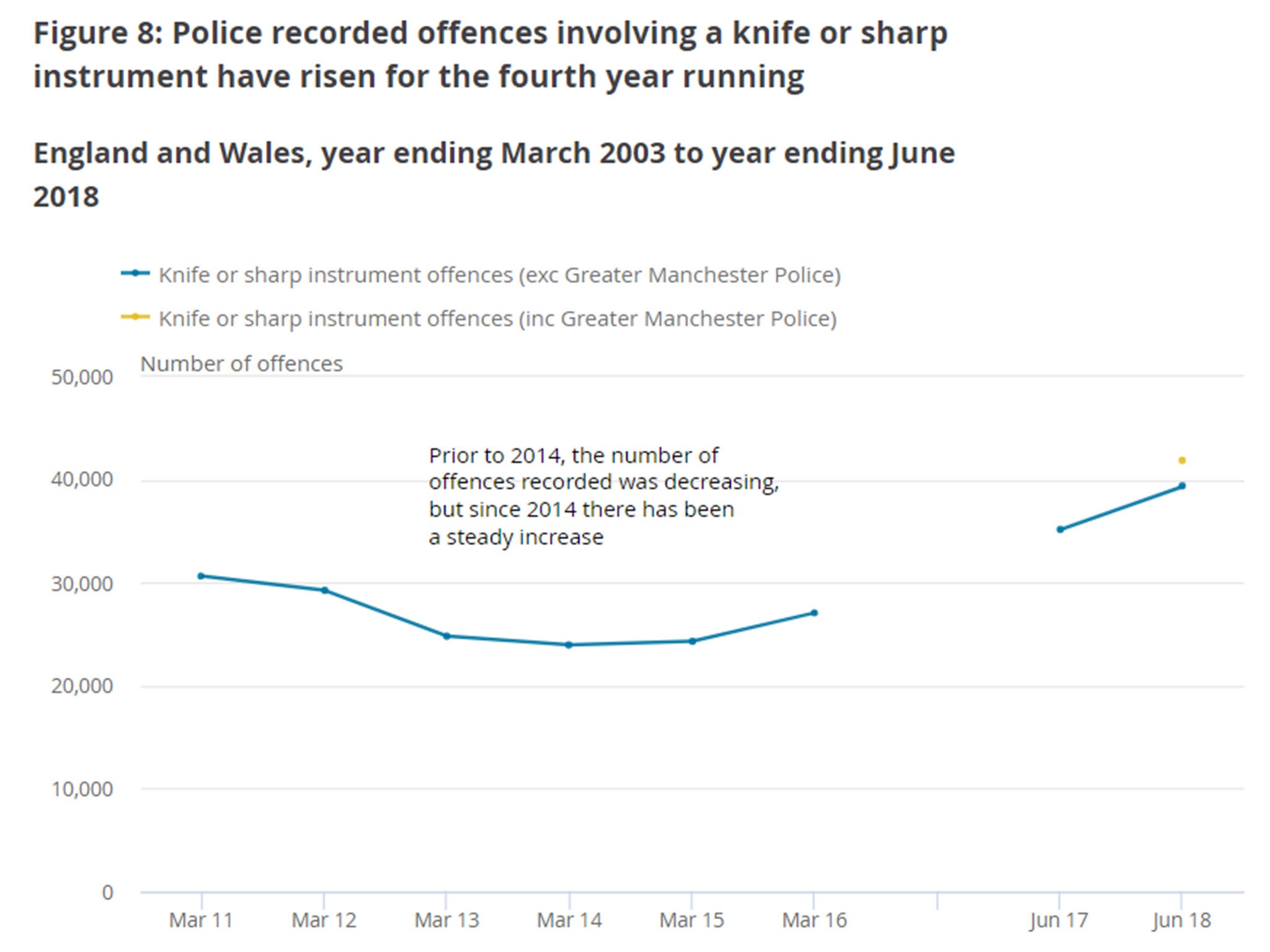
It came after the latest police figures showed knife crime at a record high, murder at the highest point for a decade and rises in robbery, vehicle theft and other offences.
Arrests have halved in a decade and the proportion of offences resulting in someone being charged has plummeted to nine per cent.
Chief Constable Thornton said that although some drivers of crime lie beyond policing, “more police and more police activity would surely result in less crime”.
She added: “We are seeing fewer police, less police activity and more crime.”
The government has not accepted claims that falling police officer numbers and budget cuts have partly caused the rise in crime and worsening outcomes.
In its first Serious Violence Strategy earlier this year, it was condemned for omitting Home Office research finding that police funding reductions “may have encouraged” offenders and “likely contributed” to a rise in serious violent crime.
The finished document named the drug market as one of the key drivers of attacks and murders, as well as “antagonism” on social media, while Mr Javid has backed a “public health approach” to the causes of violence.
Speaking to the police conference on Wednesday, the home secretary said crime was “changing faster than we could ever have anticipated” as reports of domestic abuse, modern slavery and child sexual offences rocket.
“I know you are feeling stretched, I recognise that demand has risen and you are grappling with your budgets,” Mr Javid said. “I want to do something about it.”
He said the government was spending £1bn more on policing than it did three years ago and working on a new annual funding settlement to be announced in December.
Mr Javid repeated a vow to fight for more money for police in a separate government-wide spending review, but added: “If we are to make the case for more funding this has to go hand in hand with further reforms.”
“Money is not the only issue, it is not all about resources,” the home secretary said, pledging to make stop and search powers easier to use
“Not all forces are where they need to be, some could be more effective.”
The Police Federation, which represents rank-and-file officers, has launched legal action against the government over a “derisory” 2 per cent pay rise, and forces have also been told that a £420m pensions shortfall must be met from their budgets.
Mr Javid, whose brother is a senior police officer, said the Treasury has now agreed to cover some but there is a “big chunk” of around £165m remaining, which will be considered in the financial settlement
He repeated Chief Constable Thornton's call for a focus on “core policing” and said forces should be supporting frontline officers, preventing crime, cutting capability gaps, assessing their own effectiveness and building a “more tech-savvy and less fragmented” system that makes smarter use of resources.