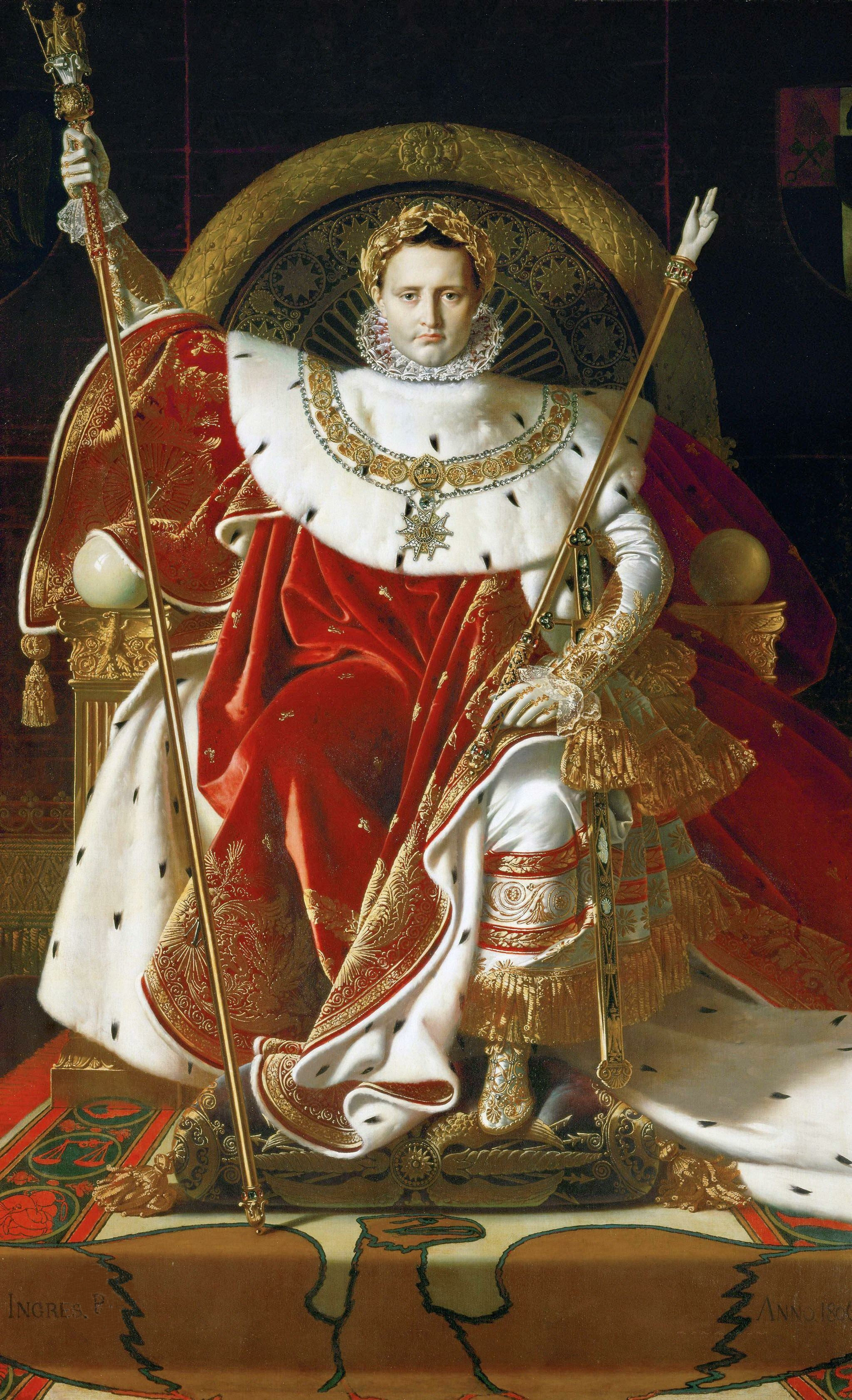
Not exactly your average citoyen ... detail from Ingres' Napoleon On His Imperial Throne
When you head to an exhibition, you're there for the paintings, not the show's title, right? After all, what's in a name?
Well, quite a lot if you've seen the Royal Academy's Citizens and Kings: Portraits in the Age of Revolution, 1760-1830. The problem with this name is that the show lacks any citizens, and since this is a vital part of the exhibition's thesis - people stopped painting royalty and started painting "real people" - it tends to invalidate the whole thing.
It's pretty much the most grievous example of mal-titling since Midnight Express turned out not to be about trains.
Don't get me wrong: the art within is almost beyond reproach in its brilliance. From Ingres' Napoleon I to David's Death of Marat, this show scales the heights of portraiture and sculpture, with plentiful (almost too-plentiful) examples of the different ways you could depict kings and aristocrats. Yes, the techniques used are themselves revolutionary.
But citizens? The sans culottes and the army regulars? You and I? No way.
The problem is that the title is an oxymoron: portraiture (both painting and sculpture) almost by its nature excludes the poor. The only people who had sufficient time and sufficient resources to be so depicted were still the aristocrats and the upper bourgeoisie. Painting rich merchants, Voltaire or George Washington hardly reflects the citizens of post-Revolution France and America.
The shining example of the show's argument is meant to be David's Death of Marat. Marat was a radical, a violently Republican Jacobin murdered in his bath by royalist Charlotte Corday. This picture, with its daring use of dark, blank space covering its top half, and its Christ-like Marat, is brilliant, moving.
Quickly the picture was reprinted and spread among the Parisian mob, the equivalent of Anna Nicole Smith's corpse shots appearing on the web, although Marat inspired revolution, not revulsion.
Yet we should not take Marat as just any citizen on la rue. He had been personal doctor to much of the aristocracy as well as a noted scientist. He was no citizen like the show would have us imagine - he was a leader, a powerful man. Marat may have been an inspiration to citizens, but the association ends there.
The rest of the exhibition does not get any nearer to proving the title. We mainly have the upper bourgeoisie, rich merchants and their families. If we've descended from kings, it is only to the new ruling classes, and under the Empire not even that.
There is nothing wrong with the paintings; far from it. But why do they need to be brought together under a banner which they cannot support? I would happily pay to see these without the falsely didactic message.
But if the Academy is trying to get them to support its title's argument - well, the medium defies the message.