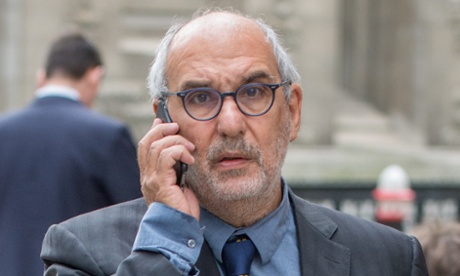
BBC executive Alan Yentob has told a court that phone hacking by Mirror newspapers felt like someone going into his home and “helping themselves to whatever they think might be worth something”.
Yentob, one of eight people suing Mirror Group Newspapers in a civil case over the practice, told the high court he felt “invaded and sickened” to learn reporters spent years routinely listening to voicemail messages from his friends, family and colleagues, among them Salman Rushdie, Alastair Campbell and Jonathan Ross.
The BBC veteran and presenter of the Imagine programme said other people who regularly left messages on his phone during the period in question, between 2000 and 2008, included Harry Enfield, Ricky Gervais, Caroline Aherne, Sting and his wife Trudie Styler, and Mel Brooks and Anne Bancroft, who were godparents to his children.
Under questioning from David Sherborne, the barrister for the eight victims, Yentob said very regular messages left by the restaurateur Ruth Rogers, a good friend along with her husband, the architect Richard Rogers, led Mirror Group Newspaper (MGN) reporters to suspect they were having an affair.
“That it was nonsense is true,” Yentob told the court. “But this in no way excuses the intrusion into our privacy. We never had an affair, but it does not mean that it would not have had devastating effects had the story been published.”
In a separate written statement of evidence presented to the court, Yentob said he used voicemail as a key method of communication, often turning off his phone during long meetings and catching up on messages at the end of the day.
In the statement, Yentob outlined the emotional effect of learning that staff from the Daily Mirror, Sunday Mirror and the People had hacked his phone countless times, as well as commissioning investigators to look into his private life.
“I am now acutely aware that I, along with my family and friends and associates, have been violated on a truly massive scale,” he wrote.
“I can only describe the feeling as a violation; it did not happen just once. It feels as if someone has been able to go in and out of my home, the most private of places, and search through my belongings, day in day out, helping themselves to whatever they think might be worth something. It has left me feeling invaded and sickened.”
The statement added: “I had never imagined my mobile phone was anything other than a safe and inviolate place where I could communicate with all the people in my life. That feeling has been shattered.”
Yentob, who is creative director at the BBC, was scathing about MGN’s response, calling the company’s apologies “shallow and misleading”. He wrote: “There was only one reason for doing this: to sell more newspapers. There was no public interest which could possibly justify this illegality. It is not hard to feel that the interception of my mobile phone messages was endemic at MGN and became an integral part of its business model for publishing newspapers.”
The case is intended to assess the extent of phone hacking and rule on the level of damages for the claimants. The other claimants are the actor Sadie Frost and ex-footballer Paul Gascoigne, TV soap stars Lucy Taggart, Shane Richie and Shobna Gulati, flight attendant Lauren Alcorn and TV producer Robert Ashworth.
The court heard earlier this week that the three titles carried out phone hacking on an “industrial scale”, making the way it was used at the News of the World seem like a “small cottage industry” in comparison.
Matthew Nicklin QC, representing MGN, said that while the company accepted hacking went on and was “unlawful, unacceptable and wrong”, it disputed the alleged scale. He said: “Some of the more extravagant claims made on behalf of the claimants are simply not the case.”
In an often testy cross-examination of Yentob, Nicklin asked him whether BBC programmes such as Panorama also relied heavily on exclusive stories.
Yenton angrily rejected any comparison. “I take offence at this,” he said. “I have never said there is anything wrong with exclusives.”
He added: “My life has been spied on and probed, collectively, by a group of people.”