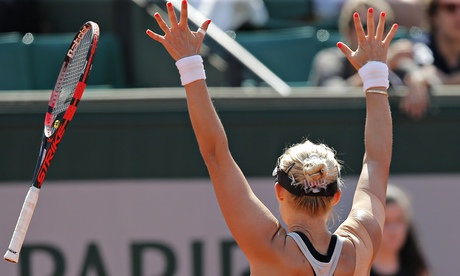
It is nearly eight months since Mrs Mirjana Lucic-Baroni, 32, shocked tennis, New York, and a host of people who had forgotten who she even was by finishing her match against the No2 seed Simona Halep with two aces to reach the second week of a slam for the first time in 15 years.
It was, she said, “the greatest day of my life”. Well, the Croatian with a history that might have been ripped from the pages of a penny dreadful will have to make room for another remarkable episode in her epic dialogue with the Romanian.
To the amazement of everyone but herself on Court Suzanne Lenglen on Wednesday, Lucic-Baroni overpowered the No3 seed and 2014 finalist even more convincingly than at the US Open to reach the third round against the French player Alizé Cornet – 16 years after her debut at Roland Garros, when she had no hyphen in her name but a thousand stars in her eyes.
Lucic had won the girls’ title in Australia and New York before she was 14, putting her alongside Martina Hingis and Jennifer Capriati. She reached the third round of the US Open in 1998 and the semi-final at Wimbledon a year later, and it took a prime Steffi Graf to stop her. But financial and personal problems forced her to quit tennis in 2003 for four years, and she later revealed her father had abused her as a child. The youthful vim seemed gone for good.
However, renewed in love (she added her husband’s name to hers when they married in 2010), she embraced tennis again. Of course life is not a fairytale, and 2015 has been tough, like so many years before.
She reached the second round in Brisbane and the quarters in Acapulco. Then she went out at the first time of asking in Hobart, the Australian Open, Antwerp, Dubai (as a qualifier), Indian Wells, Miami, Charleston, Prague and Madrid (again after qualifying). In Rome, she went out in qualifying.
Now, back in the sunshine of her autumnal years at 33, back in the big time for a moment or two, she told fans still standing and cheering in their seats on Wednesday: “I’m so proud of myself. It’s such a huge win. Amazing”.
“I hope at least three French people will cheer for me against [Cornet] next match, then I’ll be happy. I’ll enjoy it, like I’ve been doing.”
Halep, who had a blistered finger taped in the first set, looked to favour her right ankle briefly after falling in the second, but Lucic-Baroni’s fierce hitting and artful court strategy played a bigger part in the Romanian’s downfall.
Even with her right wrist, shoulder and biceps heavily strapped, the Croatian hit four aces, outserving Halep by 22kph at her fastest and leaving her stranded with flat, precise groundstrokes to win 7-5, 6-1. She struck seven winners on her forehand in the final set, two more than Halep managed on either wing in the wholematch, and the 29 she hit in the 71 minutes the match lasted blew Halep off court.
Lucic-Baroni may not get past Cornet. She may return to losing in obscure places to players known only to their friends and family. But, for now, she has the biggest smile in Paris.
Halep, who heads straight for Birmingham ahead of Wimbledon, said: “I lost. It’s not the end of the world. She played very well, hit very strong. It was difficult because I didn’t have a good feeling about the game. I can accept this, it’s tennis.”
There were a couple of other minor rarities spotted on Lenglen: Roger Federer, who sets up camp on the centre court of most slam events – and the Swiss hitting a two-handed backhand lob for 15-0 against Marcel Granollers in the seventh game of their third and deciding set.
Not much else about the match was out of character and Federer held to love for 5-2, as an otherwise entertaining match ended limply, Granollers shoving a backhand return into the net after an hour and 47 minutes to hand Federer a 6-2, 7-6, 6-3 win.
The world No2 next plays the 5ft 9in Bosnian Damir Dzumhur, who upset the Cypriot veteran Marcos Baghdatis 6-4, 6-3, 4-6, 6-2 in two hours and 24 minutes. Federer said: “I might even go so far to say I have actually almost never seen him play.”
Dzumhur, 88 in the world, saw it differently: “He is probably the biggest player ever in tennis, and I’m really glad I have the chance to play with him. That is probably the dream of every player.”
Or, on the day, a nice sort of nightmare.
Hours after her win, Lucic-Baroni reflected on her journey and on coincidence.
“When I saw the draw and I saw who I was playing second round, I knew it was going to be really tough,” she said. “I was going to have to play a great match again and back up what I did at the US Open. People say, ’Oh, it’s one day everything went in,’ and I don’t look at it like that. I know I played really well.
“The US Open was the first time in a long time that I’d had a really good result like that. So I was extremely emotional. Everything just kind of hit me at once. Now, after seeing the video of my press conference a few times, I’m trying to hold it together a bit better. No, I don’t hide my emotion.
This is who I am. And I was really so happy I shed a few tears today on the court, as well.”
She revealed she’d been asked a few times to write her life story. “I feel until it’s the end, really the end, and if it goes kind of the way I would like it to go, maybe one day.”
Lucic-Baroni, a keen student of history who grew up among architectural ruins of Croatia, is aware that her story has a logical end point and that there is no erasing some of her glorious past.
“I’m very proud of the things I achieved when I was so young. I was a little kid. When you’re a little kid... it’s amazing to me when I look at young kids, 150 [in the rankings] and improving. It’s a lot of pressure.
It’s not easy to do that. When I remember what I did … I’m very proud of that little girl, yeah.”
And what she will always remain is the girl from Croatia who created such a stir as a teenager, and another one when she reappeared from nowhere, her life rebuilt.
“I was born in Germany. I lived in Croatia until I was 16. My parents are Croatian. I am 100% Croatian, through and through. I think my temper proves that. We are stubborn, we are tough, we are fighters. Sometimes it can be little negative being temperamental, but I’m very proud of where I come from and who I am.
“Then living in States, the greatest country in the world, there is so much freedom and there is so much acceptance. I respect that. I miss really good salami and cheese – but my husband’s restaurant, that’s good.
“I also miss a little bit of culture. That’s why I love coming to Europe.
My favourite city is Rome. My husband [Daniele] is Italian. My sister also married an Italian, so we have two in the house and my mom said to our third sister: ’Please, just don’t bring another Italian in the house. Three Italians would be too much’.”
Some things remain private. Asked to pinpoint the moment the bad times turned to good, she paused and said: “That’s kind of a difficult question. The day I left Croatia was 24 July, 1998. I left my family, and I was able to have peace and love. I was able to live with my [new] family, really happy. I think that was when everything went good for me.”