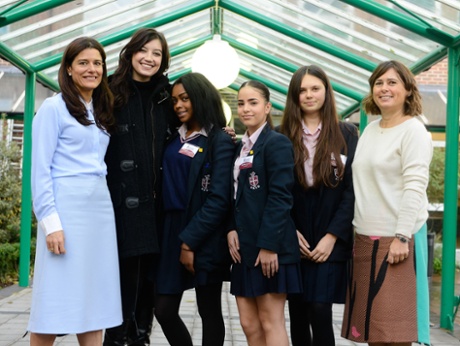
Vogue editor-in-chief Alexandra Shulman, model Daisy Lowe, British Fashion Council CEO Caroline Rush … Sounds like a London fashion week power front row. In fact, this trio – as well as 20 of British fashion’s most successful buyers, managing directors and CEOs – are gathered in the echoey games hall of St Saviour’s & St Olave’s school in Southwark, south-east London, aiming to inspire the students to pursue their dream careers.
“I started this because journalists were always asking me why there weren’t enough female role models. How silly is that?” says lawyer Miriam Gonzalez Durantez, a champion of the Inspiring Women campaign, of which today’s event is part. “There are so many wonderful women. Many of them are not well-known faces but they are amazing women, and we just need to find a way for them to talk to girls.” And so they are speed networking.
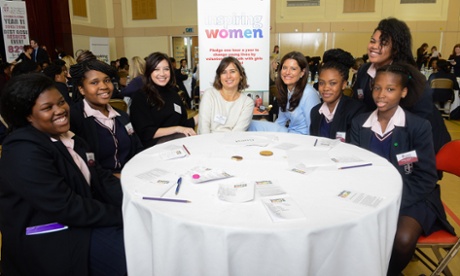
Groups of eight students grill each of the women in turn. Leila, 14, who wants to be a journalist, dives straight in and asks Gonzalez Durantez: “Is your job more challenging fun or a fun challenge?”, “Where would you be now if you weren’t here?” and “What advice would you give your 13-year-old self?” On Daisy Lowe’s table, the atmosphere is giddy. “How tall are you?” asks one girl. “Are you a feminist?” poses another. And then, crucially, “Do you know Cara Delevingne?”
Many of the students are deadly serious and focused, pumping the women for information about their big breaks in the industry, asking whether a university degree is necessary in fashion and wondering how one can have a high-flying career and a family – a subject Gonzalez Durantez knows well. “I always get a lot of questions [from students] when I tell them that, when we came to the UK, I decided to give up my job to ensure that my family was in the same country,” says Gonzalez Durantez. “I think it’s important for them to see that [you don’t have to be] a ‘hard professional woman’ or a ‘family woman’, it’s a combination of things.”
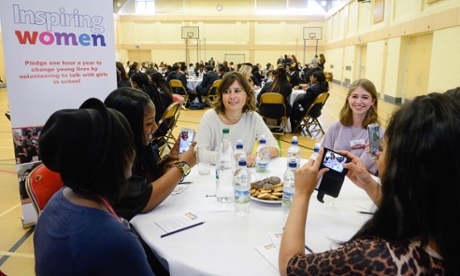
Most of the women are recognisably “fashion” in aesthetic – black polo necks, understated designer skirts (as one student puts it: “I like their swagger.”). Still, in a pep talk to the girls, Gonzalez Durantez is keen to point out that “none of these women have achieved what they have because of their sense of style or the way they look. It is through hard work.” Not that she believes that style and grit are in conflict. “I think that you are what you are and can choose freely how you want to dress,” she says. “I have never seen anyone [applying] the idea that if you dress very well you are not serious to men, so why judge women that way?”
As often happens in high school, what begins shyly ends in high spirits, as the students crowd around the women in excitement, asking for autographs – a new experience for Matches Fashion content editor Kate Blythe, for one – and hugging Daisy Lowe (“I can’t believe the school could afford for that model to come here,” says one, breathlessly). As they leave, there are good-natured cries of “This is just overwhelming,” and “I didn’t meet the Vogue woman – I want to cry.”
This is not a precise science. For Gonzalez Durantez, it’s about the students having the opportunity to meet someone or hear something that they will think back on when they are stretched, at key moments in their life. For some, she hopes, the benefits will come even more quickly. “One girl approached me today and said: ‘I thought about what you said and I am going to try hard,’ and promised to read more books this term. And I thought – yes!”