
PUNE: Minor fluctuations in climate can lead to vast scale socio-economic disruptions, a recent study has revealed.
Using records spanning over 220 years, the study found that only a 14% drop in the average annual rainfall led to vast scale socio-economic disruptions and human impacts (famines) over two centuries ago in semi-arid parts of British India (then Bombay and Madras presidencies under the British rule).
The study was conducted by climate scientists from the University of Colorado-Boulder, US, and Pune-based Indian Institute of Tropical Meteorology (IITM), among others. It was recently published in international journal Nature.
The study assumes significance, especially in the backdrop of below normal monsoon in India so far, and IMD’s forecast of monsoon ending on the lower side of normal this season. Based on the findings, researchers suggested that apart from extreme rainfall deficits, climate change risk assessment should also consider the potential impacts of more frequent low-level rainfall reductions in drought prone semi-arid regions in India.
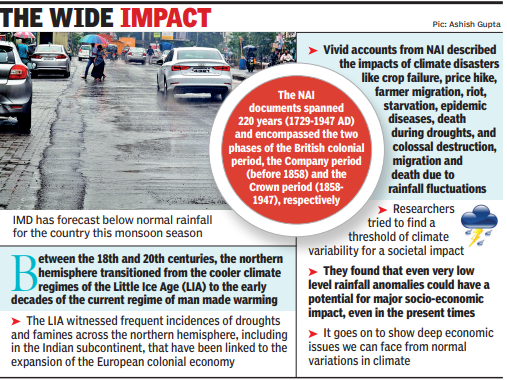
Atreyee Bhattacharya, senior climate scientist from the University of Colorado, told TOI, “Famines that caused such severe disruptions and loss of lives over 200 years ago in India were not caused by severe deficits in rainfall. The study, which analysed the impact of climate variability on the socio-economic conditions in the two presidencies during the British rule, also suggests that drier climate cycles, especially in a warming climate, appeared to be prone to an annual rainfall reduction threshold of nearly 14%. This was further worsened by colonial economic practices and policies, leading to extreme negative socio-economic disruptions that came at a steep human cost.”
The Bombay and Madras presidencies during the British rule stretched from Maharashtra in the west to Tamil Nadu in the south. To arrive at the findings, researchers turned to 18-19th century British Colonial documents, archived at the National Archives of India (NAI), New Delhi, and IMD data. They extracted information and mapped results of famine incidence (both local and regional) onto high-resolution independent records of rainfall variation (historical rainfall from IMD, tree ring reconstructions and cave carbonate based reconstructions).
She said the repeated nature of famine incidence during the 1800’s, every 5-10 years, had a huge socio-economic impact. “Every time there was a fluctuation in rainfall, there would be a famine. Thus, famines caused by rainfall fluctuations was not a one-off incident. There were close to 20 famine instances over 200 years, and every time, they caused a major impact, such as starvation and deaths,” she said.
Bhattacharya said NAI documents contained a chronological sequence of socio-economic stress triggered by ‘rain failures’, which lasted for at least one, but often two consecutive years leading to crop failures, grain price hike, food scarcity, farmer migration, increase in starvation and mortality, slavery, epidemics, riots and death.