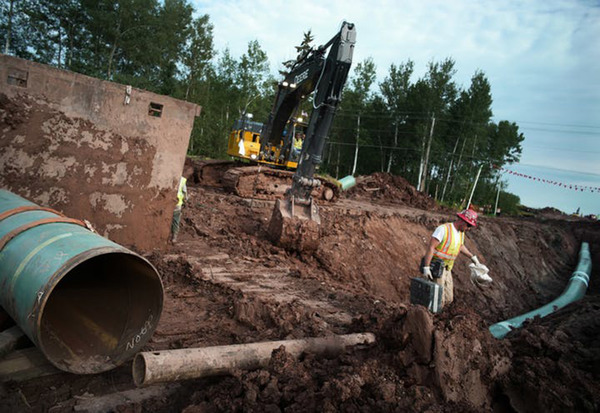
Two Minnesota regulators Thursday granted environmental permits for Enbridge's Line 3 oil pipeline across northern Minnesota, critical approvals needed for construction to begin soon on the controversial $2.6 billion project.
The Minnesota Pollution Control Agency (MPCA) approved permits dealing with water quality and wetland issues arising from construction of the 340-mile pipeline. Also, Minnesota Department of Natural Resources (DNR) granted several Line 3 permits.
The U.S. Army Corps of Engineers still must approve its own environmental permit — one Enbridge has said that it expects to get soon. A union official told the Star Tribune that he expects Enbridge will begin construction next month.
Line 3, which would transport heavy Canadian oil to Enbridge's terminal in Superior, Wis., has been navigating the Minnesota regulatory process for six years. The pipeline would cross 212 streams and affect more than 700 acres of wetlands in Minnesota.
The MPCA said in a statement that it issued its "most strigent" water quality permit to date for the Line 3 project. Enbridge must do "extensive" mitigation of streams and wetlands that it distrurbs.
"The MPCA has used sound science and thorough analysis to ensure that the necessary safeguards are in place to protect Minnesota's waters," MPCA Commissioner Laura Bishop said in a statement.
Environmentalists panned the MPCA's decision.
"Clearly, (the environmental) community is deeply disappointed that our lead environmental protection agency ... would permit a project without using the tools it has to fully review (the pipeline's) dramatic climate and environmental justice impacts," said Steve Morse, head of the Minnesota Environmental Partnership.
Pipeline supporters praised the agency.
"It's a huge day for us because it means this project has cleared Minnesota's rigorous environmental standards, said Kevin Pranis, Minnesota marketing manager for the Laborers Union. "We have every expectation our members will be building this project in December."
Line 3 would be one of the largest construction projects in Minnesota in recent years, employing over 4,000 workers at its peak. Pranis said Enbridge is likely to build three sections of Line 3 concurrently once it gets all of its permits.
The MPCA permits and a parallel water quality permit from the U.S. Army Corps of Engineers are the most significant approvals Calgary-based Enbridge needs before it starts building new Line 3, which would replace an aging pipeline with the same name.
The Corps has completed most of its work and a permit decision is expected "as soon as possible," said Craig Jarnot, Bemidji, Minn.-based North Branch chief of the Army Corps' regulatory division.
Vern Yu, Enbridge's executive vice president for liquid pipelines, told stock analysts Friday that the company expects to get the Army Corps permit "relatively quickly." The corps' permit deals with dredging and filling during construction.
The MPCA approved draft permits for Line 3 in February, but that decision was challenged by three environmental groups and two Ojibwe bands. So, the MPCA held a "contested case" hearing before a Minnesota administrative law judge, James LaFave.
He ruled in the MPCA's favor last month. The permit challengers "failed to prove" that construction of the pipeline would permanently impact water quality and wetlands, nor was there proof that the MPCA and Enbridge had undercounted the amount of wetland affected by the construction, LaFave wrote.
However, LaFave noted that the environmental groups and tribes "vehemently disagreed" with the MPCA's decision to limit the contested case to just five issues — and that he could make his judgment only on those issues.
"The issues raised by Line 3 challengers are very important and go to the ultimate question of whether the MPCA should grant the (water permit) certification," LaFave wrote.
Pipeline opponents said the MPCA should have reviewed contentions that new Line 3 would violate tribal treaty rights. They also criticized the MCPA's "narrow definition" of its own scope and authority as "arbitrary and capricious."
Groups that formally challenged the MPCA permits are: Friends of the Headwaters, Honor the Earth, the Sierra Club and the Red Lake and White Earth Ojibwe bands.
Earlier this week, the White Earth Band's Chairman Michael Fairbanks wrote MPCA Commissioner Laura Bishop asking that the MPCA suspend its regulatory process "in light of the world pandemic crisis of COVID l9."
Fairbanks wrote that White Earth is concerned about "a super-spreader event over a long winter where thousands of out-of-state people; pipeline workers and their armed security forces, environmental protectors and law enforcement — all come and hang out in the cold, and then hang out indoors at our public places in rural northern Minnesota."
Large protests against Line 3 may be in the offing.
Meanwhile, the virus' spread is accelerating in Minnesota and the state Wednesday recorded its single-day COVID-19 death record of 56.
Pranis, of the Laborers' union, said Enbridge has COVID-19 protocols for the construction site.
Enbridge has said the new pipeline is a critical safety enhancement. The current Line 3 is corroding and therefore running at only half capacity. The new pipeline would restore full oil flow.
Environmental groups and some Indian bands have said the pipeline — which follows a new route — would open a new region of pristine waters to the prospect of oil spills, as well as exacerbate climate change by allowing for more oil production.
The Minnesota Public Utilities Commission (PUC), the state's primary pipeline regulator, originally approved Line 3 in June 2018.
But its decision was unwound in 2019 when an appellate court shot down the PUC's blessing of the project's environmental impact statement (EIS) done by the Minnesota Department of Commerce. The commerce department retooled the EIS, which the PUC reapproved in February along with the pipeline itself.
The commerce department serves both as a research arm of the PUC and a representative of the public interest before the PUC. In its latter role, the department has contended since 2017 that there isn't enough long-term oil demand to merit a new Line 3.
In August, the commerce department appealed the PUC's approval of Line 3 to the Minnesota Court of Appeals. The department claims the PUC committed a "legal error" in its evaluation of the accuracy of Enbridge's long-term oil demand forecast because the company never submitted a proper forecast.
Honor the Earth, the Sierra Club, and Friends of the Headwaters, as well as the Red Lake and White Earth bands of Ojibwe, have also appealed the PUC's approval of both Line and the project's EIS. The appeals are scheduled to be heard next year.
If and when Enbridge starts construction, opponents could petition the appellate court for a temporary halt.


.png?w=600)