
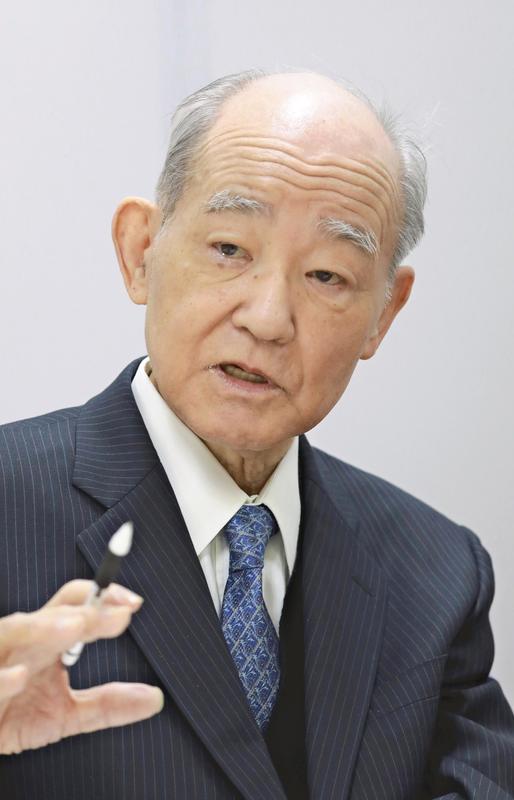
Kenji Yoshihara / Former vice health and welfare minister
The financial situation around public pensions presents an increasingly difficult challenge. The revised General Principles Concerning Measures for the Aged Society, adopted by the Cabinet on Feb. 16, did not include any root-and-branch countermeasures. In an interview with The Yomiuri Shimbun, former vice health and welfare minister Kenji Yoshihara presented his view on the current situation regarding public pension finances.
The Yomiuri Shimbun: In the public pension system, savings on payout expenses are supposed to be realized by gradually decreasing benefit levels through the macroeconomic slide mechanism (see below), in an effort to stabilize the financial condition of the system. However, since it is only triggered by rises in wages and prices, the mechanism does not work under such conditions as deflation, and it will not be implemented the next fiscal year, either.
Yoshihara: The macroeconomic slide mechanism was introduced in the 2004 amendment of the public pension system. Even though [the government's past argument that the pension system will ensure] "security for 100 years" was exaggerated, I also positively evaluated the mechanism, thinking that it had brought long-term stability and sustainability to the system.
Since then, however, the circumstances surrounding the pension system have changed completely. In addition to a rapid aging of society, deflationary conditions continued with wages and prices hardly rising as the economy faltered due to such factors as the 2008 financial crisis, which followed the collapse of U.S. investment bank Lehman Brothers.
The macroeconomic slide mechanism remains a treasured but largely ineffective measure as it has only been triggered once, in fiscal 2015. This is a very troublesome situation that requires reconsideration of the system.
Q: The financial situation of the pension system is becoming more dire as the current benefit levels for the elderly have not been reduced as planned. It is expected that this will likely result in significant decreases in the base pension benefits available for younger generations in the future.
A: The current basic pension for someone who has paid into the system for a full 40 years is about 65,000 yen per month, but that is expected to decrease substantially to about 45,000 yen per month in the future. The pension system will be unable to fulfill its original mission of securing a foundation to support the lives of citizens in their old age.
Q: What kinds of reform are necessary to prevent such a substantial reduction?
A: It is wrong to design the system based on the premise that the economy will continue to grow and both wages and prices will continue to rise. The macroeconomic slide mechanism should be transformed so it could be implemented little by little even during deflationary periods.
We also need to change our assumption that the macroeconomic slide is the only measure needed. We need to consider other valid measures as well, such as increasing the age at which pension payouts begin and extending the period of premium payments from the current 40 years (ages 20-59) to 45 years (ages 20-64).
Q: The pension age is, in principle, 65 for the basic pension, and that for the corporate employees' pension system is gradually being increased from 60 to 65. For the time being, the Health, Labor and Welfare Ministry plans not to consider making any further across-the-board increase in these ages.
A: But in other countries, even higher pension ages are becoming the norm. The United States and Germany have decided to raise them to 67, while Britain opted for 68.
Japan has a longer life expectancy than these countries and its population will be rapidly aging. Even so, the pensionable age for corporate employees is not expected to reach 65 overall until the year 2030. After that, we will need to consider raising it to at least 67 or 68.
Q: The government's newly revised General Principles Concerning Measures for the Aged Society includes consideration of a mechanism to allow applicants to delay the start of their pension payouts until after they are over 70 years old in exchange for increased monthly payouts.
A: It is a good thing to expand individual choices available, but this will not have as significant an effect on pension finances as an across-the-board increase.
Q: A key is the development of conditions in which the elderly could work more easily.
A: That is exactly right. The working-age population (15-64 years of age) supporting the pension system is expected to decrease by 40 percent to about 48 million people by around the year 2060. We must consider increasing the number of people paying into the pension system even by a little by making a society where healthy older people can work at least until about age 70.
No end to reforms
Q: You were involved in the 1985 public pension reform (see below) as the director general of the ministry's pension bureau. What was the situation at that time?
A: Under then-Prime Minister Yasuhiro Nakasone's administration, pension system reform was positioned as a major objective in accordance with a recommendation by the Secondary Provisional Commission for Administrative Reform chaired by Toshio Doko. This reform was recognized for establishing a foundation to maintain the system in a stable manner even through the 21st century.
Q: Now looking back, do you think it was overoptimistic about the financial prospects?
A: It may have been overoptimistic in hindsight, but no one at the time could have foreseen that the aging of society would continue at the rate it has and that the bubble economy would burst followed by deflation.
It is hard to make correct predictions about the future. The pension system can't avoid being repeatedly reformed in line with the changes of social and economic conditions at each time.
Q: How do you see the way the pension is currently administered?
A: Although the system is facing a difficult situation, the welfare ministry does not seem to be taking it very seriously. There is no way that politicians are going to try to implement policies unpopular with citizens, such as raising the pensionable age, unless bureaucrats start raising these issues and seeking understanding.
I don't think there can be an end to pension reform. Ideas such as one that the macroeconomic slide is sure to take care of everything will lead to the wrong path and eventually invite a serious situation. I am very much worried.
(This interview was conducted by Yomiuri Shimbun Senior Writer Hiroshi Ishizaki.)
(From The Yomiuri Shimbun, Feb 23, 2018)
--Yoshihara joined the Health and Welfare Ministry (now the Health, Labor and Welfare Ministry) in 1955. In the 1985 pension system reform, he was involved in such tasks as answering questions at the Diet as director general of the pension bureau. Afterward he assumed posts such as vice minister and president of the Japan Intractable Diseases Research Foundation. He is a coauthor of "Nihon Koteki Nenkin Seido Shi" (The history of the Japanese public pension system).
--Macroeconomic slide mechanism
A mechanism introduced in the 2004 pension reform to stabilize the system's financial situation by lowering pension benefit levels. When wages and prices rise, the mechanism limits the corresponding increase in pension benefit payments, thereby easing the financial burden on the system. Under the previous system, pension payments increased at the rate of inflation for elderly people who had already started receiving benefits. Under the macroeconomic slide mechanism, the payout increase is limited to the inflation rate minus around 1 percent.
--1985 public pension reform
A reform that created the basic pension as the foundation of the public pension system in preparation for an upcoming full-scale aging society. Previously, the public pension system was divided into multiple systems such as the corporate employees' pension, the mutual aid pension for civil servants and the national pension program for such people as farmers and the self-employed. With the progression of society's aging, however, the financial conditions of the national pension program, in particular, worsened, putting the continued existence of the program in danger. For this reason, the 1985 reform prepared a system in which all people, regardless of occupation, become members of the same basic pension and would collectively support the pension. The previous national pension system has avoided collapsing after becoming a part of the new basic pension.
Read more from The Japan News at https://japannews.yomiuri.co.jp/






.jpg?w=600)




