The Ministry of Digital Economy and Society (DES) plans to move ahead with development of the second phase of the TH-AI Passport project at a cost of 900 million baht, despite ongoing criticism of the first phase.
The second phase aims to increase the number of Thais skilled in artificial intelligence (AI) by 5 million, according to the ministry.
The winning bidder for the first phase, TH Consortium, has complied with the price performance criteria, noted the agency.
Under the first phase, the government plans to spend 1.6 billion baht to procure 12 AI models to provide up to 5 million Thais with access to professional AI platforms for one year.
DES Minister Chaichanok Chidchob defended the first phase earlier this week, insisting the project is a transparent and cost-effective investment.
He was responding in the House of Representatives to criticism from opposition People's Party MP Rukchanok Srinork, who chairs the House budget scrutiny committee. She said there were questions about the project's transparency, value for money, and data privacy implications.
According to DES permanent secretary Patchara Anantasilp, the second phase runs through fiscal 2027.
However, the second phase still needs related committees to finalise its budget.
The budget for the first phase was drawn from the government's DE Fund.
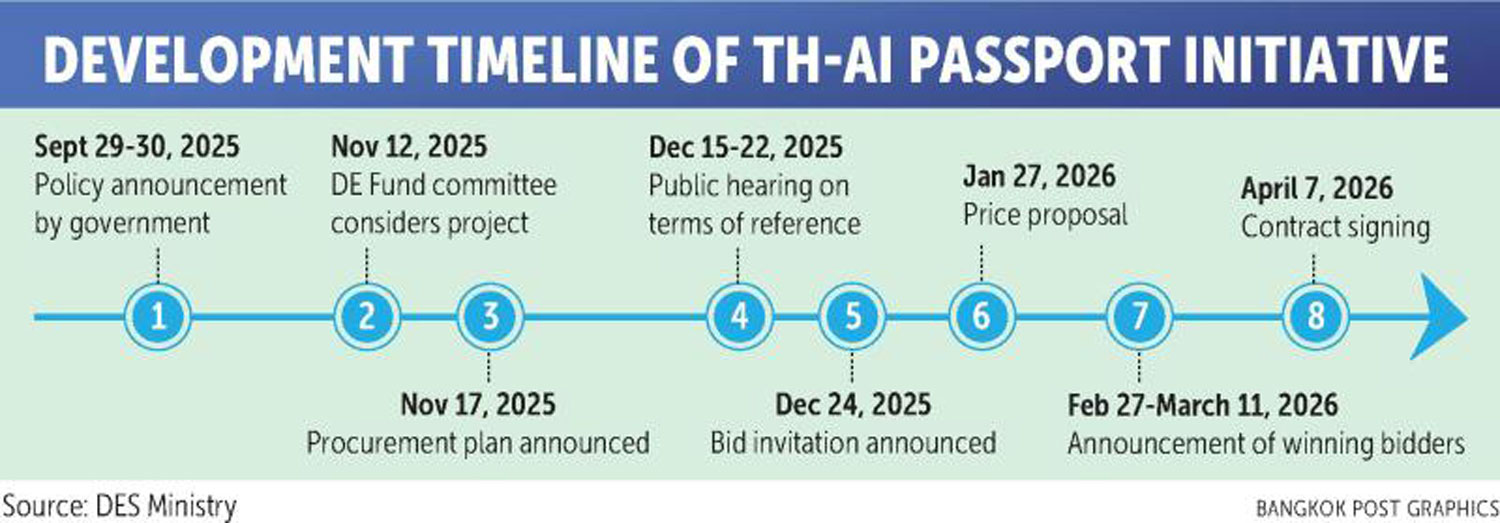
Mr Patchara and the secretary-general of the National Board of Digital Economy and Society Office held a press conference on Friday to clarify the timeline for the first phase, in response to criticism of the procurement process.
PRICE PERFORMANCE
Mr Patchara said the winning bidder was selected using price performance criteria, weighted 80% for technical capabilities and 20% for price.
"This ratio was chosen because IT projects involve complex technical requirements that cannot be evaluated on price alone, unlike office supplies," he said.
The technical evaluation considered several factors, including the bidders' track record with large-scale government projects and their ability to integrate world-class AI models, specifically those ranked in the top five globally.
The ministry also addressed allegations regarding the sources of the projected median price.
Mr Patchara said it was standard practice to survey median prices with experienced firms that have previously worked with the government.
"If we barred companies involved in the median price survey from bidding, no reputable firm would participate in the survey, and we would have no market data to work with," he said.
Two consortiums and one company bid for the first phase of the project, said Mr Patchara.
The TH-AI Passport project aims to bridge the digital divide by offering 24 different AI models.
The initiative also includes a Thai large language model to enhance the adoption and competency of the system.
While individual professional subscriptions for these models typically cost roughly $20 (700 baht) per month, the ministry's bulk procurement negotiated the cost down to 27 baht per user per month.
"Many people can only afford one model subscription. This project allows 5 million people — specifically students over 15 and first-time workers — to compare and utilise multiple premium models simultaneously," he said.
The ministry insists the timeline of the TH-AI Passport project follows a normal protocol.
Mr Patchara declined to respond to claims the winning bidder has connections with a government party.
"We don't know that angle, but we are focused on the technical base proposal through price performance criteria and their experience with state-run projects," he said.