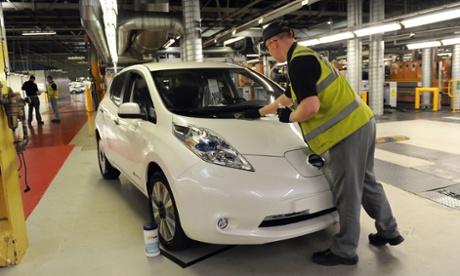
Government ministers will have their first taste of greener driving soon, with the first of a new fleet of electric vehicles to replace older fuel-guzzling ministerial cars.
The replacement is part of a £5m investment in the government’s fleet of vehicles that will result in electric cars and vans being used more widely across the public sector.
However, the initial roll-out will be small with just 140 low emissions vehicles, 64 of which will be 100% electric. Only four ministerial cars will be being replaced in the first round.
Baroness Kramer, transport minister, said the roll-out was “an important step” that would save money on fuel and help to improve air quality and tackle climate change, with lower greenhouse gas emissions and air pollutants. Many of the vehicles, including the minsiterial cars, will be Nissan Leaf models, which are 100% electric and built in the UK.
Danny Alexander, chief secretary to the Treasury, who recently launched a government prize worth £10m for the development of a new electric battery, said: “This is the right thing to do for both the environment and the taxpayer.”
The initial £5m investment is part of a broader £500m package of measures to promote ultra low-emission vehicles.
Kramer said the government’s aim was to demonstrate the usefulness of an electric vehicle fleet. The government announcement comes as a new report suggested on Tuesday that a mass switch to electric cars could cut the UK’s oil imports 40% by 2030.
Take-up of electric vehicles has been slow, in part because of a lack of charging infrastructure, and because of the limited range of the vehicles. But the latter has improved and charging points are now being built by councils and in public places such as supermarket car-parks.
However, the cars are still more expensive to buy than petrol and diesel-driven vehicles, and lower oil prices mean there is less relative advantage in fuel costs at present.