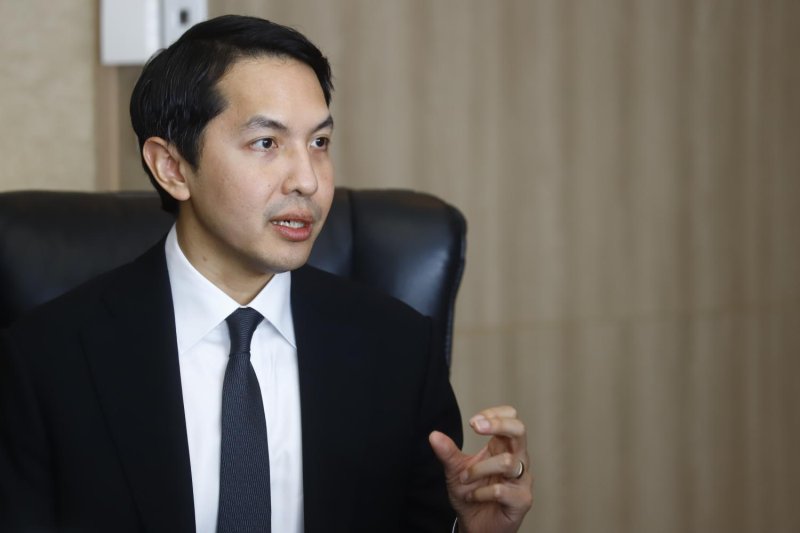
Thailand should capitalise on the strong inflow of foreign direct investment (FDI) to accelerate technology transfers and support long-term economic growth, says Santitarn Sathirathai, the vice-finance minister.
Speaking at a seminar on Thursday organised by Prachachat Turakij, a Thai-language business newspaper, he said investment applications seeking promotional privileges last year reached roughly 2 trillion baht. In the first quarter this year, applications already tallied 1 trillion baht.
"Thailand needs to transform its economy and develop new economic engines. Relying solely on the green economy may be insufficient -- the country must do more than that," said Mr Santitarn.
"While large amounts of FDI are flowing into Thailand, the key question is how much Thais actually benefit from it and to what extent technology transfer is taking place."
Foreign investment should also help promote domestic supply chains, similar to the growth of the Thai automotive industry, which led to the creation of Tier 1, Tier 2 and Tier 3 industries, enabling local small businesses to grow, he noted.
Structural problems have limited Thailand's growth potential, as the nation is an ageing society with a shrinking labour force, reducing GDP growth by about 1% annually, said Mr Santitarn.
Investment in machinery upgrades remains low, and many workers lack the skills suited to new industries.
He said Thailand must improve its existing industries while also developing sectors in demand, such as artificial intelligence, the green economy, and longevity.
Thailand is one of the most dependent economies on imported energy in Asia. The nation ranks second in the region to Malaysia in terms of the amount of energy consumed to generate GDP.
As a result, energy security has become synonymous with economic security, and Thailand is affected every time an energy crisis occurs, such as the war in Iran, said Mr Santitarn.
"We are entering a new world order, shifting from the old 'efficiency first' model, which emphasised rules-based systems and cost efficiency, to a new 'security first' era where security is increasingly tied to economic considerations," he said.
"As a result, international trade may no longer focus solely on buying from countries that can produce goods at the lowest cost, especially if there is a risk that supply cannot be maintained consistently. Instead, global trade will place greater emphasis on diversification and resilience.
"Countries viewed as safe and stable will be able to command a premium. Thailand and Asean are considered secure destinations for investment. Thailand may not be the lowest-cost producer, but its stability and security make it an attractive place to invest."
Regarding the energy transition from fossil fuels to cleaner alternatives such as biodiesel, Mr Santitarn said Thailand must jump-start all aspects simultaneously: increasing clean energy supply together with the development of smart grids, creating demand for clean energy in the transport sector, and advancing clean energy technology domestically rather than relying entirely on imports. Thailand must also train its workforce to support these emerging technologies, he said.