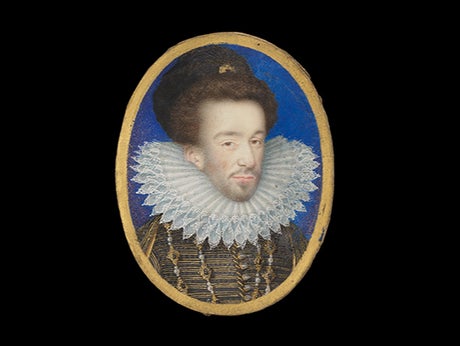
A miniature portrait of Henri III, a French king who was known for cross-dressing, has been discovered in the UK.
The 16th century "jewel-like" painting was made in Paris, but turned up in an auction in England in lockdown last year.
It is thought to have been brought across the Channel during the French Revolution.
Historians have debated the life and the sexuality of the "misunderstood" assassinated king, who wears jewels and a bonnet in the miniature.
His fondness for wearing women's clothing at court entertainments and his male companions, dubbed "mignons" who slavishly copied the royal's dress, was referenced during his lifetime.
The diarist Pierre de L'Estoile observed: "The king made jousts, tournaments, ballets, and a great many masquerades, where he was found ordinarily dressed as a woman, working his doublet and exposing his throat, there wearing a collar of pearls and three collars of linen, two ruffled and one turned upside down, in the same way as was then worn by the ladies of the court."
Mr L'Estoile also described the king's male companions, saying they wore "their hair long, curled and re-curled by artifice, with little bonnets of velvet on top of it like whores in the brothels, and the ruffles on their linen shirts (ruffs) are of starched finery and one-half foot long, so their heads look like St John's on a platter".
Experts said that the description could equally be applied to the fashions worn by the royal in the newly-discovered miniature.
Philip Mould, the gallery owner who is selling the tiny painting, said of the king's cross-dressing: "It was something that was greatly remarked upon (during his lifetime).
"It was very much his particular persona", but "also satirised" by others, he told the PA news agency.
In the miniature, the king, who has an "ironic and whimsical" look in his eye, is "wearing jewels in a way that hints at the observation made of him in the day," he said.
Henri III was murdered in 1589 and his face was "all but wiped from history" after the French Revolution, when it was dangerous to own royal portraits.
Court painter Jean Decourt's signature, along with the date 1578, was found on the back of the miniature, after a conservator opened the frame.
It is the first signature by the renowned artist to have been discovered on any work.
He is also documented to have been the official artist for Mary, Queen of Scots and is recorded as painting Elizabeth I, while visiting England.
The 57mm tall image was described in the original sale as being that of Sir Walter Raleigh before experts at Philip Mould & Co discovered it was of Henri III.
They are hoping to sell it to the Louvre Museum, in Paris, as the portrait is likely to have been painted in the building which was then the royal residence.
Mr Mould said: "This work is a French national treasure, a hugely significant unpublished image of a misunderstood King, and confirmation of Jean Decourt's immense talent.
"It would be wonderful if it could 'come home' to Paris, as I believe that is where it truly belongs. We have therefore given the Louvre the first opportunity to purchase it."
Celine Cachaud, portrait miniatures specialist, now working at the Institut national d'histoire de l'art with the Musee du Louvre, assisted with the research into the portrait and called the image a "groundbreaking discovery."
PA