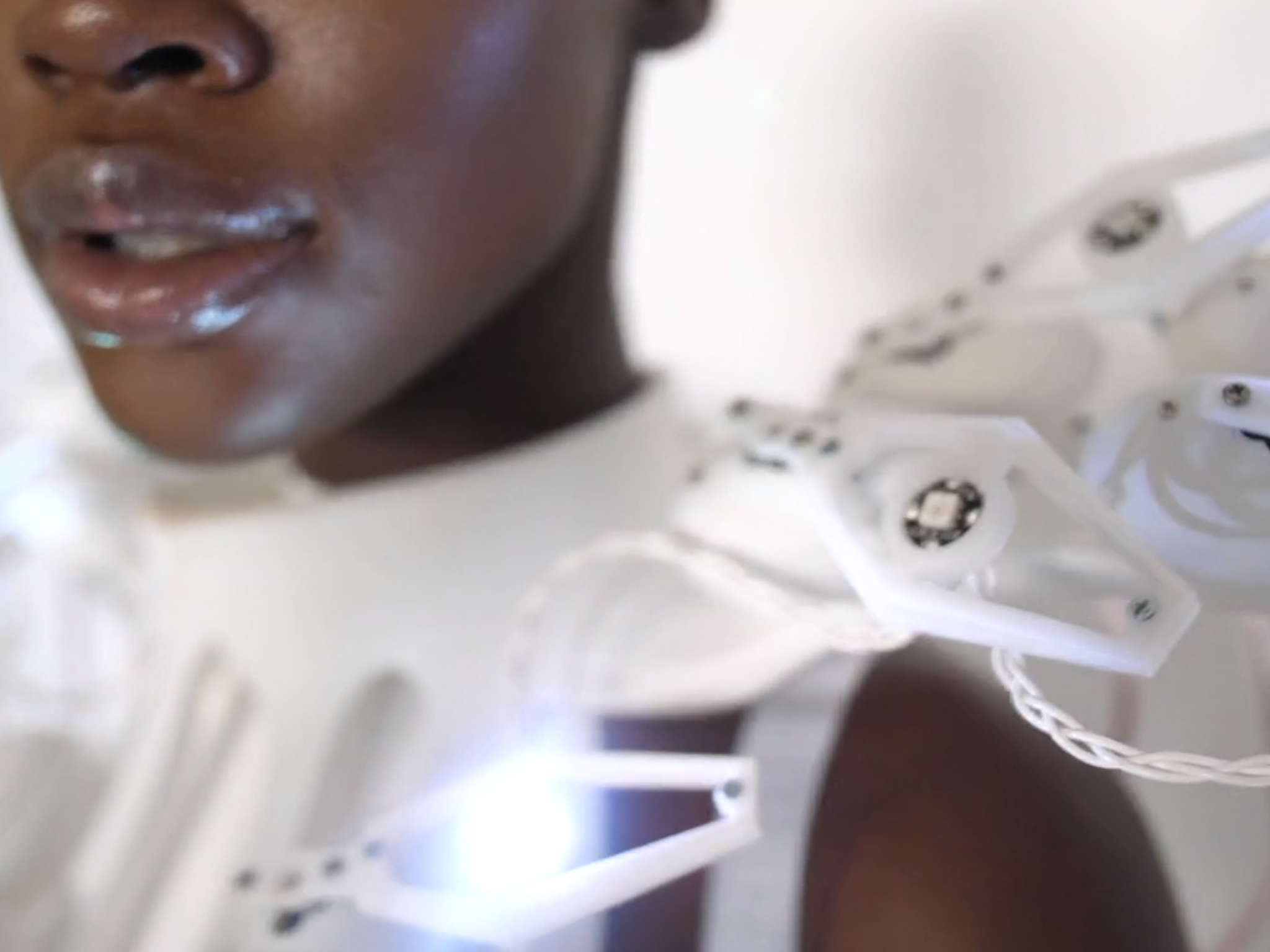
Dutch designer Anouk Wipprecht has created a dress that changes its shape based on the wearer’s brain activity.
The 3D-printed dress, called the Pangolin dress, is connected to the wearer’s brain using 1,204 electroencephalography sensors.
The sensors resemble the scales of a pangolin – a kind of anteater – which gives the dress its name.
The dress will move and light up depending on the brainwaves it receives, translating it into motion and light patterns.
As a user’s brain activity becomes more intense, the lights will flicker and the wings on the dress’ shoulders flap.
When the wearer is soothed, meanwhile, the lights glow purple, Cnet reports.
"As each of the BCI [brain computer interfaces] inputs is connected to each one of the actuators, this gives a very individual animation of the dress," Wipprecht said.
“Since we are using 64 PCB’s on the BCI, the dress needed 64 outputs”, Wipprecht told 3dpbm.
“I divided that into 32 servo motors and 32 LED’s that all are connected to each of the Pangolin grids and to PCB’s on the head of the model, creating the live visualization effects.”
The clothing itself is made from a lightweight nylon material, with the interface between the brain and the dress made by the Institute for Integrated Circuits at Johannes Kepler University Linz and neurotechnology company G.tec.
The main issue in making the clothing was avoiding overloading the dress with extra weight.
3D-printing the three-millimetre lightweight exo-skeleton on the dress was the solution – light enough to be worn, but sturdy enough to hold the various mechanics.
“We wanted to go for a very ‘cyborg’ look. Very ‘H.R. Giger-esque’. Which fits the theme of the festival as it mixes art x fashion x technology”, Wipprecht added.
The dress will be shown at the Ars Electronica festival in Austria.
This is not the first strange dress that the designer has produced.
In 2016, Wipprecht made a ‘spider dress’ which featured mechanical limbs with sensors in order to keep passers-by out of the wearer’s personal space.
Interfaces between human brains and other objects could be approaching imminently.
Elon Musk recently demonstrated a working brain-computer interface that he hopes will allow "human-AI symbiosis".
Early applications of the technology, from Musk’s Neuralink startup, will be in treating brain disorders and diseases, with Musk saying it would "solve important brain and spine problems with a seamlessly implanted device."
However, others have been more critical of the technology, claiming the company’s device is “less capable than similar medical BCIs already on the market”