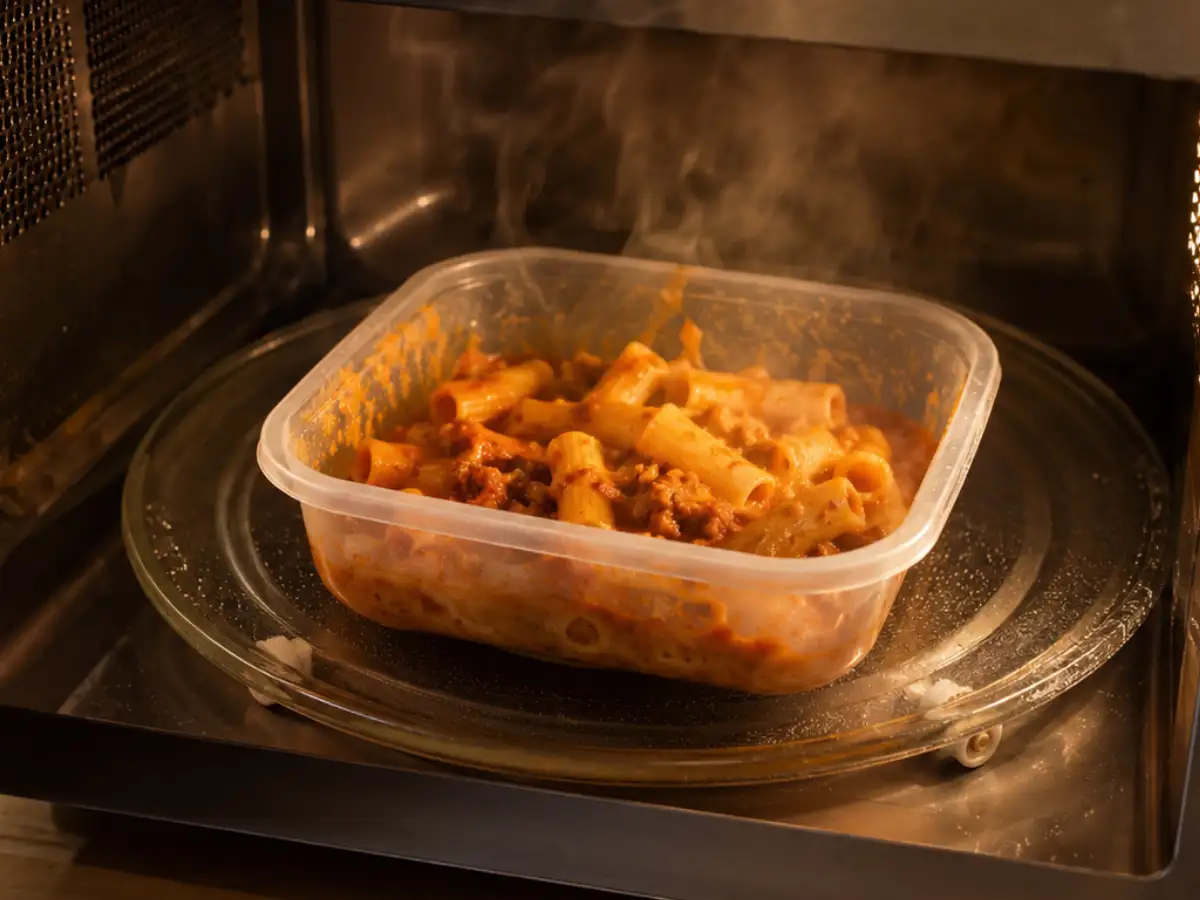
Popping last night's leftovers into a plastic container and microwaving them for a couple of minutes is a habit many Americans repeat several times a week. According to a 2023 study published in Environmental Science & Technology, the quick reheat does more than warm up your food. It can also load the food with plastic particles that are too small to see.
The study was conducted by a team at the University of Nebraska-Lincoln, led by Kazi Albab Hussain and Dr. Yusong Li. The researchers filled two polypropylene baby food containers and one polyethylene-based reusable food pouch with either deionized water or a 3% acetic acid solution to mimic aqueous and acidic foods, and exposed them to home-use conditions including refrigeration, room-temperature storage, and microwaving at full power for three minutes.
Microwaving released the most particles by far
The same study found that heating for three minutes caused one of the polypropylene containers to shed 4.22 million microplastic particles and 1.21 billion nanoplastic particles from one square centimeter of plastic alone. The second container released 425,000 particles of microplastic and 169 million particles of nanoplastic under the same conditions. In all cases, nanoplastics were about a thousand times more abundant than microplastics, with up to 2.11 billion nanoplastic particles per square centimeter in prolonged high-temperature storage.
Refrigeration and room-temperature storage weren't harmless either. Even after being stored for the equivalent of six to 12 months, the containers and pouch continued to emit millions to billions of particles, but at a slower rate than when microwaved, the study found.