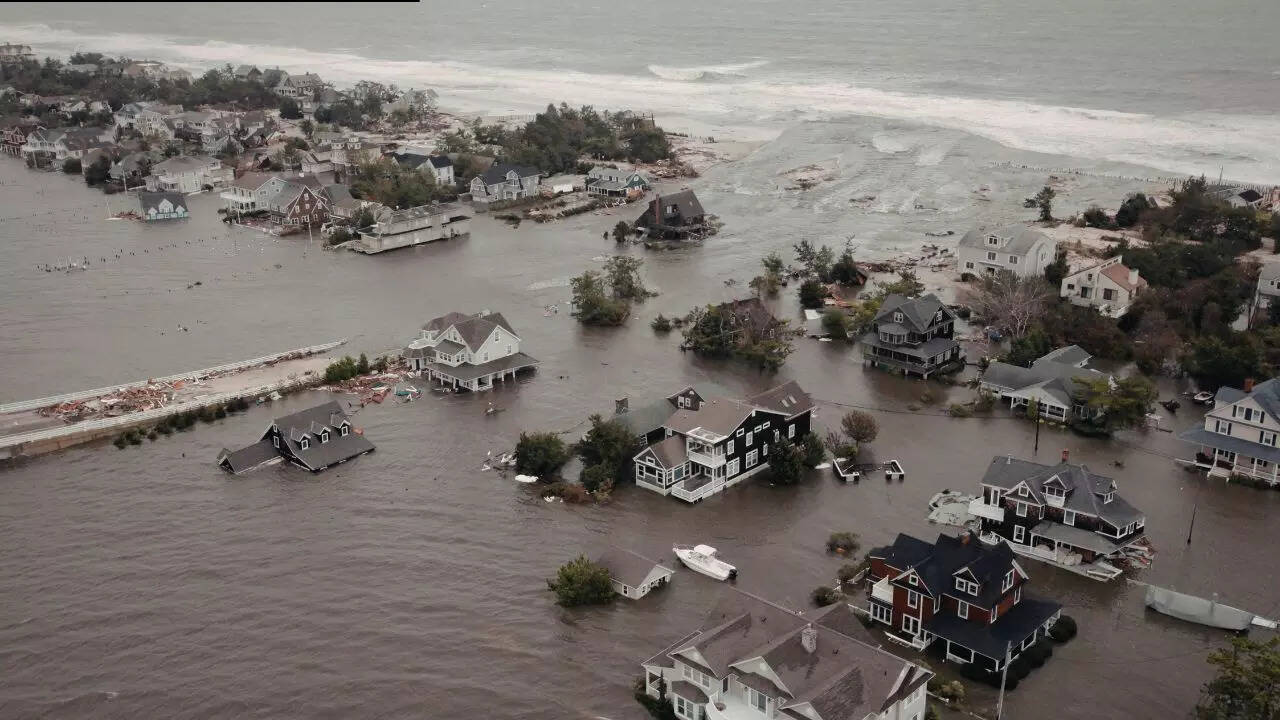
Sea level rise has long been viewed as a concern of the future, discussed in abstract forecasts and maps. Nonetheless, population growth along the US shoreline has been rapid, particularly in low-lying areas. A new study combines these two patterns. Instead than asking who is at risk now, it looks ahead, integrating sea level rise scenarios with comprehensive population predictions until the year 2100. The method avoids broad averages and instead concentrates on specific places where people actually dwell. What emerges is a calmer, more unsettling picture. Many future occupants are projected to live on land below high tide levels. The data show that the scale of exposure was underestimated due to timing rather than error.
By 2100, flooding may threaten the homes of millions across America
The research, "Millions projected to be at risk from sea-level rise in the continental United States,"starts with a simple observation. Coastal populations in the continental United States are growing, even as the risk from rising seas becomes clearer. Earlier studies often measured exposure using current census data laid over future flood maps. That method misses who might arrive later. By projecting population changes alongside sea level rise, the authors aimed to close that gap. The result is a closer alignment between environmental risk and human presence.
Millions projected to live on vulnerable land by 2100
Under a sea level rise scenario of 0.9 metres by the end of the century, the study estimates that land home to around 4.2 million people could be affected by regular inundation. Under a higher scenario of 1.8 metres, that figure rises to about 13.1 million. These numbers are significantly larger than estimates based only on today’s population. They reflect not sudden migration, but steady growth in places that may later flood.
Small area modelling changes the picture
A key feature of the study is its use of small area population projections. Instead of relying on county level data, which can hide local variation, the researchers modelled growth at the level of census block groups. This allowed them to link elevation and flood risk to where people are likely to live within each county. It also reduced the risk of assuming that all coastal residents face the same exposure.
Flood risk varies within coastal counties
Not all parts of a coastal county are equally vulnerable. Some neighbourhoods sit higher than others, even a short distance inland. By matching population projections to elevation data, the study avoided overestimating exposure in safer areas. At the same time, it highlighted low lying zones where growth is likely to continue despite long term risk. These are often areas with existing development and economic pull.
Potential displacement could match historic movements
The authors stop short of predicting mass migration, but they note that the scale of potential displacement is large. Should we fail to implement protective measures, future population movements could potentially rival significant internal migrations in US history. The comparison is not meant to alarm but to give a sense of magnitude. It frames sea level rise as a social issue, not just an environmental one.
Planning and adaptation remain uneven
The findings arrive at a time when coastal planning varies widely across states and cities. Some areas invest heavily in defences and zoning controls. Others continue to permit growth in exposed locations. By showing where future populations may face risk, the study offers a tool for local decision making. It does not prescribe solutions, but it narrows the field of uncertainty.
A slower warning rather than a sudden one
There is no single dramatic moment in the study. Instead, it presents a gradual build up of exposure over decades. People move in. Seas rise. The overlap grows. The risk does not arrive overnight, which may be why it is often overlooked. The research adds detail to that slow process, leaving the implications to settle rather than forcing a conclusion.