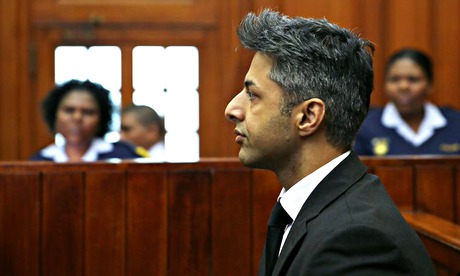
Two worlds collided. Shrien Dewani, millionaire businessman with a penchant for private jets and custom-made “his” and “hers” wardrobes, watched intently as township criminal and prison inmate Mziwamadoda Qwabe entered the courtroom, head bowed, holding tight to a flak-jacketed security guard.
It was the first week of a murder trial in Cape Town, South Africa, where the timeworn adjective “sensational” did not seem misplaced. Dewani stood in the dock accused of hiring Qwabe and two other men to stage a carjacking to kill his wife, Anni, during the couple’s honeymoon. In a plea explanation to the court, Dewani denied the charges but revealed that he was bisexual and had paid men for sex.
Dewani’s statement also revealed a life of privilege and wealth: plans for new bedrooms and en suite bathrooms in Bristol and London; a stag party in Las Vegas, including a helicopter trip; a spectacular wedding in India that cost an estimated £200,000; a honeymoon in South Africa at a luxury game lodge and the five-star Cape Grace hotel.
Like Oscar Pistorius, the Paralympic star who in another “mega-trial” was convicted of culpable homicide and will learn his sentence this week, Dewani, who went to Bristol Grammar School and eventually joined his family’s healthcare business, belongs to a jet-set elite. But unlike the Pistorius trial, the drama in Cape Town has shone a light on the alienation, desperation and hopelessness of South Africa’s underclass.
How different was the life of Qwabe in Khayelitsha, the patchwork township where Anni’s body was found in November 2010. Just 30km from the high court and Cape Town’s celebrated tourist attractions, it has the worst murder rate in the country, with one killing almost every day, according to police figures, in a population of 400,000. Explaining last week why he bought an illegal gun, Qwabe said: “There in the township it is not safe and I wanted to protect myself.”
The court heard last week that Dewani allegedly agreed to pay 15,000 South African rand (about £1,330 in the exchange rate of the time) to have his wife killed. While such an amount struck many as improbably low, in Khayelitsha life is literally cheap.
“Fifteen thousand is a lot!” said a 41-year-old unemployed township dweller who gave her name only as Princess. “Unemployment is a big problem here.” The view was shared by Yolanda Xashi, 28, also jobless, standing near a barbecue where a pig’s head rested on top of a bucket. “People are really desperate and will do anything,” she said. “It’s so hard to get opportunities or work. Who else is going to give you 15,000? So why not? People here would do anything to get a living.”
Poverty, joblessness and gangsterism are chronic in Khayelitsha, which means “new home”. Qwabe gained a certificate in electrical engineering from technical college but struggled to find work, though he has been described in court as a former insurance assessor and tour guide, and occasionally helped his mother selling meat.
Few corners of the township are bleaker than the “field of death”, a sandy expanse bordered by railway tracks and warrens of tin shacks, littered with bottles, broken glass and rubbish, but lifted, incongruously, by clutches of daisies and dandelions. Last week, children could be seen holding a penalty shootout in a ramshackle goalmouth beside a giant pool of filthy water. A clue to the field’s darker purpose lay in a series of discarded car tyres.
The field is notorious for a form of justice far removed from the hushed Dickensian court with its four ornate chandeliers, high-backed judges’ chairs and wood-carved escutcheon of lion and unicorn with “Dieu et mon droit”. It has witnessed numerous mob lynchings of suspected criminals, including “necklacings”, a racial apartheid-era mode of public execution in which the victim has a petrol-drenched tyre put round their neck and is burned to death. Vigilantes killed 78 people in Khayelitsha between April 2011 and June 2012. Many say that police failings have forced them to take the law into their own hands.
A judicial commission of inquiry into community relations with the police reported earlier this year on cases including a lesbian murdered because she refused to use a men’s toilet, only for the alleged killers’ trial to be postponed more than 45 times over four years, and a seven-year-old boy whose rapist was released on bail despite assurances to his family.
Surveying the field last week, Mzonke Matshini, unemployed and recently mugged for his wallet and phone, said: “I’ve seen people beaten up and necklaced here. There was a massive crowd, more than a hundred, and a lot of anger. People who robbed or did break-ins get burned in the field all the time.”
Matshini, 36, reflected: “I was sad. I would prefer it if the guys were arrested rather than killed. But people here have lost trust in the law. Criminals get arrested and later they are out and do the same thing again. It’s a cycle.”
Living conditions here are harsh. The most recent South African census found that, in 2011, 8,000 households in Khayelitsha reported using bucket toilets and 12,000 had no toilet at all.
Among those relying on buckets is Princess. “Crime is a big problem: all these young children fighting against each other,” she said from a yellow corrugated shack with iron security gate opposite the “field of death”.
“A guy living on this side can’t go on the other side of the road. If you walk at night, you are not safe. Even if you are inside your shacks, they break in and take your stuff. Then if you try reporting it, they will come back for you.”
THE TRIAL: THE KEY CLAIMS
More than four years of waiting came to an end last week when Shrien Dewani, a businessman from Bristol who resisted extradition citing mental health problems, took his seat in the dock accused of masterminding the honeymoon murder of his wife, writes David Smith.
The 34-year-old pleaded not guilty and outlined his version of events in a statement read by his lawyer to the high court in Cape Town. The first paragraph of the synopsis revealed: “I have had sexual interaction with both males and females. I consider myself to be bisexual. My sexual interactions with males were mostly physical experiences or email chats with people I met online or in clubs, including prostitutes such as Leopold Leisser.”
Leisser, who styles himself “the German master”, is set to testify later in the trial. There are also rumours that, possibly this week, evidence will be heard from a former British parliamentary aide who had several encounters with Dewani at a gay club in London. Prosecutors are likely to argue that this gave Dewani a motive to want his wife dead.
Dewani’s statement also denied that the November 2010 carjacking in a township near Cape Town was a charade. He said he was ordered to get out of a moving taxi by armed assailants. “I recall hitting the ground and the car speeding away. The last thing I had said to Anni was to be quiet and not to say anything. I said this to her in Gujarati.”
The court heard from a pathologist that Swedish-born Anni, 28, died from a gunshot to the neck. The court saw video footage of her lying on the back seat of the abandoned taxi in a black dress and high heels.
On Monday the trial will resume with the cross-examination of Mziwamadoda Qwabe who, already serving a 25-year sentence for his role in the murder, claimed last week: “There was a husband who wanted his wife to be killed.” Technical experts from the websites Gaydar and Recon, a site for men into fetish gear, could soon follow to discuss evidence that Dewani surfed the site soon after his wife’s death under his user name “asiansubguy”.