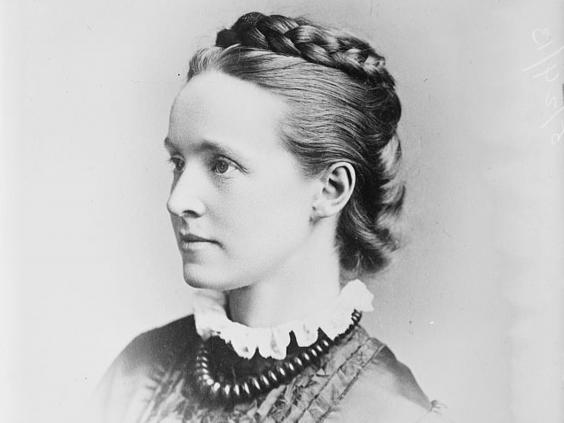
Millicent Garrett Fawcett (1847-1929), leading light of the women's suffrage movement, will be honoured today with a new statue in London's Parliament Square.
The monument, created by Turner Prize-winning artist Gillian Wearing, will be the first of a woman to be unveiled in the heart of Westminster and marks a century since MPs passed the Representation of the People Act, giving women the vote for the first time.
Fawcett takes her place before the seat of government alongside prime ministers George Canning, Robert Peel, Benjamin Disraeli, Edward Smith-Stanley, Henry John Temple, Lloyd George and Winston Churchill and Abraham Lincoln, Jan Smuts and Nelson Mandela.
The suffragist, who stressed the need for moderation and debate in the campaign for equal rights and opposed the more provocative tactics of Emmeline Pankhurst, will be portrayed brandishing a placard that reads, "Courages calls to courage everywhere", a line from her speech following the death of activist Emily Davison, trampled by a horse at the Epsom Derby of 1913.
"I wanted the monument to be as inclusive as possible and to reflect that many women were involved in progressing the rights of equality, some of whom have never been publicly recognised," Wearing said.
"It is important to realise the battle for equality didn’t come easily. It was a long, hard, arduous struggle. I can’t even comprehend how frustrating Millicent’s life must have been as she spent six decades campaigning getting women the right to vote."
Fawcett was born in Aldeburgh, Suffolk, on 11 June 1847, the eighth of 10 children in a family of prosperous barley merchants.
Aged 12, she was sent away to attend boarding school in Blackheath, London, in the company of her sister Elizabeth, who would grow up to become Britain's first female doctor.
It was here that Millicent heard a speech by the radical MP John Stuart Mill in 1866 that inspired her to become involved in politics and seek fair representation for all.
She subsequently became secretary of the London Society for Women's Suffrage and married Liberal MP Henry Fawcett, 14 years her senior, in 1868. Their daughter Philippa was born that same year.
In 1869, she joined the London Suffrage Committee and spoke at the first public pro-suffrage meeting in London.
Combing motherhood with caring for her husband - blinded in a shooting accident - and writing prodigiously, Millicent found time to participate in the founding of Newham College, Cambridge, in 1875, believing that creating new opportunities for women to enter higher education was crucial to encouraging the next generation of suffragists.
Tragedy struck in 1884 when Henry passed away, an event that led Fawcett to temporarily withdraw from public life to care for Philippa and raise four of her orphaned cousins with her sister Agnes.
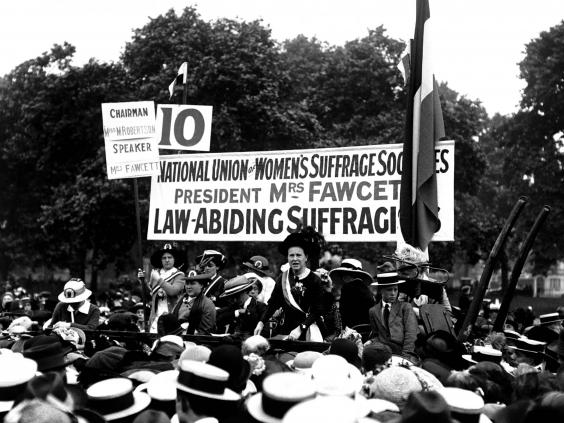
Continuing to write on a huge array of feminist causes, Fawcett was later elected president of the National Union of Women's Suffrage Socieites (NUWSS), a role in which she served between 1897 and 1919.
That organisation stressed that its membership consisted only of "law-abiding suffragists", at odds with the more militant tactics of the Pankhursts' Women's Social and Political Union (WSPU).
Fawcett explained her opposition to the WSPU in her 1912 book Women's Suffrage: A Short History of a Great Movement:
"I could not support a revolutionary movement, especially as it was ruled autocratically, at first, by a small group of four persons, and latterly by one person only… In 1908, this despotism decreed that the policy of suffering violence, but using none, was to be abandoned. After that, I had no doubt whatever that what was right for me and the NUWSS was to keep strictly to our principle of supporting our movement only by argument, based on common sense and experience and not by personal violence or lawbreaking of any kind."
Over the course of a long and distinguished career, Fawcett also lobbied for the criminalising of incest and of cruelty against children within the family for the repeal of the Contagious Diseases Act, which punished prostitutes for passing venereal complaints on to their clients.
She was also dispatched to South Africa in July 1901 and entrusted with reporting back to the British government on the conditions endured by prisoners of war held in concentration camps during the Second Boer War.
Fawcett's memorial in Parliament Square is only the latest honour to be bestowed on this extraordinary woman.
In her own lifetime, she was awarded an honorary degree by the University of St Andrews in 1899 and appointed a Dame Grand Cross of the Order of the British Empire (GBE) in the 1925 New Year Honours.
She died at her home in Gower Street, Bloomsbury, on 5 August 1929, her legacy assured.