- Global consumption of ozone-depleting substances fell by more than 98% between 1986 and 2013; all countries had stopped the use of major ozone-depleting substances by 2010.
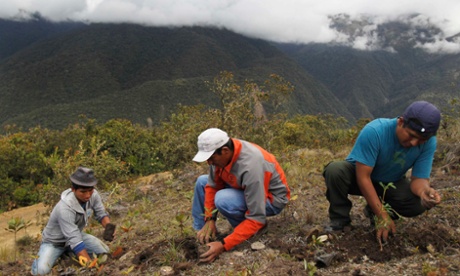
- Afforestation – planting on open land – and natural expansion reduced the net loss of forest from an average of 8.3m hectares (20.5m acres) a year in the 1990s to an annual average of 5.2m hectares between 2000 and 2010.
- Protected terrestrial areas covered 15% of land and coastal marine areas worldwide by 2014, up from 8.7% in 1990.
- Between 2003 and 2011, national forestry programmes in China resulted in the reforestation of 36.5m hectares of land.
- The percentage of protected terrestrial and marine areas in Peru rose from 4.6% in 1990 to 18.3% in 2012.
- The world met the MDG target of halving the proportion of people without access to improved drinking water in 2010 – five years ahead of schedule. However, although 2.6 billion people have gained access to improved water since 1990, about 663 million people are still without an improved source of water.
- Between 1990 and 2015, 2.1 billion people gained access to an “improved sanitation facility” – a toilet that hygienically separates people from faeces.
- Between 2000 and 2014, more than 200 million people living in slums got access to either improved water, sanitation, durable housing or less crowded housing conditions. The MDG target had been to “achieve a significant improvement” in the lives of at least 100 million slum-dwellers by 2020.
- In eastern Asia, 723 million people became new users of piped water on premises between 1990 and 2015, with 694 million gaining access in China alone.
- About 427 million people gained access to improved drinking water in sub-Saharan Africa between 1990 and 2015.
- In 2010, the UN general assembly recognised access to safe and clean drinking water and sanitation as a human right.
- One in four people had to defecate in the open in 1990; the proportion in 2015 is one in eight. However, there are still 2.5 billion people who do not use an improved sanitation facility and 946 million who still have to defecate in the open.
- Ethiopia achieved the largest decrease in the proportion of the population having to defecate in the open, from 92% in 1990 to 29% in 2015.
- In 1990, 54% of the world’s population used improved sanitation facilities; in 2015, the figure is 68%.
- Today, fewer than 1,000 children under five die each day from diarrhoea caused by inadequate water, sanitation and hygiene – compared with more than 2,000 15 years ago.