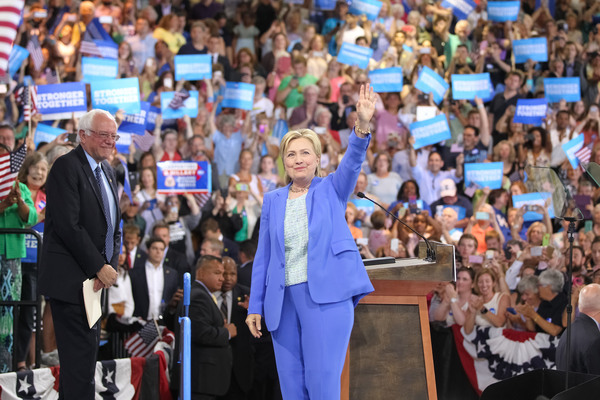
Recently in this university town, in this battleground swing state Ohio, the millennial man of the hour, former presidential hopeful Bernie Sanders, came riding through with a message.
A thousand mostly college-aged kids crowded into the Kent State University gym to cheer and chant and wave _ not so much Bernie Sanders signs anymore, but Hillary Clinton "Feel the Bern for her" posters.
Just as Sanders and his party asked them to do.
"If you voted for Bernie in the primary, vote with Bernie now," he said as the crowd roared support for Clinton.
Eager to partake in history, I went to the rally, too. I saw the thrill of the political process reflected in the hundreds of young faces, including those of my daughter, her boyfriend and my 19-year-old son who will vote in a presidential election for the first time in November.
What I didn't see until later was the irony.
Sanders was their guy. My kids and their ilk said they liked Sanders because he spoke from the heart. He drew this historically politically disinterested cohort into the presidential election machine with a refreshing honesty and conviction around the issues that are important to them. He didn't care about election strategy. He wasn't concerned about crossing aisles or placating Wall Street. He had no trouble calling out "the man." All of which appealed to progressive-leaning young people.
"He didn't treat us as children but as important as anybody else," said one KSU student, junior English major Leah Remy, as she waited for Bernie to appear.
And then he was gone from the race. And in his place, from the perspective of many young voters, rose the same-old, same-old. According to some students of the election process, including many millennials, Clinton is among the most qualified presidential candidates we've had in decades. But among detractors, she is a mainstreamer who toes the party line. Whether she actually espouses many of the same views as Sanders like her campaign suggests, many millennials don't see it. They don't see Clinton championing the radical change they are looking for, a fact Sanders criticized time and again during the primaries.
And now the young adults who found power in politics through Sanders' message, millennials representing the nation's biggest age-centric voting bloc, surpassing even Baby Boomers, are being asked, begged, cajoled and wooed into voting for her.
By their guy.
It is an irony and an educable moment that could go either way for this skeptical group; a 2014 Pew Research Center poll found only 19 percent of millennials believe most people can be trusted.
On the one hand is the lesson of pragmatism. This bitterly fought election, the first for many young-adult voters, is an opportunity to understand reality, practicality and how the world works. Which can't always be the way we want. This is democracy at work. Living it often requires compromise and a leap of faith.
On the other hand is idealism, which people in their 20s are so good at, which I, for one parent, would not want to wrestle away from them too soon. Idealism in this case is holding strong to one's convictions and not dismissing them no matter the consequences, a value Sanders modeled. Idealism in this case, for some young voters, might indeed be voting for Clinton or the GOP candidate Donald Trump. It might also be voting for the Green Party candidate because she speaks most effectively about the environment. Idealism might be writing in Sanders even though doing so would likely only serve to take votes from the two primary candidates. Idealism might be not voting at all because none of the candidates speak to a voter's ideals and values. This, too, is democracy at work, requiring a different leap of faith, not just for the individual voter, but for all of us as we live into the results of a particularly contentious and possibly pivotal election on Nov. 8.
Ultimately, the individual vote is squarely in each individual's hands, including the hands of our young-adult children, where it should be, as it should be, as it has been given.
"We give young people the right and privilege to participate in our democratic process," says my husband, who, in addition to being the father of three millennials, is a political scientist and college professor. "That being a given, we have to respect how they end up voting. We have to hope they've taken full responsibility for this privilege, that they have talked to their friends and teachers, and that they have watched and learned from social media and reputable news outlets. And then we have to let it go and allow them to mature into the process of democracy in their own way."
Come Nov. 8, 75 million millennials may surprise us. Or they may not.
Whatever they do, I hope it is with the same consciousness and conviction that a 75-year-old man managed to elevate within their ranks.
Elections come and go. It is these values, given expression within the group that will shape American thought for the next 50 years, where real hope resides.