
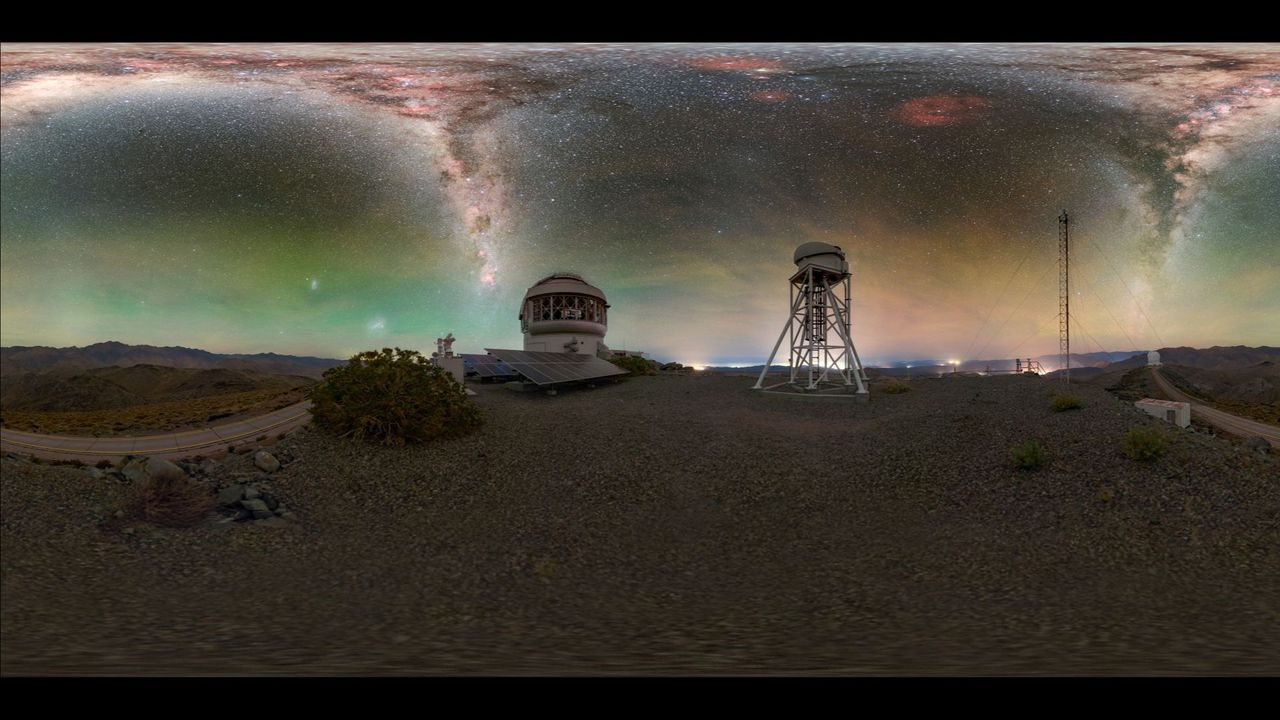
On a lonely ridge in Chile, the giant silver dome of the Gemini South Observatory opens each night to observe the faint, ancient light of the cosmos. Spread around the telescope is a glittering field of solar panels, turning sunlight into electricity so the observatory can keep doing its nighttime science with a smaller footprint.
But sometimes, the best views of the cosmos aren't as far away as we might expect. Take, for example, this stunning panorama of the night sky above the Gemini South Observatory captured by Petr Horálek, a NOIRLab Audiovisual Ambassador.
What is it?
Gemini South is one half of the International Gemini Observatory, a pair of matching 26.5-foot (8.1 meters) optical and infrared telescopes built to give astronomers access to essentially the whole sky by operating from both hemispheres. The giant mirrors at both sites let astronomers study fainter, more distant and more detailed targets. Both sites then allow astronomers to do everything from sharp imaging to spectroscopy (splitting light into its component colors to decode what objects are made of and how they're moving).
Both Gemini telescopes are known for advanced observing techniques that help counteract the blurring effects of Earth's atmosphere. According to NOIRLab, the organization that runs both telescopes, both sites use wide-field, adaptive-optics-assisted infrared imaging, which can sharpen views of everything from star-forming regions to the environments around distant galaxies. This technology complements other ground-based NOIRLab-run sites, like the Vera C. Rubin Observatory, which also has to work around the effects of Earth's atmosphere.
Where is it?
Gemini South sits high on Cerro Pachón in the Chilean Andes.
Why is it amazing?
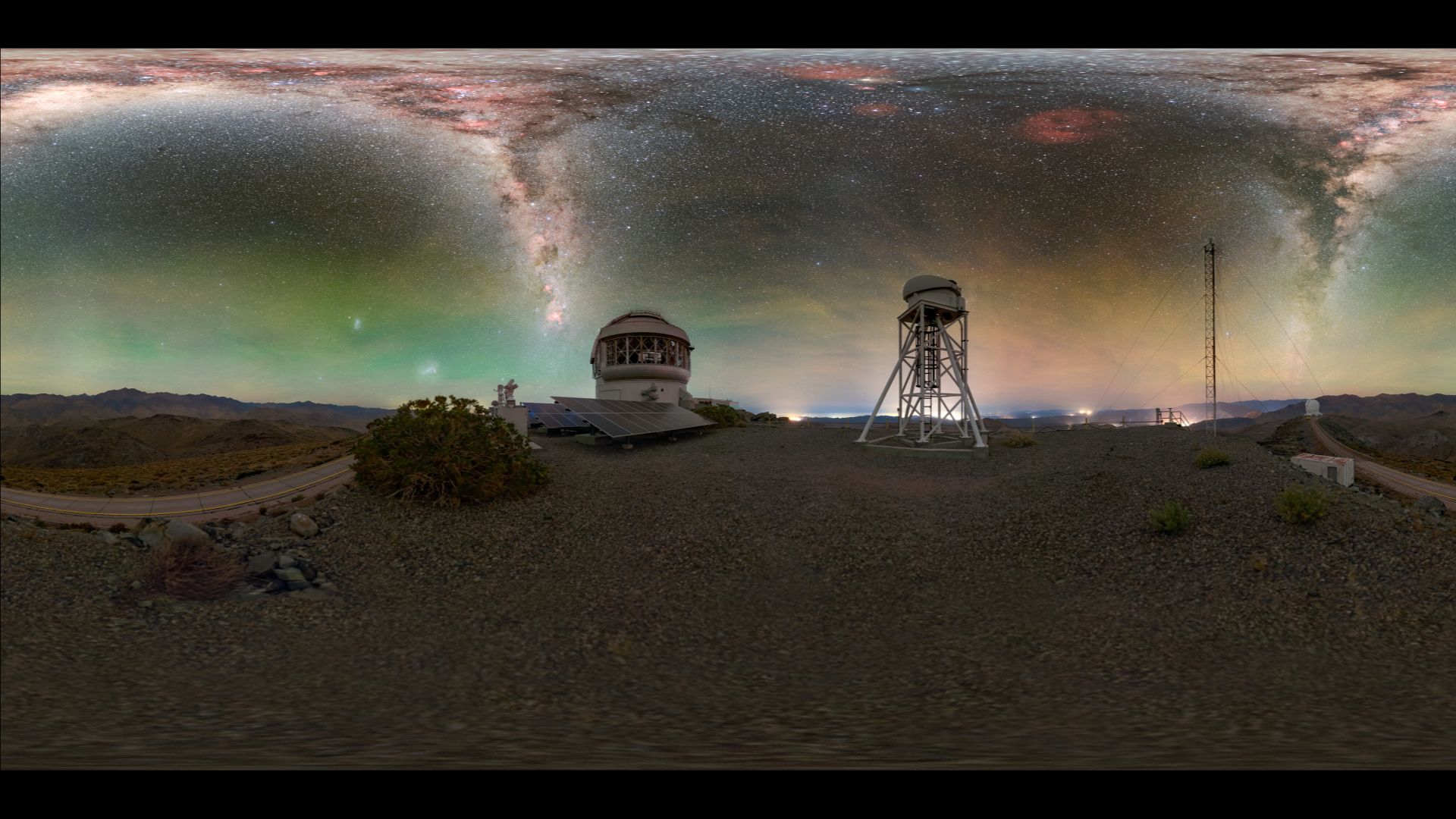
Astronomy, like other fields of science, is about patience. And for photographer Petr Horálek, patience was key in creating this stunning panorama of the Milky Way galaxy above the Gemini South Telescope.
The solar panels powering the telescope can also be seen in this image, showing NOIRLab's attempts to improve energy efficiency and reduce emissions across its sites — essentially, using science to make science more efficient. Given that large observatories need lots of power to run computers, instruments and support systems, all in a remote location, having solar panels allows the process to be more sustainable and harvest the resources already there in the area.
Want to learn more?
You can learn more about the Milky Way galaxy and ground-based telescopes.