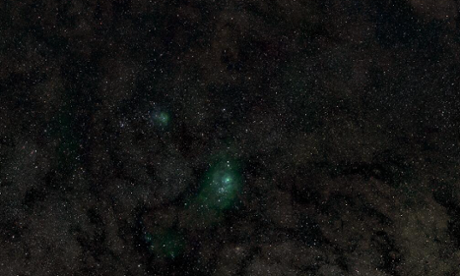
Lose yourself in the glorious star fields of the Milky Way. Astronomers at the Ruhr-Universität Bochum (RUB) have compiled one of the largest astronomical images ever made and released it to the general public.
The largest astronomical image yet made was released in June from the Sloan Digital Sky Survey. It contained more than a trillion pixels and would require 500,000 HD televisions to display it at full resolution.
This new image is a mosaic of 268 individual images. It is contained in a single data file of 194 Gigabytes. Made up of 46 billion pixels, it is so huge that the astronomers have provided an online tool to help view it.
The tool allows users to navigate around, zoom in and out, and explore the depths of space. It takes a while to load the zoomed images even with a good broadband connection but the rewards are worth it. What appear like smudges at one scale resolve into jewel-box star clusters at the deeper level.
A text box shows the coordinates of the image on display but can also be used to show specific celestial objects. For example, type in ‘Eta Carinae’ to see the explosive aftermath of this unstable star, or the Messier catalogue number (listed here) of an object in the Milky Way to be taken straight there.
The image is the result of five years monitoring the night sky using the telescope at the university’s observatory in the Atacama Desert in Chile. The monitoring programme has allowed astronomer Moritz Hackstein and other researchers to discover 50,000 previously unknown variable celestial objects.
These variations could be the result of planets passing infant of stars or multiple star systems where stars obscure each other every now and then. They are now being studied up to understand their behaviour.
The Milky Way itself is the misty band of light that runs across the sky. It is visible from dark sites well away from street lights. In 1610, Galileo raised his newly built telescope to the sky and sparked an astronomical revolution by showing that the Milky Way was made of the combined light of many distant stars. Now you can do something similar by visiting the website and zooming in.
Correction: This article’s headline, standfirst and body copy was changed on 27 October to make clear that the Ruhr-Universität Bochum (RUB)’s image is not the largest astronomical image ever made, as was initially stated.
Stuart Clark’s latest book is The Unknown Universe (Head of Zeus).