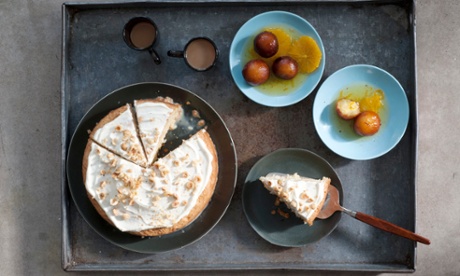
Milk is such a cheap and readily available ingredient that it’s easy to see why it stars in the bakes and cakes of so many countries around the world. Three-milk cake, or torta de tres leches as it is known in Mexico, is a celebration of milk: a lightly whisked sponge that has been soaked in condensed and evaporated milk, double cream, then topped with yet more whipped cream. This complex process belies the cake’s perfect simplicity. The milk mixture soaks into the airy (fat-free) sponge, filling the tiny air pockets with sweet creaminess, and by some miracle the structure of the cake is maintained, resulting in a soft, sweet and toothsome dessert.
I always keep a bag of powdered milk in my storecupboard – just in case I run out of the real deal and the 24‑hour shop next to my flat has to shut for the first time in its history. So, when I discovered that the south Asian treats called gulab jamun are made predominantly with powdered milk and double cream, soaked in rose (gulab) scented syrup, I finally had a real reason to use it. These are the perfect treat to make in advance as they will sit happily in their syrup for a couple of days, getting fatter and stickier as time goes by.
Torta de tres leches
The trio of milk traditionally used in the steeping of this cake makes for a tooth-ticklingly sweet dessert. I have swapped out the traditional double cream for soured cream, the sharp tang of which cuts through the sweetness of the condensed milk just enough to to keep it the right side of sickly. A dash of hazelnut liqueur is an optional extra to add a little something special to the cake. You can swap this for your favourite tipple – amaretto or coffee liqueur would work just as well
Serves 8-10
3 eggs
150g caster sugar
150g plain flour
1 tsp baking powder
For the filling
397g condensed milk
170g evaporated milk
150ml soured cream, divided in two
50ml hazelnut liqueur, such as Frangelico (optional)
A large handful of toasted hazelnuts, roughly chopped
1 Preheat the oven to 180C/350F/gas mark 4. Grease and line a 20cm‑round, springform cake tin. Crack the eggs into a large mixing bowl and add the sugar. Use an electric hand whisk to beat the eggs and sugar until the mixture is pale, creamy and it has roughly trebled in volume. To see if your mixture is ready, switch off your whisk and lift the beaters up. If the mixture that falls from your whisk sits on the surface like a ribbon for about 5 seconds then you’re there.
2 Sift the flour and baking powder into the egg mixture and gently, but efficiently, fold the flour into the mix. Make sure you dig right down to the bottom of the bowl to reach all of the flour. It is important to keep as much air as possible in the mix at this stage. Scrape the cake mixture into the prepared tin and bake for 25-30 minutes, or until the cake has turned golden, risen and a skewer inserted into the centre of it comes out more or less clean.
3 Meanwhile, in another bowl, whisk the condensed milk, evaporated milk, half of the soured cream and the liqueur until smooth. Set aside.
4 Once the cake is cooked, remove from the oven and allow it to cool for a few minutes. Sit the cake tin on a baking tray. Use a toothpick to make small holes all over the surface of the cake, right down to the base. Pour over half of the milk mix and let it soak in. Pour over the remaining milk mix and chill it for at least an hour, to allow the sponge to absorb all of the creamy milk filling.
5 Before you are ready to serve, unmould the cake, leaving the base intact, and place on a serving plate. Spread the remaining soured cream over the top of the cake and sprinkle with toasted hazelnuts. Serve cut into wedges with a strong coffee and an extra shot of liqueur, if you like.
Orange and rose jamun
Traditionally, gulab jamun, those little balls of milk-based goodness, are deep-fried and soaked in rose water syrup and flavoured with cardamom. It’s a combination so floral and intense that it has at times been too demanding for even my sweet tooth. Here, orange zest and essence add a welcome citrus kick to the fried richness.
Makes 12 balls
85g skimmed milk powder
50g plain flour, plus extra for dusting
Zest of 1 large orange
½ tsp orange blossom water
125ml double cream
1 litre sunflower oil, for frying
For the syrup
200g caster sugar
Juice of 1 large orange
2 tsp rose water
Orange slices, to serve (optional)
1 Put the milk powder, flour and orange zest into a large mixing bowl and stir to combine. Gradually stir in the cream and orange blossom water. Once they have been added, use your hands to form the mixture into a firm, slightly sticky dough.
2 Tip the dough on to a lightly floured work surface. Divide the dough into four, then cut each piece into thirds. Roll a piece in the palms of your hands into a walnut-sized ball – the heat from your hands will help to properly combine the ingredients and should ensure that there are no cracks on the surface of the balls. This should be avoided, because it could cause the balls to burst during cooking. Repeat with the rest of the dough.
3 To make the syrup, put the sugar, orange juice, rose water and 200ml cold water into a small pan set over a medium heat. Stir to dissolve the sugar, then increase the heat and simmer for 8 minutes, or until slightly reduced and syrupy. Remove from the heat and allow to cool slightly.
4 Pour the oil into a medium-sized pan and heat the oil to 160C/320F on a sugar thermometer. Carefully lower 2-3 balls into the hot oil. Gently flick the dough balls after a few seconds to prevent them sticking to the bottom of the pan. Fry for 6 minutes, turning every couple of minutes, until a deep golden brown. Remove with a slotted spoon and drain on kitchen paper.
5 Put the warm jamun in a baking dish just big enough to hold them all snugly, pour over the syrup, tilt the dish to coat the balls, then leave to stand and swell with syrup for an hour before serving. Delicious with orange slices and an extra drizzle of cream.
- Ruby will be back in two weeks.