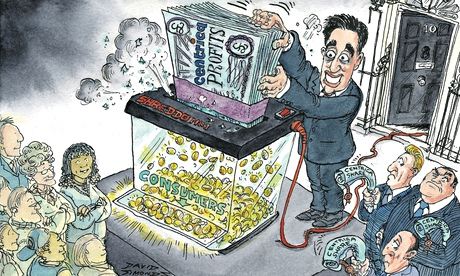
This is what political risk for shareholders in utilities can look like. In the month before the 1992 general election shares in UK utilities fell 9% on the expectation that the Labour party, led by Neil Kinnock, would win. In the event, John Major’s Conservatives were victorious and utility shares jumped almost 20% in a day. Deutsche Bank’s analysts this week recalled that contest and said: “We believe the stakes are similar this year.”
Deutsche’s analysts had run the risks on Centrica, owner of British Gas and the company that probably has most to lose if Ed Miliband gets to Downing Street. The Labour leader has pledged to introduce a price cap on energy, which the party says will cut annual bills by £120 a year on average. In rough terms, that is a 10% price cut.
“We believe Centrica’s shares could be worth at least 20% less under a Labour-led government than a Conservative one,” said Deutsche. Further, under an “aggressive” Labour administration, the downside could be 40%, implying a share price of 150p, compared with 259p today. Back in September 2013, just before Miliband made his original “price freeze” pledge, Centrica shares were trading at 400p.
Alarmist? Possibly not. The Competition and Markets Authority is investigating the retail energy market and will report initial findings in May or June. Given the political noise, it is hard to imagine the CMA concluding that the energy market is working splendidly for consumers.
“We believe it is highly likely that the CMA will find aspects of the sector which have adverse effects on competition and will conclude that profits of some energy retailers have been excessive,” says Deutsche.
If so, a prime minster Miliband would have the perfect platform from which to launch his get-tough replacement for current regulator Ofgem. One way or another, retail prices, and profits, would be dictated, or at least guided, by government.
“We believe that a Labour threat to impose tougher regulation of energy prices is a credible one, and that it would be unwise to assume retailers would make long-run margins much above 3% under such a system, unless a more generous profitability framework became accepted,” concludes Deutsche.
A 3% profit margin, before interest and tax, would be quite a turnaround for British Gas in residential energy. That is roughly what it achieved between 1999 and 2006, but since then the margin has averaged closer to 7%. It would be a shock.
Popular politics makes for terrible economics, say defenders of the current set-up. Miliband has not produced clear evidence of profiteering by energy firms, it is argued; and given the integrated structure of the UK’s energy market, in which suppliers are also generators, Labour is risking an investment strike and power black-outs.
That last is a reasonable worry. Reserve margins, the percentage of untapped supply during peak demand, have plunged in recent years – we’re been lucky to have had two mild winters in a row. But, in a roundabout way, we are also fortunate that energy policy is finally near the top of the political agenda.
The post-privatisation era has descended into a fog of distorted commercial incentives and general mistrust of corporate power. Almost no one builds plant – nuclear, wind or gas – without some form of government guarantee these days. And nobody really knows whether a 3%, 5% or 7% margin is fair at the supply end, or even the appropriate measure. Shouldn’t we be looking at return on capital?
Miliband’s prescription – economic vandalism or overdue reform of a broken market, depending on your point of view – would at least force resolution of the arguments. A dose of certainty on infrastructure investment, and an accepted definition of fair retail prices, is what this market needs. The stakes are high – but so they should be.
Bank of England economist’s deflation speech gets punctured
Bank of England policymakers will be locked in pre-election purdah for the next five weeks to avoid influencing voters. But Mark Carney wasn’t going to pull down the shutters before giving his chief economist, Andy Haldane, a thorough intellectual pasting.
Since Haldane gave a speech arguing that wages – and inflation – may not bounce back as quickly as the rest of the monetary policy committee thinks, one member after another – Carney included – has come out fighting.
Kristin Forbes, David Miles and Bank deputy governor Minouche Shafik all lined up last week to say “deflation, what deflation?”. On Friday Ben Broadbent and Carney himself joined in. With Martin Weale and Ian McCafferty already squarely in the hawkish camp, former Treasury official Jon Cunliffe is the only MPC member not to have distanced himself publicly from Haldane’s view of the world.
Haldane’s no politician. He can’t help thinking – and saying – the unthinkable. And he’s right to at least ask why wage growth has repeatedly failed to bounce back in line with MPC predictions. Other commentators, including ex-MPC member David Blanchflower and Oxford’s Simon Wren-Lewis, are also asking whether the Bank might have to run the economy hotter – by cutting rates to zero and/or restarting quantitative easing – to guard against deflation.
Haldane’s analysis – using the Bank’s own forecasting model – suggested that even if upbeat wage forecasts are right, the optimal path for policy would still involve cutting rates to zero in the short term.
Unlike his predecessor Mervyn King in 2010, Carney has scrupulously avoided commenting on the parties’ tax and spending plans – which in the Tories’ case require two years of spending cuts more severe than anything seen so far. But if Haldane is right, and the economy is more vulnerable than some suggest, another dose of austerity could be the worst possible medicine.
Over-reliant on Chinese tips?
The turnaround at London Taxi Company hasn’t been quite as fast as a cabbie rounding Hyde Park Corner, but the shift from administration to 1,000 new jobs and a brand new plant for the maker of black taxis has taken just three years.
Under its Chinese owner, Geely, which also owns the Volvo brand, LTC has increased sales and hired more staff, and has plans to develop a clean, green electric cab.
All those new jobs can only be great news, but it does pose the question of why LTC’s former owner, Manganese Bronze, couldn’t have raised the investment domestically to pull itself through the dark days of 2012, when it has to recall 400 vehicles because of a steering fault.
Jaguar Land Rover, another British basket case rescued by foreign capital, announced last week that it would double the size of its base, in Whitley, Coventry. Only when the next teetering domestic manufacturer is nurtured through hard times by a white knight from London, instead of Hangzhou, will we be able to say this country’s financial system is really fit for purpose.