
First held in 1907, Milan-San Remo – also known as 'La Primavera' – is one of the oldest races on the cycling calendar, earning its badge as one of the five Monuments, and the first one scheduled in the season.
This year's men's edition marks the 117th to take place, while the women's race – Milan-San Remo Women – is back for the second year running.
The cliché is that it's the easiest race to finish but the hardest to win, and that is borne out by the cycling greats which failed to win the race. The men's race is regularly over 300km once the neutralised zone has been accounted for, and it is a slow burn to an exciting crescendo. Both sprinters and puncheurs have succeeded on the Via Roma in San Remo.
Below, Cycling Weekly has compiled everything you need to know about the race.
Milan-San Remo 2026 route
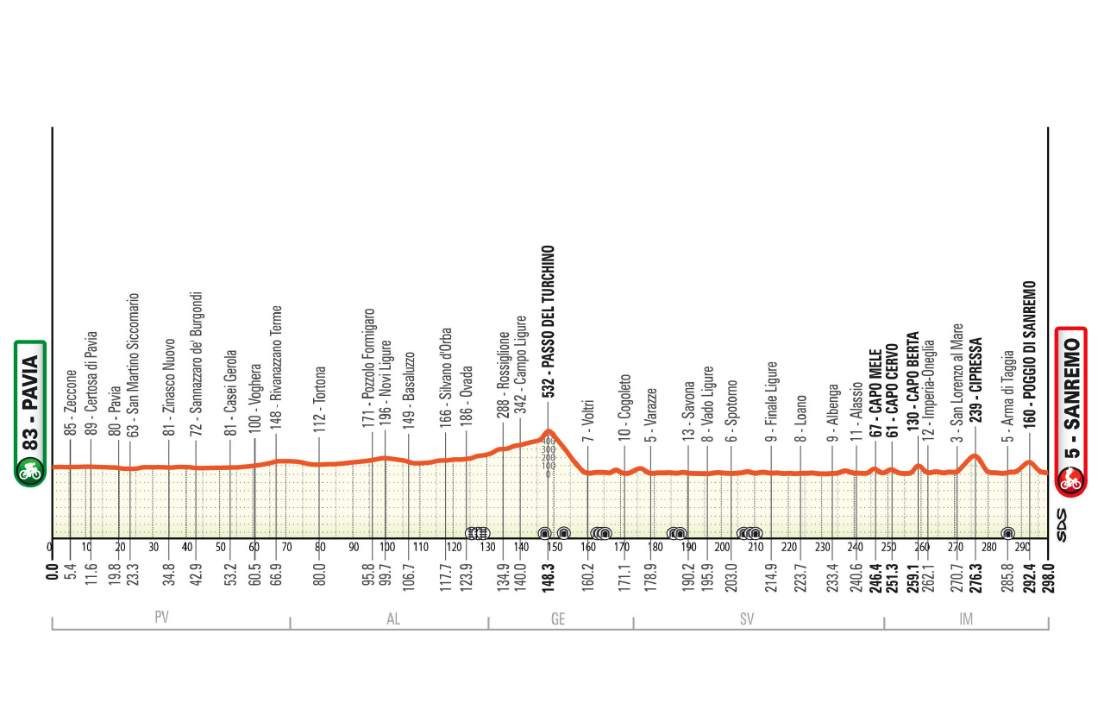
The longest Monument of the season, this year's men's Milan-San Remo takes place on Saturday 21 March and, as ever, is set to feature some of the world's best riders over its huge 298km distance.
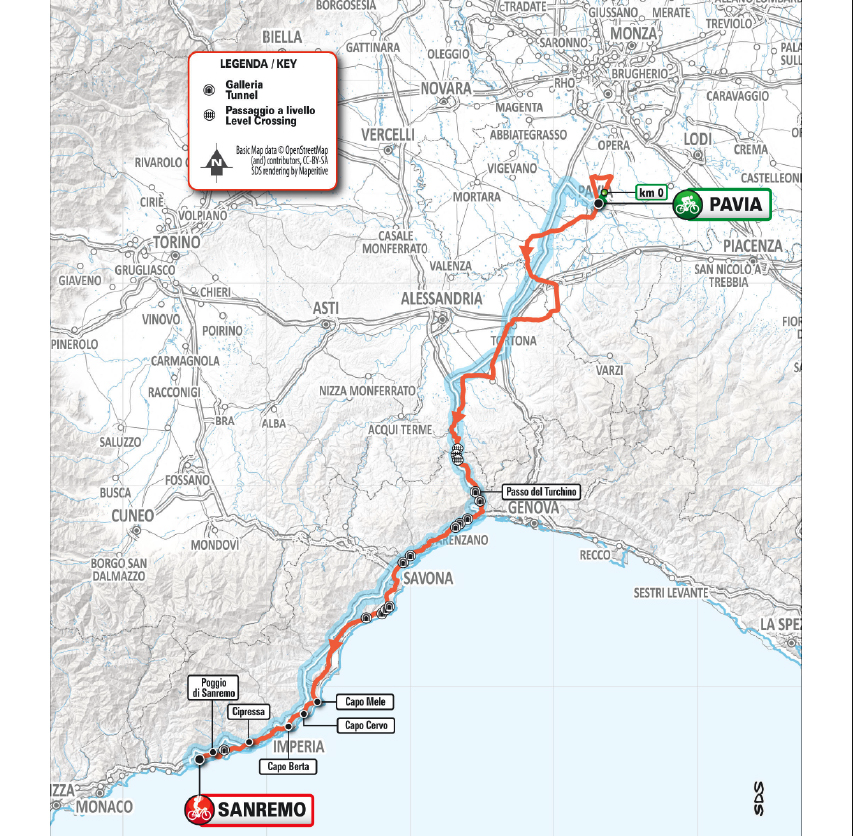
This will be the third consecutive year that the race has started in Pavia, just south of Milan, where the race has started for the vast majority of its 119-year existence.
The last time it began in Milan was 2022, after which the start moved out of the city for logistical reasons. Organiser RCS currently has a deal with Pavia province to start there, although the initial kilometres have changed slightly each year.
This year's race is 5km longer than last year's due to a bit of jinking around in the early stages, resulting in a total 298km by the time the riders reach the finish on San Remo's Via Roma.
The newer roads out of Pavia link up with the original route at Tostano after 80km, and goes on to visit all the climbs that Milan-San Remo fans know and love, including the key appointments of the Cipressa and Poggio.
The riders will first encounter the Passo Turchino at 148km, followed by the three small capi – the Capo Mele, Cervo and Berta – at around the 250km mark as the race approaches its finale. With 22km to go, riders crest the Cipressa (5.6km at 4.1%) and then finally, those who are left tackle the Poggio (3.7km at 3.7%). Often a small gap will go over the top – it then comes down to whether the escapees can cling on to their advantage on the sinuous descent and the flat 2km to the finish, or whether the chasing bunch can bring them back and unleash the sprinters within.
Milan-San Remo route history
Despite being known as the ‘Sprinters' Classic’, the Italian race would not be as prestigious as it is were it a straightforward procession to a bunch sprint, and instead the race is characterised by its torturous length, thrilling conclusion and delicate balancing act between sprinters and attackers.
The introduction of La Manie in 2008 gave the advantage to attacking puncheurs, as a difficult, significantly-positioned climb to gain an advantage over those hoping for a bunch sprint. It contributed to a handful of more selective editions - Fabian Cancellara won from a solo break in 2008 and Simon Gerrans from a group of three in 2010, and in both 2011 and 2013 a group of seven contested the finish, won by Matt Goss and Gerald Ciolek respectively.
When La Manie was dropped in 2014, the organiser's initial intention had been to make the route even harder by replacing it with the Pompeiana in a slot far closer to the finish. But that climb was deemed unsafe due to the possibility of landslides, so since 2014, the race has featured neither climb.
Now, the dynamic of the route has shifted comprehensively back to the sprinters.
After Alexander Kristoff (then Katusha) won the sprint from a sizeable peloton in 2014, the finish was moved back to its traditional finishing straight of Via Roma, and another sprinter was triumphant in the form of John Degenkolb (then Giant-Alpecin) in 2015 and Arnaud Démare (Groupama-FDJ) in 2016.
For the bold and the brave, the Cipressa provides a potential launchpad for an attack at just over 20km from the finish, but for the more realistic, it’s the Poggio.
On the back of around 280km of racing the riders are exhausted upon reaching it, and, peaking at 5.5km from the finish, any rider who goes over the top first with a gap has a chance of zooming down the descent and holding off the sprinters for victory on the Via Roma.
Only two British riders have emerged victorious at the race, with Tom Simpson being the first back in 1964 for Peugeot-BP-Engelbert team. The next came several years later in 2009, when Mark Cavendish (then Team Columbia-High Road) took victory in a bunch sprint. British champion Ben Swift (Ineos Grenadiers) has come close on various occasions.
How to watch Milan-San Remo on TV
Fans in the UK will be able to catch Milan-San Remo 2026 on TNT Sports and its streaming sibling Discovery+. If you're in the USA, you can tune in to HBO Max for all the action, while fans in Canada will find it on FloBikes.
SBS On Demand will be showing the race for free if you're Australia-based, and RAI Sport will be broadcasting it in Italy.
Milan-San Remo: Recent winners
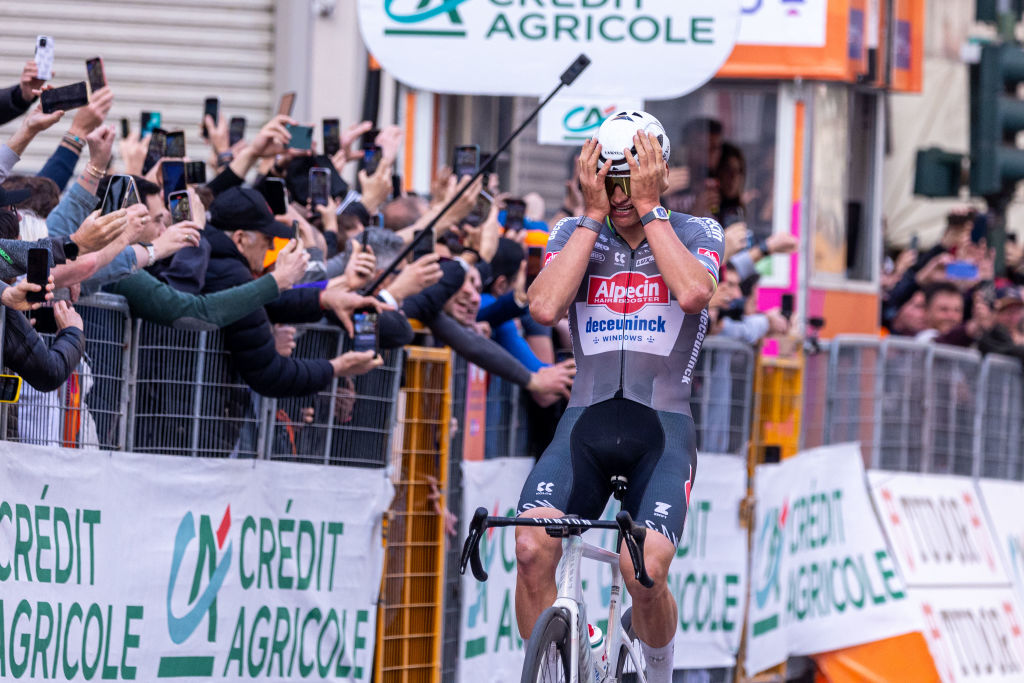
2025: Mathieu van der Poel (Ned) Alpecin-Deceuninck
2024: Jasper Philipsen (Bel) Alpecin-Deceuninck
2023: Mathieu van der Poel (Ned) Alpecin-Deceuninck
2022: Matej Mohorič (Slo) Bahrain Victorious
2021: Jasper Stuyven (Bel) Trek-Segafredo
2020: Wout van Aert (Bel) Jumbo-Visma
2019: Julian Alaphilippe (Fra) Deceuninck–Quick-Step
2018: Vincenzo Nibali (Ita) Bahrain-Merida
2017: Michal Kwiatkowski (Pol) Team Sky
2016: Arnaud Démare (Fra) FDJ
2015: John Degenkolb (Ger) Giant-Alpecin
2014: Alexander Kristoff (Nor) Katusha
2013: Gerald Ciolek (Ger) MTN-Qhubeka
2012: Simon Gerrans (Aus) GreenEdge
2011: Matt Goss (Aus) HTC-Highroad
2010: Oscar Freire (Spa) Rabobank
2009: Mark Cavendish (GBr) Columbia-Highroad
2008: Fabian Cancellara (Sui) CSC
2007: Oscar Freire (Spa) Rabobank