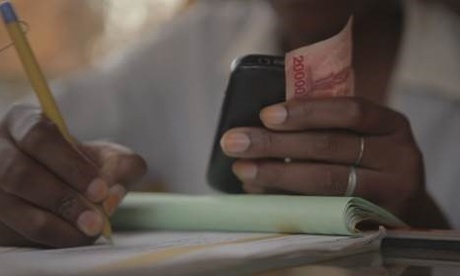
According to the World Bank, one in seven people worldwide are migrant workers (PDF) and many regularly send money back to their home countries. It’s a huge economy, and it’s growing: in 2014, the World Bank valued the global remittance economy at $435bn, an increase of 5% over 2013. Much of this growth has been spurred by remittances to Asia and Latin America: Nepal receives close to 30% of its gross domestic product through remittances – more than double the 12% in 2003.
Visa’s head of emerging product solutions for Asia Pacific, Vikram Modi, saw this growth when developing the strategy and technology for Visa’s P2P (person to person) payments initiative. “We’ve seen remittance volumes throughout the industry increasing at a 5%-10% growth every year and expect continued growth on the horizon,” he says.
Growth factors
Modi and his team see numerous drivers at play. A major factor, he says, is improved collection of data: many emerging economies are simply getting better at tracking and reporting money transfers. “Governments have recognized that remittance flows are more resilient and stable than other foreign exchange flows, particularly during recessions when families back home need more money,” Modi says.
Increasing globalization is another factor: more countries are opening up – and more of their citizens are becoming aspirational. In the last few years, more citizens from Southeast Asian countries like Burma and Cambodia have emigrated and joined the global workforce. Also increasing: the number of nations to which these workers travel. “Whereas before corridors were very clearly defined, now we see wider distribution – for instance, Filipino overseas workers are based in dozens of countries, not just Hong Kong and Singapore,” Modi says.
International migrant workers are only part of the remittance market; many workers are also migrating – and sending money – within their home countries. Lead World Bank economist Leora Klapper says that although the volumes for international remittances are larger, a greater percentage of adults send and receive domestic ones, often from cities to smaller villages. In sub-Saharan Africa, for example, more than half of adults send or receive money domestically, while only 10% receive international remittances. In East Asia and the Pacific, 28% of adults send or receive domestic money transfers, as do 18% in South Asia.
Remittances could have a major effect on economic structures: in Senegal, Cameroon, Democratic Republic of Congo and Republic of Congo, the World Bank reports, shifting domestic payments from over-the-counter money transfer operators to bank accounts could double account ownership.
“The domestic remittances market presents huge opportunities for groups looking to expand financial inclusion among underserved communities. In the developing world, about 270 million adults without an account send or receive domestic remittances in cash only – including 80 million in sub-Saharan Africa alone,” Klapper says. She adds that domestic transfers exemplify how mobile money accounts are reshaping sub-Saharan Africa’s financial inclusion landscape. About 9% of adults there report using a cellphone for these payments – well beyond the developing world average of 2%.
Hard-to-breach barriers
In spite of remittances’ growth, several barriers to workers using these services remain, as well as to the companies serving them. From the user’s perspective, cost remains a problem. In spite of industrywide efforts, fees of up to 29% are still being charged between some countries. The Bill and Melinda Gates Foundation reported that in 2012, Botswanian workers in South Africa paid an average fee of 22.7% to send their money home. Filipino workers sending home money from Japan paid $150m in fees on $1.14bn in remittances.
But even when companies offer more convenient and less costly alternatives for money transfers, they often struggle to break into the market. “When you land in a strange country and are told (by family and friends) this is the best channel, you stick with it,” Modi says.
Another problem is how banks and money transfer operators view migrant workers. When people move from an emerging economy to a developed one, the banking system in the developed economy views them as being at the bottom of the pyramid, and give them limited access to banking channels. “Because these workers don’t resemble typical bank customers in the developed market, the financial system wrongly assumes their families back home are also excluded from the financial mainstream, and therefore beyond the reach of electronic transfers,” Modi says.
In fact, his team’s research shows the relatives of these workers are not at the bottom of the pyramid. “These families aspire to own the next electrical item, buy a car, a house and support their kids becoming doctors and engineers. We aren’t talking about subsistence needs like food, water and medicine,” he says. “These are educated workers nearing middle class lifestyles; they speak English, own passports and are ambitious enough to live abroad. Filipino migrant workers exemplify this: upon returning home, their families view them as national heroes.”
This disconnect leads to migrant workers having to rely on cash-based services offered by money transfer operators juggling high competition with high operating expenses like branch offices’ rent, marketing and salaries for staff. That’s why Visa – like others in the industry – views mobile phones and the internet as attractive tools for dramatically reducing costs of transfers.
Users benefit from a mobile model
That many migrant workers are already comfortable with new technology helps. This community uses smartphones, Skype and other social media to connect with family back home, making them increasingly comfortable with using technology for financial transfers as well. “The time is right for that transition,” Modi says.
He describes the typical migrant worker’s experience with sending funds home. On a weekend, the worker must travel to an agent location, stand in line, fill out forms, count out cash, collect a receipt and finally inform recipients that the money is on its way. Users accept charges of $10 or more for the transaction because the process appears complicated, high-tech and infrastructure-heavy.
By comparison, when workers use mobile phones, the effort and overhead of sending money diminishes and customers’ view of a reasonable service fee changes. With mobile transfers, the money goes directly in a receiver’s bank account – with minimal associated costs.
A Good Enabler
Several bright spots exist. Modi is hopeful for the 20% of so-called unbanked adults – just over 400 million people – who receive wages or government transfers in cash. Emerging economies are investing in expanding the reach of banks, and banks are issuing tens of millions of new debit cards. On the sending side, some countries, notably in the Middle East and Southeast Asia, have begun using prepaid cards as a payroll tool for foreign workers – and all this will make mobile remittances easier, Modi says.
Additionally, Visa’s services and products can make such remittances easier. Visa Direct allows each Visa card issued to receive credit into its associated account. Remitters can send money simply by entering the recipient’s card number. This method costs less than cash-based money transfer systems and is quick. Visa has updated the system for real-time capability and to work with card numbers, social or email identification numbers, and mobile numbers. Hundreds of millions of Visa cards can already receive money this way, and other card networks are following suit. “This growth is good for consumers and the industry, helping grow the ecosystem for financial inclusion,” Modi says.
Visa Direct operates through more than 100 financial institutions in more than 20 countries. “We are discussing with banks to make our cards work through mobile channels, working with banks and new players to distribute Visa cards more widely and cost-effectively. This is one of the big focus areas in emerging markets,” Modi says.
And more companies are working to make remittances cheaper. London-based startup Transferwise, now operating in 22 currencies, pairs up users who want to buy a particular currency with those wanting to sell it, a move that saves on expensive foreign exchange fees. Another program, Peer Transfer, serves millions of students studying in the US by allowing parents and other benefactors to pay international education fees online.
The World Bank predicts that remittances to developing countries (PDF) will grow to an annual average of 8.4% over the next three years, raising flows to $516bn in 2016. Klapper sees massive financial inclusion gains within reach. The key is making transactions cheap: a major reason people use commercial services versus bank accounts is to avoid high wire transfer fees on modest sums, she says.
Modi says he’s confident that migrant workers’ increasing comfort with digital technology and their growing access to debit and prepaid cards will help boost remittance growth. “The shift towards mobile remittances is gaining traction. We have a global network which is electronic, low-cost, cross-border and multicurrency,” he says. “All you would wish for in terms of an efficient, trustworthy and global remittance infrastructure is in place.”
Content on this page is brought to you by Visa, sponsor of the Financial inclusion hub.