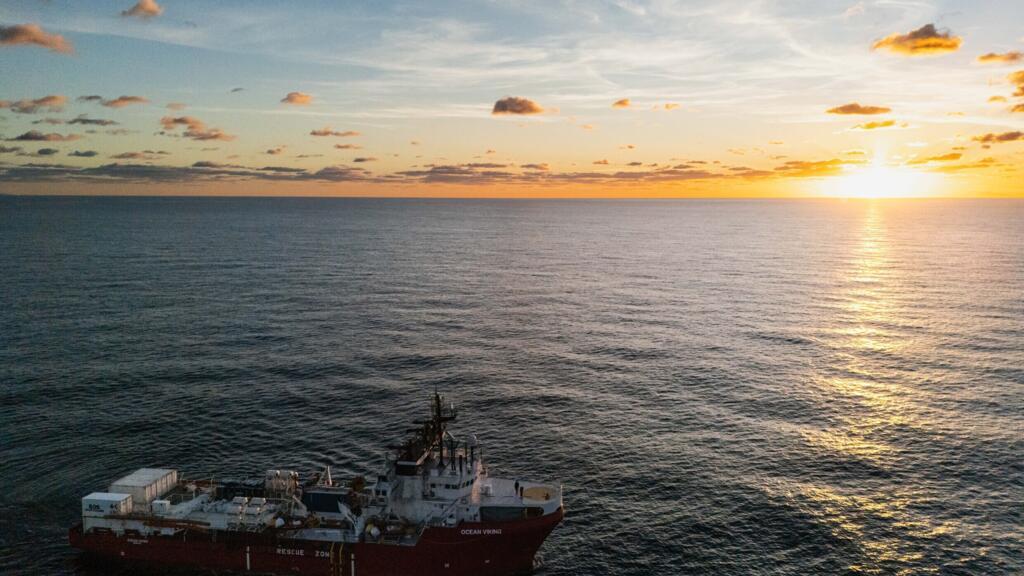
After months out of service following an armed attack in international waters, SOS Méditerranée’s migrant rescue vessel, the Ocean Viking, has resumed operations in the central Mediterranean. In an interview with RFI, Claire Juchat, the NGO’s operations manager, described returning to sea as a relief but said that tensions with the Libyan coast guard persist.
“It’s a relief because we had to stop operations for three months after the attack of the EU-funded Libyan Coast Guard against the Ocean Viking in August” Claire Juchat said. “People are still leaving Libyan shores because they have no other choice.”
A hostile operating zone
The Ocean Viking resumed rescue operations in late December, following the attack in late August 2025. According to the NGO, the vessel was fired upon with 100 bullets for around 20 minutes while carrying survivors and searching for another boat in distress. No one was injured, but the ship was damaged and remained docked for several months. She compared the operating environment to "a war zone".
Italy confines Ocean Viking migrant rescue ship for 20 days
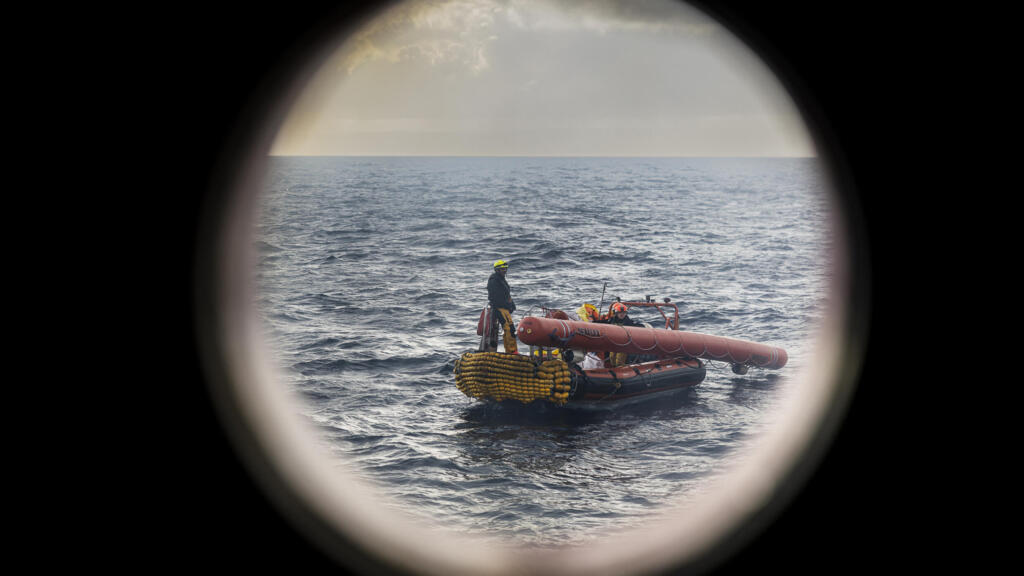
Despite the risks, Juchat says returning to sea was necessary. “We rescued 120 people in the past few weeks,” she said. “Of course, it’s a bit scary to be back at sea because we know that the Libyan Coast Guard are still very active.”
The Libyan coast guard, which is organisationally part of the Libyan navy, acts as a proxy force for the European Union to prevent migrants from reaching Europe’s borders.
The EU has financed Libya's migration policy through the Emergency Trust Fund for Africa, which provided €465 million between 2015 and 2021, and through the NDICI-Global Europe instrument, which allocates €65 million for the 2021-2027 period. It remains unclear how much of that funding reaches the Libyan coast guard.
The European Center for Constitutional and Human Rights says evidence indicates the vessel that attacked the Ocean Viking was handed over by Italy through an EU-funded programme. Following the incident, SOS Méditerranée filed a complaint with French prosecutors in Marseille, southern France.
The EU's response
Critics argue that the EU's policy enables abuse. Libya is not considered a “place of safety” for disembarkation by the United Nations, due to a lack of security and human rights violations.
SOS Méditerranée and 42 other humanitarian and civil society groups have previously urged the European Commission to suspend cooperation with Libya on search and rescue, accusing the EU and Italy of funding of legitimising a “culture of impunity for violence.”
Ocean Viking migrant rescue ship back in the water after 10-day stoppage
The European Commission has said it would maintain its approach. “This is what we have been doing and we keep on doing at different level, and this is our policy for now,” Commission spokesperson Guillaume Mercier responded last year to the concerned parties.
Juchat also criticized Italian policies that require rescue ships to disembark rescued people in distant northern ports.
“Sometimes up to Genova or Ravenna,” Juchat said, noting how this removes rescue vessels from the central Mediterranean for days and increases fuel costs, further limiting the NGO's ability to operate.