EL PASO, Texas _ Darkness had fallen, but few in this cramped outdoor detention camp would sleep.
The desert is cold at night, and most of the migrants huddled here had nothing but thin blankets made of insulated plastic to protect them from gusty winds. Rows of families, including parents clutching small children and babies, lay directly on the dirt floor. Some had been living like this, exposed to the elements, for four days.
U.S. immigration officials say this hastily erected holding pen under a bridge in El Paso is an extreme but necessary response to a recent surge of Central American families that have crossed into the U.S. illegally in recent months and asked immigration officials for asylum.
At a news conference in El Paso this week, U.S. Customs and Border Patrol commissioner Kevin McAleenan said an uptick in such arrivals has pushed the overall number of migrants detained at the U.S. border to numbers not seen in more than a decade, with an especially large increase here on the far western edge of Texas. His agency, McAleenan said, had hit a "breaking point" and has run out of space in which to process asylum seekers.
The scores of families shivering each night under the bridge in El Paso highlights a seismic shift in the type of migrants seeking to reach the U.S. in recent years _ as well as the failures of U.S. policy to adapt to those changes.
A decade ago, the vast majority of people apprehended at the border were single adult men who had been caught trying to sneak into the U.S. But in recent weeks, nearly two-thirds of those detained by U.S. agents have been families who turned themselves in to officials and asked for asylum.
An extension of the border wall, which President Donald Trump has repeatedly called for in response to what he terms an immigration "crisis," won't do much to stop these families from exercising their right to seek asylum. A winding river separates much of the border where Trump wants to construct new portions of the wall, and a barrier would need to be built several feet north of the actual border line up on a sturdy levee.
Each day here, large groups of asylum seekers have been walking across the shallow river and then waiting on the narrow strip of U.S. territory north of the river and south of a newly constructed section of the wall. Sooner or later, khaki-clad Border Patrol agents pull up in vans and pick them up.
U.S. officials and migration experts say the country's border infrastructure simply isn't equipped to deal with this new wave of border crossers.
After all, the Border Patrol's mission is to detect people seeking to illegally enter the United States, not house and process thousands of asylum seekers each day.
Similarly, the country's overburdened immigration judges aren't equipped to quickly try the hundreds of thousands of asylum cases the U.S. expects to see this year. There are currently more than 855,000 immigration cases awaiting adjudication, according to Syracuse University's Transactional Records Access Clearinghouse, meaning asylum applicants wait on average more than 700 days to see a judge.
Since President Trump reversed his controversial policy of separating parents and children at the border last year, families that ask for asylum have been processed by immigration officials and then released into the U.S. with an asylum court date years in the future.
The recent quick release of families who have asked for asylum appears to be fueling a mass exodus from Central America, with an estimated 1 percent of the entire population of Honduras and Guatemala on track to be apprehended at the border this fiscal year, said Adam Isacson, a researcher at the think tank Washington Office on Latin America.
"There is a message that if you think you need to leave, now is the time," he said.
What is needed, Isacson said, is not more border fencing but more aid to Central American countries to address the root causes of migration, and a mass hiring of new immigration judges to cut case backlogs.
The U.S. has been seeing an uptick of asylum-seeking families and unaccompanied children over the last five years, he said, and U.S. policy must adjust to that. "This is the new normal," he said.
Trump has repeatedly criticized the recent crush of asylum seekers, painting them as economic migrants who use the asylum process as a back door into the U.S. At a rally in Michigan on Thursday, the president mocked those who request asylum, calling their efforts to win protection in the U.S. "a big fat con job."
Migrant advocates insist that many of those crossing have legitimate fears of returning to their home countries. They say the outdoor holding center under the El Paso bridge is evidence that the U.S. is not treating migrants humanely.
"This is absolutely an unconscionable way to treat people," said Taylor Levy, legal coordinator at Annunciation House, a migrant shelter in El Paso. "You don't let children sleep under underpasses."
The story of one migrant father who crossed the border into El Paso on March 21 with his 9-year-old son and asked for asylum underscores the complexity of the issue.
Elmer, a 32-year-old from Guatemala who gave only his first name because he said he fears persecution back home and from U.S. immigration authorities, promised to pay a smuggling network $6,000 to ferry him to the U.S. border.
The smuggler told him to bring his son on the journey, because while single adults who seek asylum are typically detained for months under U.S. policy, families requesting asylum are quickly released.
Elmer said eight of his relatives and 10 of his son's grade-school classmates had left in a similar fashion in recent months, thanks to rising crime in the city where they live and the falling price of coffee beans, which have hurt farmers like Elmer. In Guatemala, he earned less than $10 a day.
The pair's long trek north with a series of smugglers was long and often frightening, Elmer said. As they crossed Mexico packed on hot buses, he worried he and his son might be kidnapped by criminal groups known to prey on migrants.
But the worst moment came once they crossed into the U.S. and were corralled into the outdoor holding pen in El Paso, which was surrounded by razor wire. He and his son slept on the dirt for four days. Sick migrants coughed and babies wailed all night. Adults were fed two sandwiches each day.
"We were hungry and cold," he said. "Those were some of the hardest days of my life."
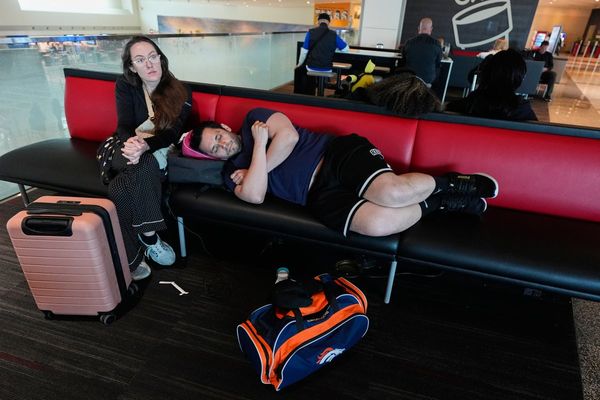
The pair were finally processed for asylum and released to a local migrant shelter two days ago. On Thursday, they sat in the El Paso Greyhound station, waiting to board the first of several buses that would take them to Alabama, where two of Elmer's sisters live.
The station was crowded with dozens of migrants who had just been released from federal custody, some of whom, like Elmer, wore bulky ankle monitors over their pants.
As soon as they reached Alabama, Elmer planned to phone his wife, who was home in Guatemala with their other son.
First, he said, he would tell her he was safe. Then, he said, he would urge her not to make the long journey to join him.
The nights outside under the bridge in El Paso had been too difficult, he said. "I don't want them to run that risk."