Adapting Salman Rushdie's epic novel for the stage is like trying to lasso a leviathan. Inevitably it thrashes about and ultimately slips from the grasp of the theatrical troika of Rushdie himself, Simon Reade and Tim Supple; yet there is a wild recklessness about the project that kept me engaged for much, if not all, of three and a quarter hours.
The problems are obvious. Rushdie's novel is built around the conceit that its narrating hero, Saleem Sinai, born on the stroke of independence in 1947, is not just handcuffed to history: in a sense he is history, in that he becomes a symbol of the whole seething sub-continent. Swapped at birth, he is raised by rich Muslims and endowed with the artist's gift for storytelling; his poor counterpart Shiva, on the other hand, grows up to become the man of action, riot and war.
It is a brilliant literary device which enables Rushdie to encompass Indian history from 1915, with the meeting of Saleem's grandparents, to the 1980s and to present an enfolding series of Arabian Nights stories. But drama does not have the novel's expansive sense of time. And, although the adaptation is skilfully reinforced by newsreel film reminding us of the march of history, there comes a point when exhaustion sets in. Characters and incidents are subsumed by this restless Indian kaleidoscope. And a crucial second-half sequence, dealing with the war in East Pakistan and showing Saleem leading a group of men into a phantasmagoric jungle, loses much of its visionary quality.
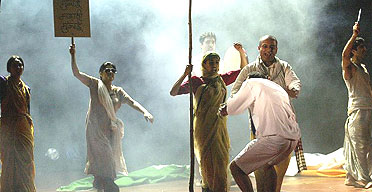
It would need something on the scale of the RSC's Nicholas Nickleby to do full justice to Rushdie's original; and even in the book Saleem asks whether the urge to encapsulate the whole of reality is an Indian disease. Yet, for all my caveats, this version does manage to capture something of the novel's narrative abundance. Early on we see Saleem's doctor-grandfather examining his modest future wife through a perforated sheet from which a nipple hilariously protrudes. And you get a sense of the horror of the 1919 Amritsar massacre as Brigadier Dyer orders his troops to open fire, with a cry of "We have done a jolly good thing".
It is an evening of memorable moments in which huge narrative gallons are squeezed into a pint pot. It is also held together by Supple's fluid production; Melly Still's design, which projects film and video on to screens; and, above all, by Zubin Varla's performance as Saleem. He is simultaneously narrator, chameleon-like changeling, historic symbol and ruined victim of the Indira Gandhi years. He dominates the stage and a production which gives you something of the novel's aromatic flavour.
· Until February 23. Box office: 020-7638 8891.