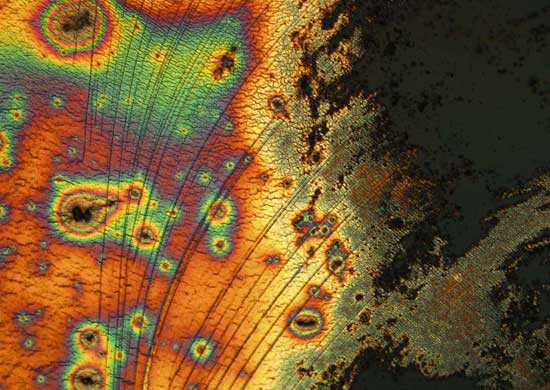
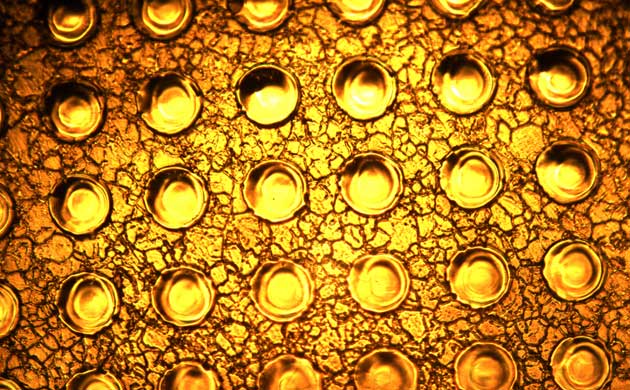
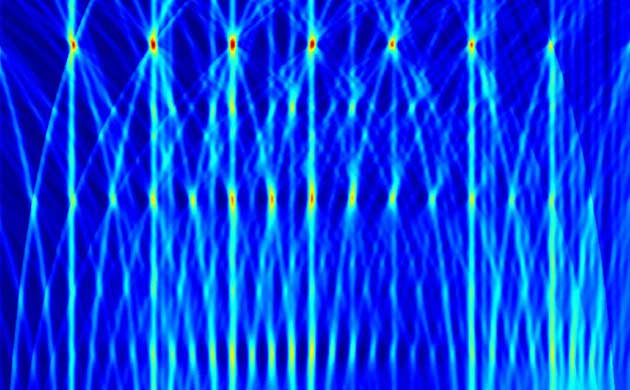
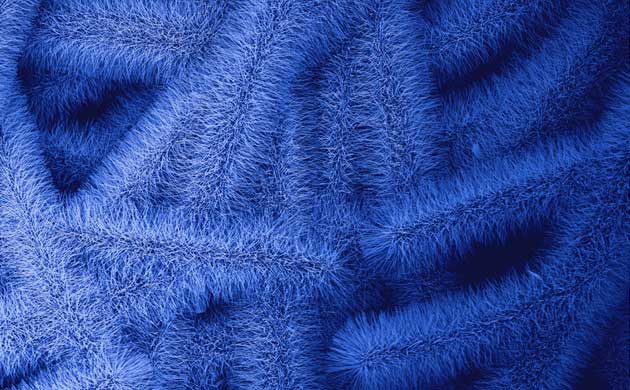
"Moth" (Third Prize) A thin, elastic metal film made of PDMS (polydimethylsiloxane) and gold, used to make stretchable electronicsPhotograph: Ingrid Graz/University of Cambridge"Laser-Drilled Micro-Sized Hole Array" Holes drilled in stainless steel using a pulsed fibre laser firing 500,000 pulses per second. It took 0.1 milliseconds (50 pulses) to drill each holePhotograph: Kun Li/University of Cambridge"First Bar of an Aria" Computer-generated analysis of the tempo of the first two bars of the aria from the Goldberg Variations by J. S. Bach. The x axis corresponds to time and the y axis to tempo. Computer analysis of musical tempo is a first step in developing "machine listening"Photograph: Ian Howard/University of Cambridge
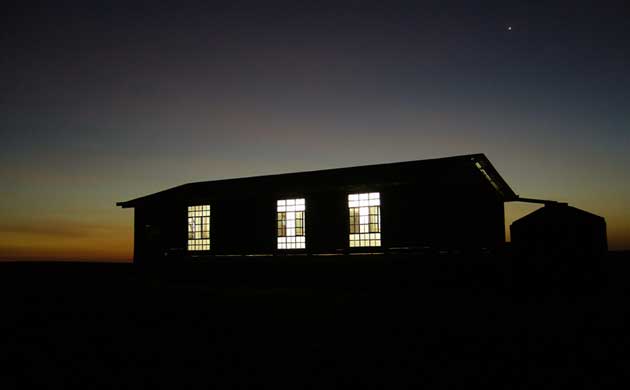
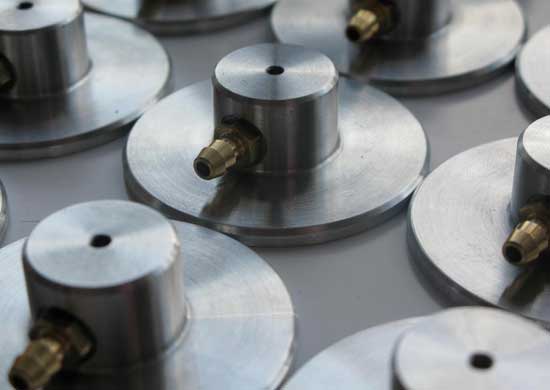
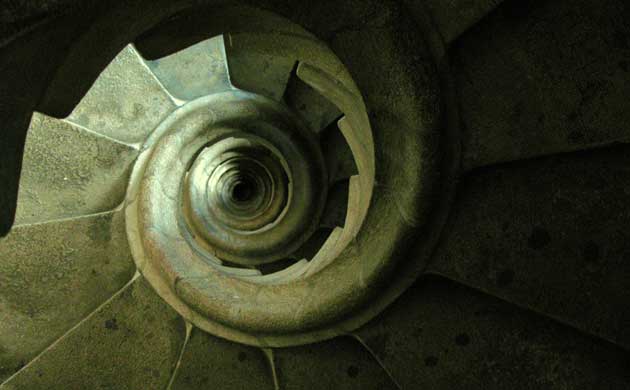
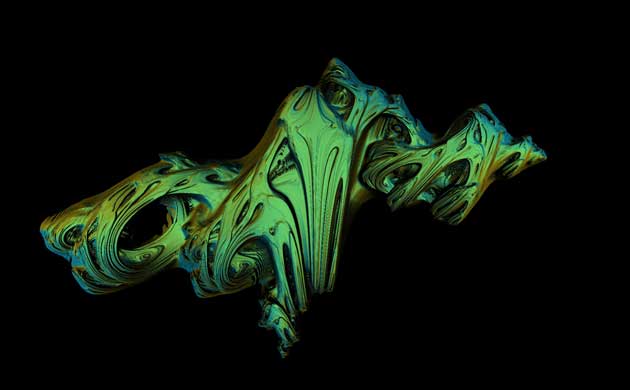
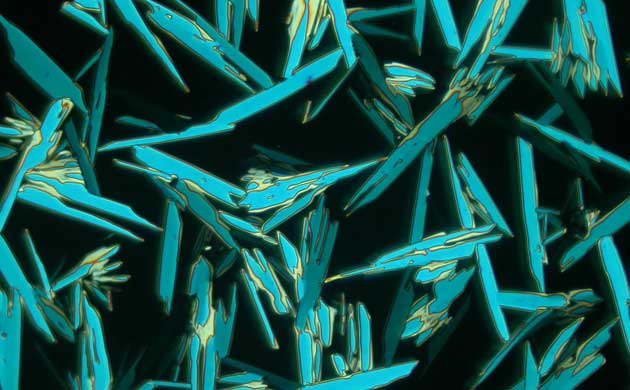
"First Light" (Second Prize) Photographer Sam Cocks writes: "15th March 2007. Taken at sunset, this unenhanced photograph captures the first night of power for the secluded Masai village of Essilanke. The village school provided the site for the first trial of a project that I spent three months working on in Kenya: developing a small-scale wind turbine capable of providing a practical solution for electrifying remote regions" Photograph: Sam Cocks/University of Cambridge"Crystal Tinsel" Scanning electron micrograph of zinc oxide nanowires growing on carbon fibresPhotograph: Sharvari Dalal/University of Cambridge"Air Pucks" High-pressure air is blown through the brass connector and comes out through a hole in the base to create a low-friction air bearing. These pucks were used in "air sleds" for research into how the brain controls arm movements. The sled supports the weight of a subject's arm on a cushion of air during the experiment and constrains its movements within a planePhotograph: Ian Howard/University of Cambridge"Sagrada Familia" A seashell-like stairwell at Gaudi's unfinished cathedral in Barcelona. Photographer Brendan Baker writes: "The stairs are a glimpse at how natural forms can be used as design inspiration, a strong underlying theme of recent biomimetic approaches to materials and product design." (Biomimetics is the application of biological systems to engineering design)Photograph: Brendan Baker/University of Cambridge"The Surface of a Hyper-Complex Escape-Time Fractal" Engineers often exploit a mathematical trick for combining two or more "regular numbers" into one "complex number", allowing them to carry twice the information inside their equations. These simple equations can generate astonishingly detailed fractals. This is a three-dimensional "slice" through the four-dimensional surface of one such fractalPhotograph: Rich Wareham/University of Cambridge"Blue Spikes" (First Prize) Liquid crystals, described by photographer Sonja Findeisen-Tandel as "neither crystalline nor liquid but something in between". Photograph: University of Cambridge
Sign up to read this article
Read news from 100’s of titles, curated specifically for you.