Microplastics are found everywhere, in everything from clothes to cosmetics. Although largely invisible to the average consumer, these tiny pieces of plastic pose an outsized cause for concern when they flow from households into rivers and the sea. As scientists increasingly sound the alarm on plastic's detrimental impact on delicate ecosystems, the race is on for governments and businesses to develop and mass-produce alternatives.
Microplastics are tiny pieces of plastic that measure 5 mm or less. Primary microplastics are used in cosmetics and industrial abrasives, while secondary microplastics are those that result when items such as plastic bags and bottles are broken down by ocean waves or ultraviolet rays. According to the Economy, Trade and Industry Ministry, about 190,000 tons of primary microplastics were sold in Japan in 2016, which is equivalent to 2% of the amount of plastic waste generated per year.
▪ Absorbed by plankton, fish
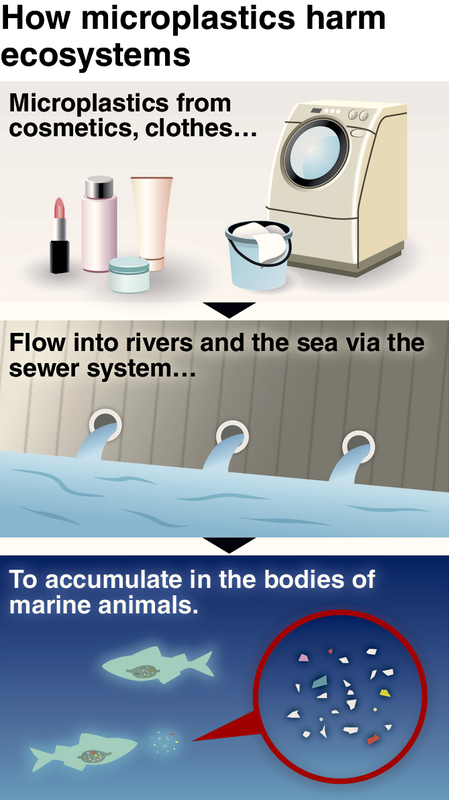
Cosmetics such as lipstick and mascara often use microplastics as small as 0.001 to 0.1 millimeter to create a glossy look. Microplastics are also used to make polyester and other clothing material.
When people rinse off their makeup or do a load of laundry, microplastics escape into the sewers and empty out into rivers or the sea.
So far, research has not found microplastics to be harmful to human health, but there are concerns about their impact on ecosystems. Readily absorbed by the sea, microplastics also accumulate in the bodies of organisms such as plankton and fish.
Over the last few years, there has been a growing movement in both Japan and overseas to reduce the use of microplastics.
▪ Banned in face wash, toothpaste
In 2019, the Japan Cosmetic Industry Association decided to ban the use of a type of microplastic called "scrubs," an abrasive powder that can be an ingredient in exfoliating facial cleansers and toothpaste. The association's members no longer use scrub components.
In the clothing industry, major companies such as Adidas AG and H&M Group are shifting to alternative materials such as natural, plant-based textile fibers.
However, it is proving difficult to replace microplastics in cosmetics. A midsize cosmetic maker in the Kanto region uses microplastics in 11 items to create a glossy look or make them easier to apply. This group of products includes lipstick, mascara, foundation and eyeshadow.
"We can't find affordable alternatives," a company official said.
▪ Pricey biodegradable wood fibers
Some development efforts are being buoyed by government subsidies.
Osaka-based packaging materials manufacturer Rengo Co. has developed a technology to process wood fiber cellulose into tiny beads about one-tenth the thickness of a hair.
Cellulose decomposes in one to two weeks in the soil and a month in the ocean, which makes it less of an environmental risk. The material could be applied in cosmetics, such as foundations and lipsticks, though it remains more expensive than plastic.
"We're trying to find the cheapest possible manufacturing method," a project leader said.
Tokyo-based chemical manufacturer Daicel Corp. has succeeded in processing cellulose acetate, which is used in television LCD panels, into a raw material that can be used to make sunscreen and foundation.
The product is scheduled to hit the market this year, and the company said it has received inquiries from cosmetics companies in Europe, the United States and Japan.
▪ EU to ban microplastics in cosmetics, other products
Efforts to regulate the use of microplastics have been making headway in Japan and overseas.
The European Union is discussing banning the use of microplastics in cosmetics and other products.
In Japan, the revised law on promoting the treatment of articles that drift ashore came into effect in 2018, which calls on businesses to refrain from using microplastics in their products, though it only requires them to make an effort toward that end and carries no penalties.
The Environment Ministry has been subsidizing the development of alternative materials since fiscal 2019, and will start subsidizing projects with the aim of creating microplastic-free products this fiscal year.
The ministry is also investigating cosmetic makers and other manufacturers for their use of scrubs in about 110 items, such as facial cleansers and body washes.
"It is important not to generate microplastics that can create marine pollution. We want to encourage companies and consumers to switch to alternatives and reduce outflow," said a ministry official in charge of the matter.
However, some in the cosmetics industry believe the worries are overblown. One insider said, "Overall, it's a tiny amount. I sometimes wonder why [the concern]?"
Kyushu University Prof. Atsuhiko Isobe, an expert on microplastics, said: "Once microplastics are made, they will eventually find their way into the environment. The government needs to act, such as by first subsidizing small and midsized manufacturers that have switched over to substitutes, then by banning microplastics altogether in the future."
Read more from The Japan News at https://japannews.yomiuri.co.jp/