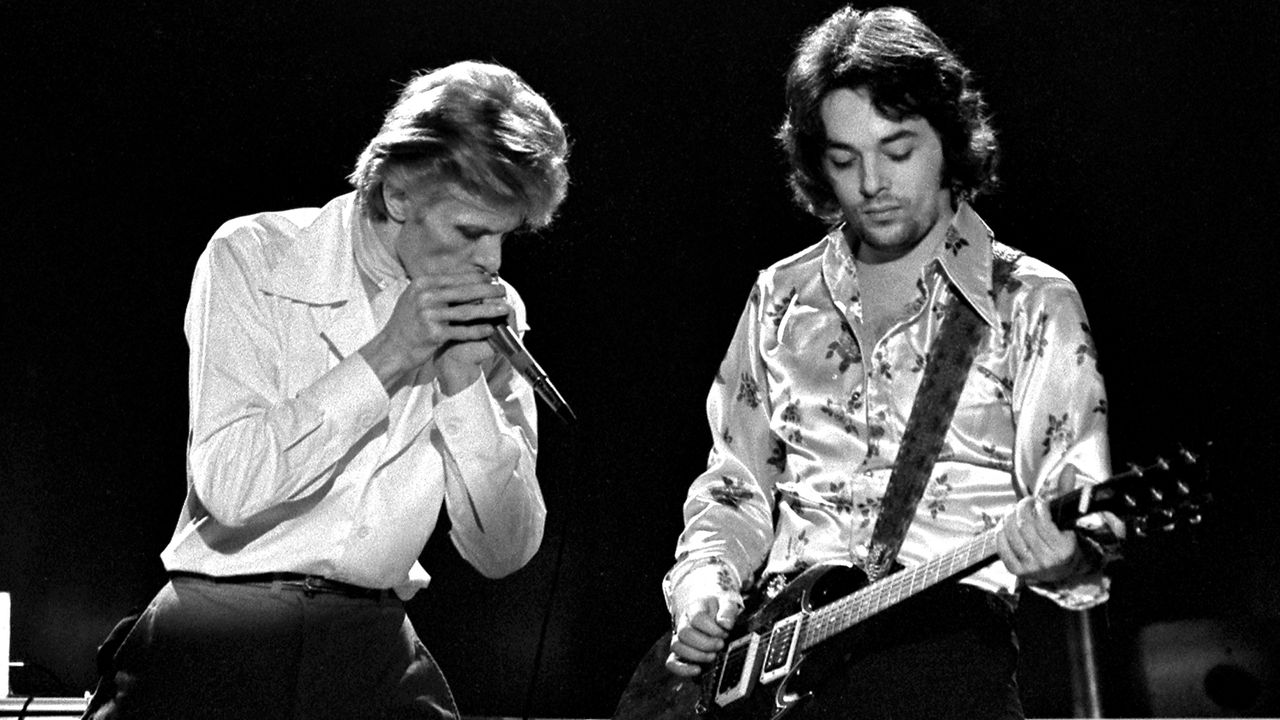
Earl Slick has looked back on his experience of replacing Mick Ronson in David Bowie’s band, admitting he was apprehensive about stepping in for the underrated guitar hero.
In the mid-1970s, after Ronson left the Bowie camp, Slick was appointed his replacement. It was a daunting task, to say the least, with Slick stepping into one of the most coveted session spots in popular music.
Not only did he have to hold his own against a bona fide musical visionary in the form of Bowie himself, he also had to follow in the footsteps of an immensely skillful and popular outgoing guitarist, who was loved both by fans and the media.
In a recent interview with NME, Slick reflected on the momentous milestone in his career, and recalled feeling rather nervous about the task at hand.
“I wasn’t nervous about anything other than the fact I was replacing one hell of a guitar player, who I was a big fan of,” Slick admits.
“Mick was a star, man. It felt like replacing Keith [Richards] or something. I shat my pants. I thought everyone was going to hate me, the crowd was going to try to kill me and the press would murder me.
“The next day we got the reviews and the reaction for the fans. I was like, ‘Phew! I did it!’ After the first gig I was fine, but that’s where the stress came from.”
There was also the question of just how close Slick should emulate his predecessor. The guitarist wanted to do things his own way. Bowie agreed.
“One thing I’m really lousy at is that I cannot copy other people note-for-note, so I don’t really do a lot of sessions,” he continues. “I didn’t want him to want me to be Mick.
“I said, ‘How do you want me to approach this?’ He said, ‘I hired you because I like what you do. Do what you do’. Obviously, there are key things that Mick did that I couldn’t do any better so I did those, but the rest of it I just did like me.”
Slick’s fear was understandably, but ultimately unfounded. Indeed, he quickly fell into step alongside Bowie and the rest of the creative camp, contributing to several worldwide tours with Bowie and working on albums such as Young Americans and Station to Station.
Earlier this year, Slick sat down with Guitar World to discuss how he assembled his fellow Bowie band alumni for KillerStar – which Bower gave his blessing to before he passed away.
And, in related Ronson news, Gibson recently honored the quietly spoken rock ‘n’ roll guitar hero with a limited edition recreation of his Bowie-era Les Paul.