LANSING, Mich. — The board in charge of certifying Michigan's election results will hold a pivotal meeting Monday when its four members will decide whether to cement President-elect Joe Biden's 154,000-vote victory in the state or boost President Donald Trump's push to question it.
At that crossroads, the Board of State Canvassers will convene at 1 p.m. EST Monday — 20 days after the Nov. 3 election.
The canvassers, two Democrats and two Republicans, have been presented with the certified results from all 83 Michigan counties to review, and staff from the state Bureau of Elections has recommended that they certify the results and make them official.
Monday's 1 p.m. meeting will be conducted remotely with public access due to the pandemic. The Detroit News will carry live video of the meeting on this page. It will also be available through the secretary of state's Facebook page. Members of the public wishing to ask questions or speak can sign up to do so ahead of the meeting through the secretary of state's website.
Under Michigan law, the Board of State Canvassers must begin the state certification process within 20 days after the election (which this year is Nov. 23) and wrap it up within 40 days of the election (Dec. 13).
Unofficial returns show Biden, a Democrat, won 154,188 more votes than Trump, a Republican, in Michigan. Certification ultimately determines which candidate Michigan's 16 Electoral College votes will be cast in Lansing on Dec. 14.
Legal experts have said the canvassers have few options but to certify the results.
"If the secretary of state places the county returns before the board, and no information is missing, the board has an obligation to certify. It has no other duties to exercise," said Steve Liedel, an election law specialist for Dykema Gossett law firm in Lansing who served as former chief legal counsel to Democratic Gov. Gretchen Whitmer's transition team.
Lavora Barnes, chairwoman of the Michigan Democratic Party, backed that analysis in an interview Monday.
"They have one job, and that is to certify this election," Barnes said of the canvassers.
If the canvassers don't certify on Monday, an action could be filed in court on the same day to compel them to do so, Liedel said.
Protesters were gathering near the state Capitol on Monday morning in advance of the meeting. An electronic billboard nearby in downtown Lansing from the group Prosperity Michigan reads, "We voted. We counted. Next step, the State Board of Canvassers certifies the results."
There are three potential scenarios for the board's meeting: Certification, a delay, or a 2-2 deadlock among the board members. The two latter scenarios could lead to court fights designed to force certification.
Top Michigan Republicans and allies of Trump have made claims of widespread election fraud without evidence in attempts to block certification of the results. The heads of the Michigan Republican Party and Republican National Committee on Saturday wrote to the board asking members to delay certification, putting pressure on the two GOP members, Norm Shinkle and Aaron Van Langevelde.
Michigan House Speaker Lee Chatfield on Sunday raised the possibility of a "constitutional crisis" if the board splits on Monday. His comments on Fox News came two days after he, Senate Majority Leader Mike Shirkey, R-Clarklake, and other Michigan Republicans met with Trump at the White House, amid much scrutiny in the wake of Trump's challenges to results in several states.
"It would then go to the Michigan Supreme Court to determine what their response would be, what their order would be," said Chatfield, R-Levering, on "Fox & Friends." "If they didn't have an order that it be certified, well now we have a constitutional crisis in the state of Michigan. It's never occurred before."
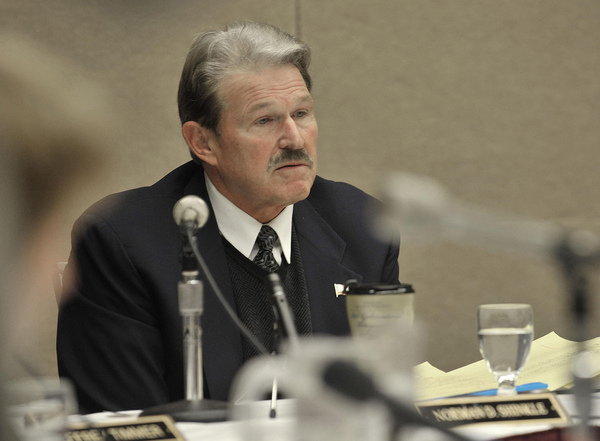
At least one Republican canvasser has expressed reservations. Shinkle, a state canvasser since 2008 who is heavily involved in state GOP politics, said he's considering asking for a delay at Monday's meeting to review the reasons for unbalanced poll books in Detroit that Wayne County officials said totaled about a few hundred votes out of 878,000 ballots cast countywide.
A group of pro-Trump protesters gathers in front of the Austin Building in Lansing on Nov. 23, 2020.
Shinkle said he has many questions about lingering allegations in Wayne County, all of which have been refuted by elections officials there.
The unbalanced poll books do not necessarily indicate voter fraud, but are likely the result of clerical errors, experts say. Canvassers certified Detroit results with imbalances in 2016 and in the August primary.
If Shinkle and Van Langevelde were to vote against certification, the board would deadlock 2-2 and the results would remain unofficial. In that case, the board is likely to be taken to the Michigan Court of Appeals, which could order the canvassers to carry out their duty.
David Dulio, a political science professor at Oakland University, noted that Biden is projected to win 306 electoral votes, so even if Michigan's 16 votes were thrown into question, the former vice president would still have more than the 270 votes necessary.
"Take away 16 electoral votes away from Joe Biden, he still has 290. He still wins," Dulio said.
States have until Dec. 8, what is known as "safe harbor" day, to choose electors to ensure they will be accepted by Congress.
When the vote is certified, Whitmer will notify the U.S. secretary of state of the electors who align with the state's popular vote. The electors will cast Michigan's 16 votes in the Electoral College next month in Lansing.
The electors, nominated by their parties, vote on Dec. 14. In past years, the vote has occurred at Michigan's Capitol.
Whitmer appoints the members of the Board of State Canvassers. She chooses them from lists of three potential candidates submitted by the two major political parties. When a vacancy occurs, the party from which the departing member came has 10 days to name potential candidates.