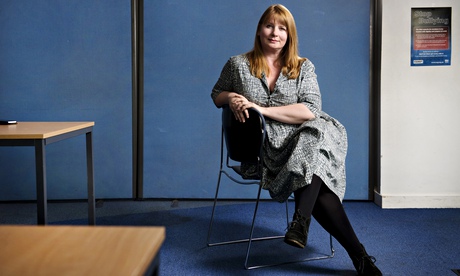
Since she became general secretary of the National Union of Journalists in 2011, Michelle Stanistreet‘s summer months have been spent, not on holiday somewhere sunny, but embroiled in industrial disputes. Yet this year was different as the “shabby, stitched-up deal” over the future of the BBC means industrial action will come later. Stanistreet took a holiday, but she’s already preparing for the battle ahead.
On the day she speaks to the Guardian, NUJ reps from across the BBC have gathered to discuss their response to the deal and the cuts that will follow it. “One of the outcomes of today’s meeting is that our members are prepared to take strike action to defend jobs and to defend members at risk as and when they have to,” she says.
The s-word has by no means been unheard-of in the various battles between the union and the BBC – and other media organisations. But this is the first time Stanistreet has been so clear about the union’s resolve to challenge the fallout from the deal that will see the BBC cover the roughly £700m cost of providing free TV licences for the over-75s. She is motivated in part by the experience she gained when she first took over the leadership of the union soon after the last such arrangment, struck by the then BBC director general Mark Thompson in 2010.
“It appalled and shocked, not just union members, but licence fee payers,” she says, adding that she has regularly discussed preventing the same thing happening again with the current boss Tony Hall. “Tony has sat with us and repeatedly said ‘I absolutely agree with you, it should never have happened in that way. Of course, licence fee payers should have been consulted. Of course, any process must be transparent, it must have integrity’. And what’s happened again this time round?
“Staff at the BBC and the general public have been betrayed once again by the very person – and the very team of people – there to uphold the values of the BBC, its integrity and its relationship with the licence fee payers. It was beyond belief that another secret, shabby stitch-up was secured without due transparency and consultation and process.”
Hall, she says, “allowed himself to be shafted” by the government. But what else could he have done when he picked up the phone to culture secretary John Whittingdale – was Hall not simply securing the best deal possible in the face of overwhelming pressure? “The very straightforward thing to do in the face of unacceptable governmental pressure and interference would be to say ‘fuck off, do your worst, we’ll fight that’.” That, she says, would have earned Hall the respect and the support of BBC staff, the unions and the “vast bulk of licence fee payers”.
She accuses Hall of indulging in “doublespeak” last Monday when he focused on a “vision of a BBC with many partners, [which] … is actually about an opportunity to provide a sop, not only to his political enemies, but also to his commercial enemies, who are desperate for a piece of the licence fee income”.
“This is foolhardy,” she adds. “Anybody who believes that the crisis that has been facing local and regional newspapers in the UK is a consequence of the BBC’s commitment to quality content or public service broadcasting as an ethos is living in cloud cuckoo land.
“The devil is going to be in the detail, which is not available as yet, but I would be deeply concerned about the BBC funding reporters to work for commercial newspaper groups, who should be funding proper quality local coverage themselves.
“When there’s been decisions to make about investing in local newspapers, these self-same companies have preferred to line their own pockets.”
She speaks passionately about what she sees as the scourge of management largesse at the BBC, calling herself the corporation’s biggest critic. And other managers clearly raise her hackles too: the name of Richard Desmond, her former boss as owner of the Sunday Express, is sneered, rather than spoken.
Stanistreet has rarely backed away from a fight. The government’s planned reforms to the law governing industrial action, she says, are “the biggest assault on trade unions ever in this country”. Making it “nigh-on impossible” to take lawful industrial action will “make unlawful strike action and industrial action an inevitable consequence”, she warns.
She says she doesn’t believe that sort of fight is what the Tories want, but if it is, “then make no mistake, that’s what they’ll end up with”.
And Stanistreet can point to victories she’s achieved. The union handed a dossier of evidence from BBC staff to Dinah Rose QC, who carried out a review of sexual harassment at the corporation.
“It was a very big body of work and we pushed very hard for the BBC’s bullying and harassment policy to have genuine independence built into it. It took us 18 months to secure that, but we did that last year. The extent of the bullying that was going on at the BBC was a major eye-opener. Whether it was sexual harassment, bullying because someone was disabled, women being forced out, or vile sexual abuse.”
Making the union more proactive, alongside its usual activities, has been deliberate, Stanistreet says. Besides its work on harassment, it has become vocal on the issue of football clubs banning journalists. And it has been involved in a push to improve the representation of women, with Stanistreet giving evidence to a Lords committee inquiry in October last year.
“Intakes of journalists are level pegging in lots of places but the reality is that … you don’t have the same degree of representation of women in senior roles. You still have so many employers who have incredibly backward approaches to flexible working and life is made intolerable for women who have kids.”
Ultimately, she says, many women are “forced to vote with their feet”, which reflects “so badly on the major corporations dominating the media”.
Stanistreet adds: “You might turn on your television and there’ll be as many women as men presenting. But, if you look behind the screens, that figure becomes incredibly imbalanced. Or you might see women of a certain age on your screens but, once they hit their 40s or 50s, they suddenly become invisible again.”
“Every survey we do … produces anecdotes that continue to make me feel sick or ashamed of the reality of working life for far too many of our women members.”
She feels similarly about the representation in the media industry of people with black and other ethnic minority backgrounds, as well as those who cannot rely on their parents to bankroll their early careers. Those are fights she readily admits the union is still far from winning.
After the coming battle with the BBC, she may need another holiday before returning to those again.
Curriculum vitae
Age 41
Education Merchant Taylors’ School, Crosby, Liverpool University (English and history)
Career 1999 feature writer, books editor, Sunday Express 2006 vice-president, NUJ 2007 president 2008 deputy general secretary 2011 general secretary