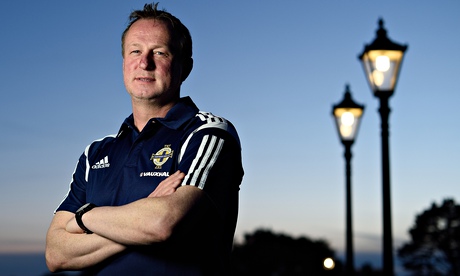
Being the manager of Northern Ireland can be a lonely business. Michael O’Neill is self-deprecating on that point. That O’Neill leads his team into Saturday’s match with Romania as the second-placed team in Group F, having secured 12 points from a possible 15, is notable enough. Northern Ireland were drawn from pot five, which consisted of nine teams that have never qualified for the European Championship, but are already on the brink of qualifying for Euro 2016.
It is, though, with a close look at resources – or rather the lack of them – that O’Neill’s work gains further credence. Even some players at his disposal from relatively prominent clubs have not been turning up for international duty from a background of regular football.
The Scotland manager, Gordon Strachan, has an abundance of options by comparison. O’Neill bluntly admits: “If I lose Steven Davis, I’m not replacing him.”
O’Neill has not had the luxury of a single home friendly match during his tenure. Throw in a dismal domestic scene in Northern Ireland itself, plus the lack of youthful talent picked up by major clubs and progress has been semi-remarkable. This is not rare for O’Neill, who left home as an 18-year-old and a month later found himself in the Newcastle United first team alongside Paul Gascoigne.
“I have watched games from Burton v Chesterfield to Fleetwood against York, to Old Trafford, to Rangers v Queen of the South,” O’Neill says. “Twelve months ago I was watching Paddy McNair play for Manchester United’s under-19s – but that’s where the lads were.
“ We have less than 50 players in the four leagues in England and top two in Scotland. Full stop. The problem we have is a lot of those players are in League One and League Two. Roy Carroll is in League Two now. There are 12, 13 players in League One; it is a big jump to playing international football. The Scottish Premiership is a big jump up to international football.
“There are times when I have gone into unbelievable amounts of research on players’ eligibility and been knocked back by someone who says they are not interested. I have set up meetings with players who have phoned just beforehand to say they aren’t turning up. You take a few knock-backs along the way.”
The role has been made tougher still by regulations that state any player born in Northern Ireland is eligible to play for the Republic, a route accepted by Darron Gibson, James McClean and others albeit none, pertinently, under O’Neill’s watch.
“The rule is very unfair,” he insists. “It is grossly unfair for us to develop young players, train them, take them to tournaments and then if the option comes up for them to play for the Republic of Ireland, there is nothing to stop them doing it. I have no problem if there is a bloodline there; that is the same as any other country.
“I think the associations should be able to come to an agreement on it. My understanding is we have tried to do that and they have said ‘the rules are the rules and we are allowed to do it’. It is pretty hard for a country of our population, with so few players.”
Overdue qualification for a major tournament would surely equal positive legacy. “Without detracting from 1982 and 1986, I think this would possibly mean even more because in those years we didn’t have the eligibility situation that we have now,” says O’Neill.
“Qualification for a major tournament focuses everyone. Northern Ireland is a different place in terms of society than it was in ’82 and ’86. I think the new stadium [a rebuilt Windsor Park] will be a huge thing for Northern Ireland, not just the national team but football in general.
“With all these things coming together, we hopefully have a bit of a wave that we can ride. Qualification could focus everyone and hopefully the mood we have here now would continue to grow.”
Eyebrows were raised when O’Neill accepted overtures from his country in 2011. He had, after all, shown a clear aptitude for club management both on a part-time basis with Brechin City -– he doubled up in the financial services sector – and at Shamrock Rovers, whom he guided to back-to-back League of Ireland titles. O’Neill made history by taking Rovers to the group stage of the Europa League on a playing budget of €600,000 and with a batch of players on 42-week contracts.
“I thought there was no point in my going for the interview if I wasn’t prepared to take the job,” he recalls. “I also felt that I couldn’t be a worse manager for doing it, that if you do well in this job then you never know where it might take you. I didn’t think it would damage me too much.
“It wasn’t long between starting out at Brechin and being in a dugout where Fabio Capello was in the next one. I love that challenge, of going out to compete, of getting players to the point where they believe they can play at that level. That is really satisfying. I haven’t been disappointed at all with any young player I have had to pitch into these situations.
“The international games are big. We go to Portugal and play in front of 48,000. We played in Uruguay last year before the World Cup, there were 60,000 people there. We had a back three there with 90 caps; the problem was Aaron Hughes had 88 of them.”
The Europa League was vital to O’Neill’s development. It offered him rare opportunity. “You could have 10 years of management in England and no European experience, whereas I had eight European ties under my belt; FC Copenhagen, Juventus, Rubin Kazan, Tottenham,” he adds.
“And, in all honesty, we had a team that wasn’t good enough to compete at that level. In all the ties we had, we were only the favourites once. I guess preparation ideas started in me then: ‘How can we compete at this level? How can we not be shown up?’”
O’Neill places emphasis on coaching aspects that work in his current scene: Man management, tactics and intense preparation. He isn’t afraid to break with convention or to admit he is not the type to find mentors on whom to lean. “There’s not one manager I would pick the phone up to and ask advice, I have never really done that,” he says.
“I have had a couple of conversations with Martin O’Neill but more on this job and taking it at the outset, taking it forward, before Martin was in his position.
“I just sort of trust things. The decision process is important as a manager. To be good at it, I’m not sure you always need to go and seek help. You have to learn to become a decision maker and not dance around things.
“I hear about managers who won’t name their team until an hour and a half before kick-off because they don’t want any complications. My players will know my team and I don’t care if they are disappointed to be out of it because I will sit down and explain to them why. I’m not scared to show my hand. I won’t compromise the preparation of the team to keep the players guessing.”
O’Neill refuses to contemplate where his job may take him next. One thing he doesn’t plan is a career path; partly through acknowledgement of the short lifespan for managers in England. Romania, and reaching the 15-point mark, which would surely set Northern Ireland on their path to France, are fixed in his sights.