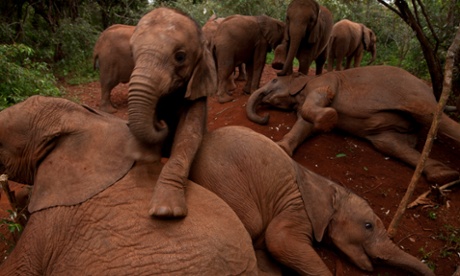
These baby elephants have all lost their mothers. They were either killed by ivory poachers, or they fell in wells while trying to get water. The babies are at an orphanage in Nairobi. When a new one comes in, it’s utterly traumatised: only one in 10 survives.
The most bizarre thing about these orphans is that the older ones take care of the new arrivals. The elephants lying down are just two years old, but they’ve become matriarchs – 20 years too soon. The one with its foot up is nine months old. His elders are lying there saying: “Hey, you can get on us!” This is exactly how they play in the wild. Being sociable and protective is something elephants do naturally. It tears your heart out.
There are about 50 elephants at the orphanage, run by the Sheldrick Wildlife Trust, and they have qualified keepers, men from local villages. It’s one of the most dangerous professions on Earth, yet the Sheldrick keepers never strike the animals – unlike in zoos where control is done by force, with electric shocks, sharp objects or water deprivation.
The keepers rarely let strangers in because it’s a pain in the ass protecting them. A newcomer like me gets knocked down a lot. I wanted the animals to quit paying attention to me, so I could focus on my photographs instead of just trying to stay upright. By the time I took this, I’d been there three weeks, and the elephants knew me.
Someone will call from somewhere in Kenya and say: “We found a baby elephant.” They’ll fly there and bring it back to Nairobi for veterinary care. If it survives, it eventually works its way back to Tsavo national park. They go back into the wild in a carefully controlled way. It’s not done until they’re about six, and they still go out with local men until they’re fully independent. They’re given water and milk until they’re eight or even 10.
I’ve spent 20 years photographing African elephants. On foot in the wild, you get charged all the time. They smell human and think danger. I’ve had lots of close calls: I’ve been chased, had to run up trees, and my colleague Mike Fay was gored 17 times by a crazed female who’d lost her baby. Fortunately, he survived – and was back out working as soon as he could.
When an older elephant dies, the herd mourns. I remember one matriarch who died from a snakebite – members of her family stood over her body for days. Friends from childhood, or the matriarchs of other clans, also came to stand guard, keeping hyenas, vultures and other predators at bay. I once found an elephant graveyard. I always thought they were just something out of Tarzan, a fantasy, but I put a camera on a set of bones to see what would happen – and, sure enough, animals would come by all the time to touch the bones. They’re touching somebody they know.
Elephants are still being slaughtered, and now the trade in ivory is being used to back insurgencies. Everybody’s funding their rebel group with elephant tusk. We should not allow it. It’s nuts to kill an animal for its teeth, its digging tool. If this was being done to humans, money to stop it would pour in. I try to make the sexiest picture I can, but it has to have an ulterior motive, showing people we don’t have much wild left; we must protect it. This picture says to the world: look how much they care for each other – how can we kill them for useless trinkets?
CV
Born: Alabama, 1952.
Studied: Became a photographer in the army during the Vietnam war.
Influences: Henri Cartier-Bresson, Eugene Richards, Alex Webb.
Low point: “I had malaria 25 times as a young man and have had knee surgery five times.”
High point: “Winning wildlife photographer of the year for a lion picture in Tanzania – and becoming staff photographer at National Geographic.”
Top tip: “Stick at it.”
• Earth to Sky: Among Africa’s Elephants, A Species in Crisis by Michael Nichols, is out now