Afternoon summary
- Theresa May, the home secretary, has said that she has rejected a request from the police to authorise the use of water cannon in England and Wales. In a snub to Boris Johnson, the mayor of London and a potential rival to May for the Tory leadership, she said that the three water cannon he had bought second-hand from Germany for London were not in a fit condition to be deployed and that allowing water cannon would undermine the principle of policing by consent. Johnson spent £218,000 on the machines.
- Harriet Harman, the interim Labour leader, has accused the prime minister of “rigging the rules” by changing the law on trade union political funds while leaving untouched the way companies and hedge fund managers are free to provide unlimited funds to the Conservative party. Labour leadership candidates have also condemned the plans too.
- David Cameron has admitted he is “disappointed” after official figures showed unemployment rising for the first time in more than two years.
-
Cameron has told MPs that he agrees with the IMF that Greece needs further debt relief. Speaking at PMQs, he also said that Britain could offer Greece humanitarian aid if it leaves the euro. He said:
It is not for Britain to bail out eurozone countries and we wouldn’t do that. But as a member of the European Union, if Greece were, for instance, to leave the euro and wanted humanitarian assistance, I’m sure that this House and the British public would take a more generous view. Sorting out the problems of the eurozone, which we have always warned about the dangers of this eurozone, is a matter for eurozone countries.
- Cameron has said he will consider whether to impose a blanket ban on prisoners who have absconded from an open prison ever being placed back into the lower security jails ever again.
- Michael Gove, the justice secretary, has said that Britain could still be a beacon for human rights in the world even if it withdrew from the European convention on human rights. (See 11.38am.)
- Philip Hammond, the foreign secretary, has told MPs that the UK hopes to reopen its embassy in Iran before Christmas, four years after it was ransacked during protests against sanctions. Philip Hammond has said.
-
Andy Burnham, the Labour leadership candidate, has said that the party should do more to champion the interests of the self-employed. In a major speech on the economy, he said:
Before the election Labour rightly highlighted the plight of those pushed into self-employment due to a lack of secure work.
But we didn’t acknowledge that most self-employed people have higher job satisfaction and that they are a key ingredient of a successful economy of the future.
So I want to correct that mistake.
Labour has always been the workers’ party, and in the 21st Century that means Labour must be the party of the self-employed too.
So under my leadership these vital members of the workforce will no longer be an afterthought – every policy will be considered for its impact on them, and we will study ways to reform Universal Credit and other government programmes to ensure that they address the needs of the self-employed as well as those in traditional employment.
That’s all from me for today.
Thanks for the comments.
Updated
A Staggers blog claims that private polling shows Jeremy Corbyn ahead on first preferences in the Labour leadership contest. My colleague Alberto Nardelli is sceptical. He writes:
After the election, we should take polls with a pinch of salt for a while. “Private polling” doubly so. According to “private numbers”, Labour was on course to be the largest party at May’s election and the Lib Dems to retain more than 30 seats.
The broader issue here though is that due to a lack of trust in public polls, unaccountable private surveys, rumours and speculation risk taking over the political debate.
The 25 year old German water cannon that Boris can't use pic.twitter.com/M7IoEp9aDP
— Alan Travis (@alantravis40) July 15, 2015
Conservatives on the Greater London Assembly have criticised Theresa May’s decision not to authorise water cannon. They are now calling for the Met to be allowed to deploy sound cannon. This is from Tony Arbour, a Conservative GLA member.
The home secretary has made the wrong decision in not allowing the Metropolitan Police the use of water cannon. Not only are water cannon a better alternative to rubber bullets, they act as a powerful visual deterrent to violence. Another crowd control alternative is now required and I suggest the Met adopt sound cannon. They are low cost, safe, extremely mobile, and would be very effective at dispersing a riot or violent demonstrations. Though I hope another riot never happens we must be prepared to protect Londoners against all eventualities.
According to a news release from the GLA Conservatives, a sound cannon can cost as little as £18,000. “They look like small satellite dishes and emit a targeted, high pitched alarm tone in short bursts,” the release says. “They’ve been deployed in cities such as New York, Chicago and Barcelona and were available to the police during the London 2012 Olympic Games.”
Sadiq Khan, the Labour MP who is in the contest to become his party’s candidate for London mayor, has said that if he wins, he will sell the water cannon Boris Johnson purchased. He put out this statement.
It was not needed and it is nothing short of a scandal that almost a quarter of a million pounds of taxpayers’ money was blown on equipment which cannot legally be used.
The appropriate response to the 2011 London riots was to pursue those criminals responsible through the justice system and then soberly reflect on the underlying issues which gave rise to the trouble.
The purchase of water cannon was a knee-jerk response by an out-of-touch Mayor who should have been making efforts to heal London’s communities rather than scrambling to purchase a new weapon that police could aim at them.
As mayor of London, one of my first acts would be to sell off the water cannon to raise money for a series of youth projects which contribute to maintaining strong, cohesive and harmonious communities.

This is from Nick Timothy, who was Theresa May’s special adviser in the last parliament.
There are many operational and ethical reasons for not allowing water cannon, but simply put it's incompatible with our model of policing.
— Nick Timothy (@NickJTimothy) July 15, 2015
Liberty, the human rights pressure group, has welcomed Theresa May’s decision. This is from Sara Ogilvie, a Liberty policy officer.
We wholeheartedly welcome the home secretary’s decision not to authorise police use of water cannon. She should be commended for listening to vital evidence about the repercussions of their use for individuals and communities alike. Water cannon have no place in a society premised on policing by consent.
Boris Johnson told Sky News that London would keep its three water cannon in case they were authorised at some point in the future.
The MayorWatch blog has an alternative explanation.
Ignore the spin, Boris is keeping is water cannon because they’re unsellable scrap http://t.co/grN2prRrxJ pic.twitter.com/H9bMMRlhuJ
— MayorWatch (@MayorWatch) July 15, 2015
On Sky News Boris Johnson says just said London will keep the three water cannon it is not allowed to use. Theresa May has refused to authorise their use for now, he said. But he said she confirmed that at some point in the future she would be willing to reconsider a request to use them.
(That is technically true. May said, if there was a fresh application, she would look at it. But she said nothing to suggest that she would come to a different decision.)
Boris Johnson defends his water cannon purchase
Here is an extract from Boris Johnson’s question to Theresa May.
Can I remind her that the decision to buy the Wasserwerfer was taken in light of the strong support of the commissioner of the Metropolis for this operational tool for crowd control, of the strong support of the prime minister, and indeed of the strong support of the people of London, expressed in a poll which found 68% were in favour. And indeed in the interests of economy, since we were able to buy these machines and thereby save £2.3m. No one on either side of the House wants to see the deployment of water cannon anywhere in the United Kingdom. And I fail to see the physiological difference between people of England and Wales and the people of Northern Ireland.
This is from the Evening Standard’s political editor, Joe Murphy.
Did you know ... Boris's water cannon were disguised as dust carts when ferried over the channel pic.twitter.com/ZFd3m270E2
— Joe Murphy (@JoeMurphyLondon) July 15, 2015
Theresa May's three reasons for refusing to authorise the use of water cannon
In her statement Theresa May said there were three reasons why she was refusing the authorise the use of water cannon. Here is the key passage explaining her reasoning.
Firstly, the medical and technical issues raised by the reviews do not give me the degree of confidence that I need to authorise less lethal weaponry.
While evidence suggests that these water cannon are unlikely to result in serious or life-threatening injuries as currently built and used as envisaged, the assessment nonetheless poses a series of direct and indirect medical risks from their use. These include the possibility to cause primary, secondary and tertiary injuries, including musculoskeletal injuries such as spinal fracture, as well as other serious injuries such as concussion, eye injury and blunt trauma. International evidence supports this conclusion; in Stuttgart a 66-year old protestor was completely blinded during a protest by a similar model of water cannon to those under consideration.
At the same time, I remain unconvinced as to the operability of the machines under consideration. They are 25 years-old and have required significant alterations and repairs to meet the necessary standards. The final SACMILL assessment found 67 separate outstanding issues that would still need to be addressed before they could be deployed, including serious faults that, if deployed, would have significant operational implications.
Secondly, my decision also takes into account the operational case for water cannon. The original police request argued that water cannon offered a flexible option to disperse crowds, protect premises and deter disruptive behaviour that might otherwise have to be dealt with by forcible means.
However, it made clear that water cannon has limitations, especially in response to fast, agile disorder. This has been borne out by further discussion with chief constables, who raised the possibility that the vehicles may serve to attract crowds to a vulnerable location and noted that evidence from Northern Ireland suggests that the deployment of water cannon usually requires significant advance notice - casting doubt on their utility in a riot scenario.
Finally, I am acutely conscious of the potential impact of water cannon on public perceptions of police legitimacy. As a number of chief constables argued, in areas with a history of social unrest or mistrust of the police, the deployment of water cannon has the potential to be entirely counterproductive.
The three water cannon purchased by Boris Johnson for the Met were Ziegler Wasserwerfer 9000 models.
This is from my colleague Vikram Dodd.
Five of six largest police forces did not want water cannon; only the (Boris led) Met did http://t.co/g8znQzYhVX
— vikram dodd (@VikramDodd) July 15, 2015
Alex Salmond, the SNP MP, says instead of doing a proper assessment, Boris Johnson went ahead and bought antiquated water cannon that he now cannot use. Isn’t this the kind of thing councillors used to get surcharged for?
May says she is sure Johnson acted on the basis of the information available to him.
Nick Herbert, another Conservative former police minister, says he disagrees with the decision. It undermines the commitment the prime minister gave during the London riots, about all options being on the table for police. And they have been used in Northern Ireland just this week, he says.
May says Northern Ireland is very different. During the London riots, the police were dealing with a rapidly moving situation.
James Cleverly, a Conservative, says he agrees with Boris Johnson on this. Would May approve the use of smart water, to identify ringleaders in riot situations?
May says she has looked at this. If the police want to apply to use smart water, they can.
Diane Abbott, the Labour MP and another candidate for Labour’s nomination for London mayor, says Londoners will be relieved by this decision.
Damian Green, the Conservative former police minister, says he disagrees with this situation. The police use tasers, he says.
May says she has ordered in investigation into the use of tasers, because of a number of “issues” around their use.
Sadiq Khan, the Labour MP and a candidate for the party’s nomination for London mayor, asks May if she can ever imagine the 25-year-old Met water cannon being used.
May says she has refused this application.
Updated
May says water cannon would not have helped in the London riots. The police were dealing with a moving situation. It was very different from the stand-off situations you get in Northern Ireland.
Joanna Cherry, the SNP home affairs spokeswoman, says the SNP government in Scotland does not support the use of water cannon. Can May promise she won’t change her mind in the next five years?
May says she has taken this decision on the basis of the evidence put to her. The police can make a fresh application at any time.
Boris Johnson, the Conservative mayor of London, says the decision to buy the three water cannon was taken with the strong support of the Metropolitan police commissioner, with the support of the prime minister, and with the support of the public. Some 68% of Londoners were in favour. And by buying them second-hand he saved £2.3m. He asks May to confirm that if, in the “vanishingly unlikely event” of a serious outbreak of violence that posed a threat to life and limb, it would be open to the Met to apply again to use them.
May says the police can at any time apply to use a weapon that has not been authorised.
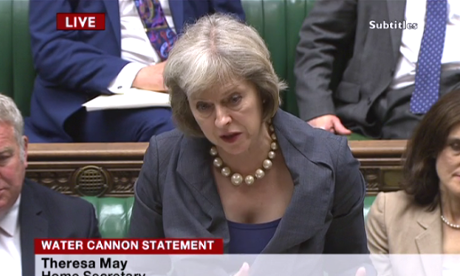
May is responding to Cooper.
She says the purchase of the three water cannon was a matter for the London mayor.
Boris sitting behind Theresa May as she humiliates him by announcing he cannot use his expensive water cannons pic.twitter.com/VsadMXAFnd
— Isabel Hardman (@IsabelHardman) July 15, 2015
Cross Boris pic.twitter.com/CUvo6tUOmZ
— Isabel Hardman (@IsabelHardman) July 15, 2015
Yvette Cooper, the shadow home secretary, says she often disagrees with Theresa May. But, on this, she says she could not agree more.
She praises May for the conscientious way she dealt with this.
It was troubling that the submission from the Association of Chief Police Officers did not even mention the case of the 66-year-old blinded in Germany.
She says water cannon have never been deployed in England, Scotland and Wales. She says no one has put forward a case for changing that.
She asks May to confirm that the Home Office did not pay for Boris Johnson’s water cannon.
Johnson did not even buy good water cannon, she says. They were 25 years old, and needed more than 60 alterations.
Just as George Osborne has quashed Johnson’s airport ambitions, May has quashed his cannon ambitions.
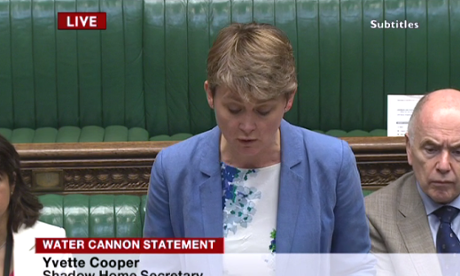
May says she is not convinced by the operational case for water cannon.
And she is concerned that authorising them could be counter-productive, she says.
She has given the police new powers.
But where new powers could cause harm, where the operational case is not clear, and where they could undermine the principle of policing by consent, she will not give the police new rights.
May says she will not authorise water cannon in England and Wales
May says water cannon are classed as a less lethal technology.
The assessment process is comprehensive, she says. It has covered the medical implications.
It has also included information from operational trials of the three water cannon bought by the Met.
May says she received the reviews just before the election.
In additional to the scientific and medical assessments, she wrote to some senior officers and retired officers to ask about their use.
On the basis of the evidence provided by the police, she has decided not to authorise the use of water cannon.
-
May says she will not authorise the use of water cannon in England and Wales.
First, the medical and technical issues do not give her the confidence to allow them, she says. There are medical risks from their use.
She says a 66-year-old protester was blinded by one in Germany.
She says she is also concerned about the machines. They are more than 20 years old.
Theresa May's statement
Theresa May, the home secretary, is making her statement now.
She says in March 2014 she received a formal request for water cannon to be authorised in England and Wales.
In June the mayor of London approved the purchase of three of these water cannon. They arrived in July.
She says her decision applies to all 43 forces in England and Wales.
Boris Johnson, the Conservative MP and mayor of London, has arrived in the chamber, Politico Daily reports.
London Mayor Boris Johnson has arrived in the chamber to find out if Mrs May will authorise the use of water cannon by the Met
— Politico Daily (@Politico_Daily) July 15, 2015
Theresa May's decision not to authorise water cannon use to be confirmed in Commons statement very soon - will Boris Johnson be there?
— Danny Shaw (@DannyShawBBC) July 15, 2015
A year ago the Met bought 3 water cannon from German Federal Police, a decision approved by Boris Johnson, & began training their officers.
— Danny Shaw (@DannyShawBBC) July 15, 2015
May to refuse to authorise water cannon, BBC reports
This is from the BBC’s Danny Shaw.
Hearing that Theresa May has refused to authorise the use of water cannon. Statement soon
— Danny Shaw (@DannyShawBBC) July 15, 2015
That is a snub to Boris Johnson, the mayor of London, who spent £218,000 on three of them for the Metropolitan police.
Updated
Theresa May, the home secretary, is about to make a statement about whether or not she will authorise the use of water cannon in England and Wales.
This article, by my colleague Robert Booth, explains some of the background to this controversy. He also describes what it is like to be hit by a water cannon. Here’s an extract.
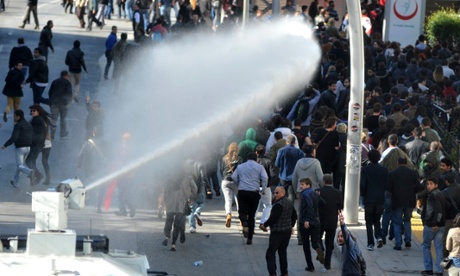
The cold jet from the water cannon slammed into the back of my head, tipping me off balance and sending adrenaline pumping around my body. This was the Ziegler WaWe 9000 in action: a German-built 30-tonne riot-tamer that can blast its targets with up to 18 litres of water a second and toss demonstrators like rag dolls. It is the kind of weapon that the home secretary, Theresa May, is now deciding whether to introduce to English and Welsh streets.
There seems to be less PMQs comment on Twitter from journalists than normal. I can only find one tweet attempting to score it, from the Sun.
Last PMQs before recess: Osbo thought Cam nailed it. Well, so did we. Harman 2 v 4 Cameron http://t.co/D1oczzKZNW pic.twitter.com/lDwfHc55Kd
— #SunNation (@SunNation) July 15, 2015
Otherwise, there is general consensus that Harriet Harman did quite well, given the circumstances.
From Sky’s Joey Jones
Uncomfortable PMQs for @HarrietHarman but she really is doing pretty well. Might feel a bit lonely after events of recent days.
— Joey Jones (@joeyjonessky) July 15, 2015
From the Independent on Sunday’s Jane Merrick
Given the last few days it should've been a tough #pmqs for Harriet Harman, but Harman is even tougher. Street-fighting performance 💪
— Jane Merrick (@janemerrick23) July 15, 2015
From ITV’s Chris Ship
Brave of Harman to take on Cameron on welfare given the Labour squabbling in recent days. That #pmqs could've been a lot worse for her...
— Chris Ship (@chrisshipitv) July 15, 2015
From the Sunday Post’s James Millar
Hattie Harman, on her way out & surrounded by critics showing her class here with a strong turn. #pmqs
— James Millar (@PoliticalYeti) July 15, 2015
PMQs verdict
PMQs verdict: All the David Cameron v Harriet Harman PMQs exchanges have had the quality of “friendly” football matches. That’s not because they are friendly. It’s because, in terms of the overall Westminster narrative, they don’t really count. Harman asks serious questions about serious topics, but MPs know that until Labour elects a new leader, Cameron does not really have to engage, and consequently none of this really matters. (Or it matters even less than usual, if you take an ultra-dismissive view of PMQs, which I don’t.) This has been true of all the Cameron/Harman exchanges, and it was true again today.
It showed in the essential, low watt nature of the whole exchanges. It never really felt as if Harman or Cameron were getting out of second gear. Harman was at her best on how the amount people are gaining from the “national living wage” will not compensate for what they are losing from tax credits (where she is absolutely right), but she did not not seriously discomfort Cameron, and Emma Lewell-Buck probably made the same point more effectively (because she asked about a specific individual - see 12.34pm.) Cameron came with a pre-prepared script about the Labour leadership candidates disagreeing with Harman over welfare, but it was an easy hit, and it felt as if he was scarcely trying.
Otherwise, it was surprising how easily Cameron saw off the questions about the union reforms. On the Today programme this morning Justin Webb was rather better at exploring the flaws in this legislation than Harman was here. Cameron’s argument that forcing union members to opt in to political funds is just an act of “consumer protection” was disingenuous, but, given that Ed Miliband introduced his own version of an “opt in” rule for donations, Labour is going to need a better argument if it wants to fight this particular aspect of the legislation effectively.
Updated
Labour’s Michael Meacher asks why, if this is such a great economic recovery, wages are still 6% below what they were seven years ago? Why is the growth rate not better? And why is the trade defict £100bn?
Cameron says, in two words, the reply is: “Ask Gordon.”
The defict is down by half, he says. The economy grew by 3%. It is growing faster than major competitors’. The economy is 10% bigger than it was when he became prime minister. And this week he introduced a national living wage, he says.
And that’s it. I’ll post a verdict soon.
Labour’s Emma Lewell-Buck asks Cameron to confirm that a care worker in her constituency will be worse off because of the tax credit cuts, even allowing for the increase in the minimum wage.
Cameron says that worker will benefit from the minimum wage increase.
Last night Labour voted against that, he says. “Put that on your leaflets.”
Andrew Turner, a Conservative, asks if Cameron agrees immigration needs to be cut.
Cameron agrees. He says 60% of people coming to the UK from Europe are job seekers; they don’t have a job already. That is why he is addressing welfare rules.
Andrew Gwynne, the Labour MP, says many women born in the 1950s will lose out because of pension changes that have been introduced. Will Cameron look again at how this group of women was affected.
Cameron says it was right to raise the pension age. That enabled the government to introduce the tripe lock. If you go down Labour’s route, you end up not being able to pay proper pensions.
Judith Cummins, the Labour MP, asks if Cameron was told there would be problems with the electrification of the TransPennine route before the election.
Cameron says he was told after the election. Instead of just gripping, all MPs should support the programme.
Paul Flynn, the Labour MP, says asylum seekers are disproportionately located in Labour constituencies.
Cameron says asylum seekers are dispersed in the same way they were under Labour. But he will look at this, he says.
Steve Brine, a Conservative, asks about the death of the three recruits on the SAS training mission. Will Cameron ensure the army inquiry getting underway introduces changes to ensure this does not happen again?
Cameron says he speaks for all MPs when he says their hearts go out to the families of those involved. This was a tragic case. The MoD has apologised. Some changes have already been made to this training exercise. This must not happen again.
Alasdair McDonnell, the SDLP MP, asks about the disorder in Belfast. Will Cameron join him in urging residents to join genuine dialogue to resolve the dispute?
Cameron says those scenes of disorder are deeply damaging to Belfast, and to its future. Where it is possible for people to get together, that is the best thing that can happen, he says.
Snap PMQs Verdict
Snap PMQs Verdict: Harman was reasonably good on the IFS findings, and employment and support allowance, but she should probably have called it a day there, because Cameron (who had effective lines on the budget) walked it easily in the final two exchanges, on the union reforms. More later ....
Harman says Cameron does not understand that a lot of these people can only work intermittently. She does not need to be patronised by Cameron about not understanding the minimum wage: Labour introduced it. The IFS says 3m families will be worse off by £1,000 a year.
Turning to the union reforms, she says they look like an attack on Labour funding. Will Cameron only commit to introducing these measures on a cross-party basis? And will he impose caps on individual donations.
Cameron says Labour always comes back to unions.
Why did Labour vote against the national living wage, he asks.
On union funding, he says there is a simple principle here. If you want to give to a party, it should be an act of free will. If this was not happening in Labour, Labour would be saying this was an act of mis-selling, and that the government was engaged in consumer protection.
Harman says, to be democratic, Cameron should not just act in the interests of the Tory party. He is rigging the rules of the game. He has already changed the rules to stop charities speaking out. He wants to be a one nation prime minister, but he is just governing in the interests of his party.
Cameron says giving should be an act of free will. He thought Harman was the moderate one. The leadership candidates are heading off to the left. They oppose all the welfare changes. Some even describe groups like Hamas as their friends. In the week we’ve discovered Pluto, they want to recolonise the red planet.
Harman turns to the budget. The rise in unemployment is worrying. George Osborne said his changes would make working people better off. But they won’t. The IFS said it was “arithmetically impossible” for the poor to benefit. Will Cameron confirm that?
Cameron says it is disappointing that the claimant count has gone up. But youth unemployment is down, and long-term unemployment is down. Wages are up by 3.2%, compared with inflation, which is zero. Cameron says Harman told him that he would have to increase minimum wages by a quarter; in fact, he is increasing them by a third.
Harman says Cameron said the budget would protect the most vulnerable. Support for people with conditions like Parkinson’s will be cut from £100 to £70. The budget will hit those sufferig from life-limiting conditions.
Cameron quotes figures apparently showing a family will be better off. Labour has not grasped the importance of the minimum wage, he says. He quotes Harman says Labour won’t oppose the welfare bill, and cuts in benefit for people with more than two children. He welcomes that. It is a pity her partyu does not support that.
Turning to the employment and support allowance, he says the changes will affect new claimants. And they will get help to get into work.
Harriet Harman says it is important a deal has been reached on Greece. The deal should be implemented in a way that is fair to Greece. The IMF says it is unsustainable. Has the chancellor discussed this with the head of the IMF?
Cameron says Harman is right to raise this. The principle that there must be debt relief is right. It is in the UK’s interest for the eurozone to resolve how it conducts itself. They need to resolve these issues, and quite fast.
Harman says, with President Putin waiting in the wings, this has wider significance. This is not just about economics.
Cameron says Harman is right. It is not for Britain to bail out eurozone countries. But if it left the euro and needed humanitarian assistance, he thinks the Commons would take a different view.
Philip Davies, a Conservative, asks Cameron to give an assurance that no one who absconds from an open prison will be sent back to one.
Cameron says he will look at this idea. Prisoners with a history of escape are prevented from being sent to an open prison except in exceptional cases. He will consider the case for a blanket ban.
Roberta Blackman-Woods, a Labour MP, says the inter-generational fairness index published this week shows opportunities for young people have decreased. So why is the government cutting maintenance grants?
David Cameron says there are record numbers of young people going to university. He says replacing grants with loans was the right approach. It was the approach taken by Labour in 1997, when Harriet Harman was in the cabinet, he says.
Cameron at PMQs
PMQs starts in five minutes.
It is the last before the Commons rises for the summer recess next Tuesday.
But it is not Harriet Harman’s last as Labour leader. There will be one more in September before the new Labour leader is elected.
Gove's evidence to the justice committee - Summary and verdict
Michael Gove is still something of an unknown quantity as justice secretary, and this hearing was helpful because it enabled us to help get the measure of him. Overall, he made a pretty good impression. Here are verdicts from three of the most prominent legal bloggers.
From David Allen Green
So far Gove has offered warm words, and reversed some of Grayling's follies. Still too early to say if there is a substantial improvement.
— Jack of Kent (@JackofKent) July 15, 2015
It is a measure of how bad the MoJ was under Grayling that Gove coming in and, well, not being Grayling can be seen as a great development.
— Jack of Kent (@JackofKent) July 15, 2015
From Matthew Scott
Overall - a very different tone from Gove compared to Grayling, but most of the difficult questions were kicked into touch. #GoveJC
— Matthew Scott (@Barristerblog) July 15, 2015
From Adam Wagner
Remember when they gave Obama the Nobel Peace Prize basically because he wasn't George Bush? Sense of post-Grayling Gove-hope is like that
— Adam Wagner (@AdamWagner1) July 15, 2015
In education, Nicky Morgan benefited in much the same way by not being Michael Gove.
Here are the main points.
-
Gove said that Britain could still be a beacon for human rights in the world even if it withdrew from the European convention on human rights.
Everyone recognises that the administration of justice in English and Welsh courts, and in Scottish courts, sets a gold standard, and did so before the Human Rights Act was passed, and before our adherence to the [European convention on human rights]. The critical question is: when you look at the adminstration of justice, when you look at the way governments behave, when you look at the culture of rights in a country, is that country continuing to act as a beacon?
I would say two things. One, the lord chief justice, not the sitting lord chief justice but the previous lord chief justice, Lord Judge, said there is nothing in the convention that isn’t in common law, that has grown out of that. Some people may argue against that view, but that is not the view of a party hack. It’s the view of one of the most distinguished judges in this country.
The second thing I would say is that Britain’s leadership on the world stage, moral leadership on the world stage, under this government and previous governments, doesn’t depend on our [Gove seemed about to say “membership of the ECHR”, but he paused. He went on:] It’s exemplified every day by the way in which we choose to use our power and influence to support freedom and democracy globally.
Asked if Britain would remain a signatory to the convention while he was justice secretary, he replied:
That’s my hope, but I can’t give a 100% guarantee.
He also said his plans for a British bill of rights would be published in the autumn.
-
He said that the very steep fall in the number of people taking cases to employment tribunal since fees were introduced by the coalition did not prove that people were being denied access to justice. Last year figures showed a 70% drop in cases. Gove said the impact of fees was being reviewed, but that he would only consider getting rid of fees if there was evidence of injustice, and that so far that evidence did not exist.
My view would be that it is only if one can point to examples of rough justice one should seek to reconsider. A simple reduction in the number of people going to employment tribunals is not in itself proof that there has been any injustice visited on anyone ...
I’d have to see whether or not there was an example of people, or an individual, who had been dismissed, who hadn’t had appropriate access to justice as a result, and that hard case, or those hard cases, would led me to think again. But at the moment what I think is likely to have been the case is that the bar has been set at a higher level, absolutely, but there is no evidence yet that the bar being set at a higher level has meant that meritorious claims by people who feel that they are being discriminated against aren’t being heard.
- He said that he was “open minded” about extending community punishment. New technology made it easier to impose genuinely tough community sentences, he said. But he acknowledged that the public were sceptical about community sentences.
- He ducked a question as to whether or not there were too many people in jail. It was for the courts to decide who went to jail, he said.
- He said he wanted to keep talking to the lawyers staging a protest over legal aid cuts. He took their concerns seriously, he said.
- He said he was considering giving magistrates powers to impose longer sentences.
- He said the rehabilitation revolution promised by the coalition in 2010 had been “particularly difficult” to deliver.
-
He said the the Ministry of Justice was on the verge of signing a contract with a private firm to improve the collection of unpaid court fines.
Updated
Andy Slaughter, the Labour MP and shadow justice MP, has been heckling Gove on Twitter.
Gove talking nonsense. https://t.co/36Ek1XNIuc
— Andy Slaughter MP (@hammersmithandy) July 15, 2015
Philip Davies goes next.
Q: How worrying is it that 363 murderers are in open prisons? And that a third of them have absconded in the last 10 years?
Gove says sentences for murder have gone up in recent years. People are only transferred to an open jail if they are assessed as being suitable.
Gove says public safety has to take precedence.
And that’s it. The hearing is over.
I’ll post a summary soon.
Nick Thomas-Symonds, a Labour MP, asks if Gove can say that Britain will remain a signatory of the European convention on human rights as long as he remains in post.
Gove says that is his hope, but he cannot give that guarantee.
Q: Will any British bill of rights be subject to the European convention?
Gove says he does not want to pre-empt what the government will say. But, as David Cameron has said, he does think human rights existed before the convention.
The rights in the convention are “admirable”.
But they have got to apply in a context where people do not think they are being abused.
Q: Doesn’t the Human Rights Act give British judges a say?
It does, says Gove. But that is not the only way judges can intervene on human rights.
Before the Human Rights Act, judges stood up to the executive. And ministers passed laws to extend liberty. So the HRA is not the “be all and end all” when it comes to protecting rights.
Q: If we leave the European convention, what signal would that send internationally?
Gove says everyone recognises that the administration of justice in English and Scottish courts sets a gold standard, and did before the HRA. The question is: Will the UK continue to act as a beacon?
The lord chief justice has said there is nothing in the convention that is not also in English common law.
And Britain’s moral leadership on the world stage is shown every day by the way we support freedom and democracy globally. So we should look overall at how the government act.
Q: Which European countries are not signatories to the ECHR?
Gove says he is not sure. Thomas-Symonds tells him it is Belarus.
Gove says Britain was a beacon for human rights before the ECHR existed.
Gove says his personal view is that in the past the justice system have been over-eager to leave children with biological parents, even where they are at risk.
Gove reveals Whitehall inquiry is underway into what has gone wrong with the satellite-tracking tagging contract: "It's been a big problem."
— Alan Travis (@alantravis40) July 15, 2015
Alex Chalk asks if there are too many or too few people in prison.
Gove says that is a very good question.
But it is not a matter for him, he says. Sentencing is a matter for the courts, and he does not want to say what the courts should be doing.
Richard Arkless, the SNP MP, says he was pleased about Gove’s decision to lift the limit on the number of books a prisoner can receive. And he asks about tribunal fees.
Gove says he is glad Arkless supports his move on books. He wants education to be a higher priority in prisons, he says.
He says his speech last month was designed to show how seriously he takes access to justice.
But, as Bob Neill revealed with his first question, he has to save money too.
Gove says there is too much drug use in jails. He has been surprised by how prevelant it is. At Pentonville 9% of prisoners leave with a drug habit, even though they did not have one when they entered, he says.
Gove says the death of Lorraine Barwell, the custody officer attacked as she was escorting a prisoner, was one of his worst moments as the job. He has written to her family, and hopes to meet her children. He wants to find out what lessons can be learnt from what happened.
Back in the committee Gove says he is “open minded” about whether to extend the use of restorative justice, and community justice.
He is interested in whether the technology exists to enable the courts to apply genuinely tough community sentences.
But he knows the public is sceptical. He will keep an open mind at this stage, he says.
Theresa May, the home secretary, is making a statement in the Commons later on water cannon. London has bought some second-hand water cannon from the Germans, but the Metropolitan police cannot use them unless May gives them permission, and for months she has been delaying a decision on this.
The statement will be at about 1.30pm, because there is a statement on Iran first. I will be covering the water cannon statement in detail.
Gove says Chris Grayling showed “real leadership” in cutting costs in the prison service. But now he is asking if there are any places where the shoe pinches too tightly.
Cristina Rees, a Labour MP, asks if Gove will accept recommendations in the Harris review, including that, if there is a death in custody, the secretary of state should phone the family.
Gove says he is not ready to accept its recommendations yet. He is still reflecting on them. But he says it was a “helpful” report.
Q: What is happening about replacing Nick Hardwick as chief inspector of prisons?
Gove says he is glad Hardwick has agreed to stay on for a bit while a replacement is being found. A panel is being set up to find a replacement, but the ultimate decision should be taken by the secretary of state, he says.
He says he is also looking for a new chief inspector of probation.
Bob Neill says they will now speak about prisons. He asks about Lord Harris’s report into suicides in prisons.
Gove says it was “difficult reading”.
He says the recidivism rate has not changed for years.
He wants to think hard about how prisons are governed.
He says one of the people he has been most impressed by in his new job is Michael Spurr, the chief executive of the National Offender Management Service.
Gove says the Ministry of Justice is on the verge of signing a contract with a private firm to improve the collection of unpaid court fines.
Richard Burgon, a Labour MP, says is is concerned that when people file a case online with an employment tribunal, they are referred to as customers.
Gove says the legal system is a community and a maket.
At the moment, despite the drop in the number of cases going to tribunal, there is no evidence that people are not getting access to justice, he says.
Back to the justice committee, where Gove confirms that the government is reviewing the impact of the increase of in employment tribunal fees.
He says a reduction in the number of cases does not necessarily prove that people are not getting access to justice.
It is important not to have “too promiscuous” a use of employment tribunals, he says.
Unemployment rises for first time in 2 years
Here are the headline unemployment figures.
- Unemployment rose by 15,000 between March and May to 1.85m, the first rise in more than two years. That is 5.6%.
- The claimant count last month rose by 7,000 to 804,200.
- Average earnings increased by 3.2% in the year to May, 0.5% up on the previous month.
Here is the Office for National Statistics news summary. And here is the statistical bulletin, with the full details (pdf).
Alex Chalk, a Conservative goes next.
Q: What plans to you have to deal with the legal aid protest?
Gove says he wants to keep talking to lawyers about how he can address their concerns. He takes their concerns seriously, he says.
Updated
Gove says he has an “open mind” as to whether magistrates new powers.
He has asked officials how he could lift the burden on magistrates, by taking work off them.
For example, should they be dealing with non-payment of the TV licence fee? There is a case for decriminalisation of that.
And he has asked whether they need more powers, specifically powers to give longer sentences.
Philip Davies, the Conservative MP, says in youth courts magistrates can sentence for up to two years. Why not just introduce that for magistrates dealing with adults?
Gove says he wants to be sure that doing that would not have “unintendend consequences”.
Q: What are those unintended consequences?
Gove says:
By definition, they are an unknown unknown.
Gove says there will be further court closures. But, when he publishes a list of courts due to close, it will be consultative. If a community can make a good case for a court staying open, he will be willing to think again, he says.
Gove confirms that it is full steam ahead with his predecessor, Chris Grayling's programme for 140 court closures
— Alan Travis (@alantravis40) July 15, 2015
Updated
Gove says IT in the courts service is a problem. In the Ministry of Justice, he has discovered its own IT is “hardly gold standard”.
Bob Neill, the Conservative MP who chairs the committee, is asking the first questions.
Q: How will you do all this when your budget is being cut?
Gove says Neill has identified a problem. He says his budget is not protected.
He says he accepts that those who complain about legal aid cuts are motivated by concern for justice, not self-interest.
He says he is disappointed that the Criminal Bar Association has voted to join a protest over legal aid cuts.
He is concerned the criminal bar is no longer seen as an attractive career option, he says.
Michael Gove's evidence to the justice committee
Michael Gove has just started giving evidence to the justice committee.
He is listing his priorities as justice secretary.
First, he wants to put through courts reforms. He spoke about some of these ideas in his first speech. Essentially, he will be implementing reforms already proposed by the judiciary, by the lord chief justice and Sir Brian Leveson.
Second, he wants to improve the way we deal with offenders.
And, third, he wants to look again at our approach to human rights. He is doing this “on the instructions of the prime minister”, and indeed on the instruction of the British people, he says.
Updated
The legal world is still trying to work out what to make of Michael Gove as the new justice secretary, and this morning we’ll learn more about this approach to the job when he gives evidence to the Commons justice committee for the first time. Recently Gove pleased liberals by scrapping the restrictions on the number of books a prisoner can receive in jail. Knowing Gove, it would not be a surprise if he went further and made reading compulsory for inmates - the classics, obviously.
Here is the agenda for the day.
9.15am: Michael Gove gives evidence to the Commons justice committee.
9.30am: Unemployment figures are released.
11am: Nick Clegg, the former deputy prime minister, gives evidence to a Lords committee about social mobility.
12pm: David Cameron faces Harriet Harman at PMQs.
Around 12.40pm: MPs begin a debate on English votes for English laws (Evel).
1.30pm: Michael Fallon, the defence secretary, gives a speech to a Rusi air power conference.
As usual I will be covering the breaking political news as it happens, as well as bringing you the best reaction, comment and analysis from the web. I will post a summary at lunchtime and another in the afternoon.
If you want to follow me on Twitter, I’m on @AndrewSparrow