A strange final-round game decided this week’s €90,000 London Classic and provided India’s Vishy Anand with an unexpected consolation for his world title match defeat.
There were six elite grandmasters, no obvious bunny in the field and only five rounds, so the Classic was always likely to spark a cautious approach. It ended in a triple tie for first between Anand, Russia’s Vlad Kramnik and Anish Giri of the Netherlands, who each scored one win and four draws. They shared the money but Anand took the trophy on tie-break.
Ten of the 15 games were halved and the growing – some would say pernicious – reliance among top grandmasters for the Berlin Wall with its early queen exchange (1 e4 e5 2 Nf3 Nc6 3 Bb5 Nf6 4 0-0 Nxe4 5 d4 Nd6 6 Bxc6 dxc6 7 dxe5 Nf5 8 Qxd8+ Kxd8) continued. One-third of the games began this way and all but one were drawn.
The football-style scoring system, three points for a win, meant that the England No1, Michael Adams, the lowest-ranked player in the field, could have shared first had he converted an edge against Anand in the final round.
The opening was a Berlin, of course, but with a special significance. Adams had been a secret member of Magnus Carlsen’s aides for his world title defence against Anand and his presence in Sochi was revealed only after the match was over. The Cornishman is an expert on both sides of the Berlin, so Adams v Anand at London Olympia was probably Team Carlsen’s latest attempt to demolish the Wall.
Adams did produce an interesting concept, using his a1 rook to support his a pawn’s push to a5 so as to undermine Anand’s queen’s side pawn phalanx at a7-b6-c7-c6. On the other flank Adams went Bg5 to force the exchange of dark-squared bishops. The plan worked fine and White had a clear edge until move 17, when Adams pushed c2-c4 (c2-c3 was precise) to support his d5 knight. This later allowed Anand’s knight to centralise at d4.
It came down to a knight and pawns ending with level material, which should have been drawn. But Adams was untypically short of time, five minutes for a dozen moves. He is normally a safe pair of endgame hands but miscalculated badly, sending his king to gobble up Anand’s king-side pawns instead of a safe centralising plan. The delighted Anand simply advanced his own a and b pawns on the other flank and won the race at a canter.
Afterwards Anand said the Berlin should be renamed the London Defence, since the opening also helped Vlad Kramnik seize the world crown from Garry Kasparov in 2000. Their match, too, was staged in the London borough of Hammersmith. Chess players are a conservative bunch in naming openings and the Berlin has been named such since it was analysed by German expert experts 160 years ago. The Wall was added only via Kramnik.
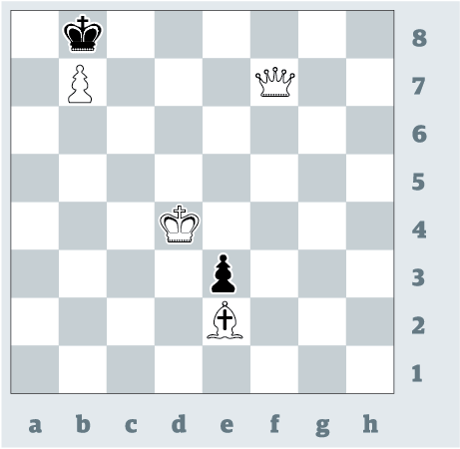
3369 1 Kc4 Ka7 2 Qc7 Ka6 3 b8N mate.