A civil rights group has filed a lawsuit seeking to overturn an “inhuman” ordinance that it says forces registered sex offenders in Miami to live in a squalid and rodent infested open-air camp without toilets or running water.
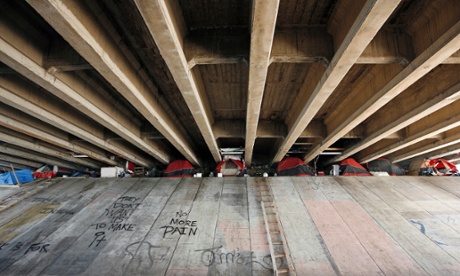
According to the American Civil Liberties Union, dozens of released inmates have no choice other than to sleep nightly on the exposed area of land next to railway tracks because of the county ordinance that prohibits them residing within 2,500 feet of any school.
The lawsuit, filed Thursday at the US district court in Miami, comes four years after a public outcry led to the dismantling of a notorious similar shantytown of more than a hundred sex offenders under the Julia Tuttle causeway in the city.
It claims the ordinance denies the plaintiffs their constitutional right to personal safety and accuses Miami-Dade County officials of reclassifying a youth centre as a school last year so it could evict offenders from a nearby mobile home park, forcing them to sleep rough.
“The conditions are horrid,” ACLU attorney Brandon Buskey said of the makeshift camp that springs up every night in a bleak warehouse district of the city close to the border with neighbouring Hialeah.
“It’s a scramble to find food and water. There are no toilets, no sanitation, and many sleep on mats or in chairs. Disease, exposure to the elements, no drinkable water, these conditions make it extremely difficult to find and maintain stable employment and psychological treatment, which are the only two factors proven to reduce the likelihood of reoffending.
“Housing restrictions like Miami-Dade’s have no impact on reoffending and, are more likely to increase it.”
The ACLU says the problem was created by the adoption of the county ordinance in January 2010, which removed all previous municipal restrictions on offenders’ residence and led to the disbandment of the five-year-old causeway encampment.
Many of the offenders who lived there moved into the River Park mobile home park, one of the few locations in Miami thought to be eligible under the ordinance with affordable housing. But in 2013 the Miami-Dade police department, which is responsible for enforcing the ordinance, received a complaint that the park was too close to the Miami Bridge family centre, which acts as an emergency shelter for youths.
Even though the ordinance refers specifically only to “public or private kindergarten elementary, middle or secondary schools”, the county decided to designate Miami Bridge as a school because it offered educational programmes, the ACLU said.
As a result, almost a hundred registered offenders living at River Park were ordered to move out, and most have ended up spending their nights at the railway encampment instead.
Jeff Hearne, legal panel chairman of the ACLU’s Miami chapter, told the Guardian that on an average night 70 or more men arrive at the site from about 8pm onwards, setting up their mats, lawn chairs or tents, and stay until dawn the following morning. The men have to use nearby bushes as a toilet, he said, looking out for snakes and rodents in the dark before they go.
“It’s pretty bleak,” he said. “You’ve got people in their 70s to men in their 20s. The shocking thing is many of them are not actually homeless. They have places they can stay, and they do during the day, it’s just that the ordinance forces them here at night. It makes no sense.”
Three camp residents feature in the lawsuit as plaintiffs, all named John Doe to protect their identities. The first, a man now in his 50s, was convicted in 1992 of lewd and lascivious conduct with a 14-year-old. He has a mental disability and has fallen ill several times while sleeping at the tracks, the lawsuit claims.
Plaintiff number two, in his late 40s, was convicted in 2006 of molesting a 14-year-old. He says the Florida department of corrections, which is also named in the complaint as a defendant, approved the camp as his official residence.
The third complainant, a man in his 50s, has a 1999 conviction involving two teenagers. He says he was evicted from his apartment in March because of the ordinance and has been sleeping in a vehicle at the camp every night since.
“Sending someone just out of jail into homelessness makes no sense, not for the person and not for the public,” said Nancy Abudu, legal director of the ACLU of Florida. “The Miami-Dade ordinance is not just unworkable, it’s unconstitutional.”
The group, through the lawsuit, argues that the ordinance violates the US constitution and Florida statues and is therefore invalid. It is seeking a judge’s order permanently barring the county from enforcing it.
A spokeswoman for Miami-Dade mayor Carlos Gimenez said he won’t comment on pending litigation