MIAMI _ Political furor erupted Friday against Miami-Dade Mayor Carlos Gimenez for requiring local jails to detain immigrants in the country illegally at the behest of the federal government, effectively abandoning Miami-Dade's stance as a "sanctuary" county.
Gimenez decided Thursday to comply with nonbinding, two-day "detainer" requests after President Donald Trump signed an executive order Wednesday threatening to deny unspecified federal grants to cities and counties that don't fully cooperate with immigration authorities. In 2013, Miami-Dade stopped holding inmates for Immigration and Customs Enforcement because the federal government did not reimburse the county for the expense.
The Justice Department took that to mean Miami-Dade was a "sanctuary" for undocumented immigrants, a designation the county has disputed though there is no legal definition for a sanctuary jurisdiction. Other big-city sanctuaries have pledged to defy Trump.
Trump praised Gimenez's action late Thursday on Twitter, calling it the "right decision."
"Strong!" Trump wrote, bringing worldwide attention to Gimenez's action, the first of its kind in the country.
Immigration advocates descended on County Hall, staging a protest _ called on short notice _ of more than 100 people that forced a lockdown of the Stephen P. Clark Center in downtown Miami to keep the demonstrators out.
"Hey, Gimenez, shame on you!" Miami labor union organizer Kathy Bird Carvajal shouted into a megaphone. "You are an immigrant, too."
Closing the County Hall lobby forced pedestrians to undergo questioning at the door about why they wanted to enter a public building that houses Metrorail and Metromover stations. Buses were diverted from their popular stops outside the building. The street was closed to traffic.
The uproar that followed seemed to catch county leaders by surprise. Gimenez was on vacation Friday, leaving his communications director, Michael Hernandez, and other aides to field questions from reporters about what Gimenez's action would mean in practice.
Hernandez said county police would not act as immigration deputies, though the corrections department will in effect subsidize immigration detentions.
The county's tax-funded jails will now extend custody by 48 hours _ but not indefinitely, county administrators say _ for someone held on local criminal charges if federal immigration authorities request it. Before Thursday, the jails released everyone immediately once they served their time or bonded out, whether federal authorities wanted them to or not. As a matter of course, police notify federal agencies of everyone they arrest by sharing fingerprints and identification.
Ali Noorani, executive director of the National Immigration Forum Action Fund, an immigration advocacy group, said using detainers to hold inmates longer than 48 hours has been ruled unconstitutional by some courts elsewhere in the country.
"A detainer is not a warrant," he said. "So in that way it has very limited legal standing in being able to actually hold somebody."
That's why counties like Broward and Palm Beach have adopted administrative rules saying they will honor detainer requests only if federal authorizes provide deportation orders or warrants signed by a judge. Miami-Dade established no such criteria in Gimenez's memo.
The previous Miami-Dade policy allowed jails to grant 48-hour detention requests, but only if federal authorities agreed in writing to cover the additional housing costs of about $200 a day. With Washington refusing to pay, the requests weren't honored. Gimenez's action dropped the reimbursement requirement.
Last year there were 174 such requests, out of more than 80,000 people booked, according to Deputy Mayor Russell Benford, who oversees the corrections department.
"It is a minuscule number of people that are actually affected by this," he said.
A report released Thursday by the liberal Center for American Progress and the National Immigration Law Center found that sanctuary counties fared better on a number of key indicators _ including crime rates, median household income and labor-force participation _ than nonsanctuary counties. The study included Miami-Dade.
Immigration advocates descended on County Hall, staging a protest _ called on short notice _ of more than 100 people that forced a lockdown of the Stephen P. Clark Center in downtown Miami to keep the demonstrators out.
Closing the County Hall lobby forced pedestrians to undergo questioning at the door about why they wanted to enter a public building that houses Metrorail and Metromover stations. Buses were diverted from their popular stops outside the building. The street was closed to traffic.
Friday, only one man showed up outside County Hall to support Gimenez. Alex Gonzalez, a law-firm employee and Cuban-American, brought a "Make America Great Again" sign bearing Trump's name.
"We have a new president," Gonzalez, who also wore a "Cubans 4 Trump" T-shirt, said in English and Spanish. "Our laws must be respected. Our borders must be respected."
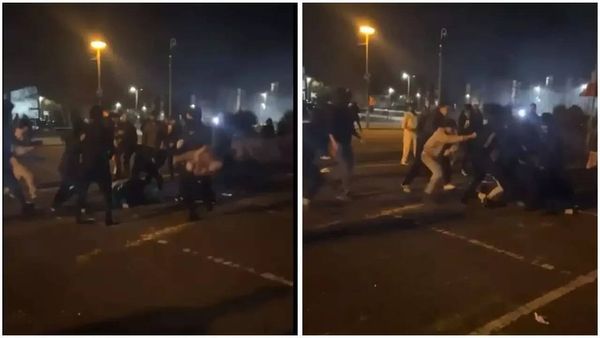
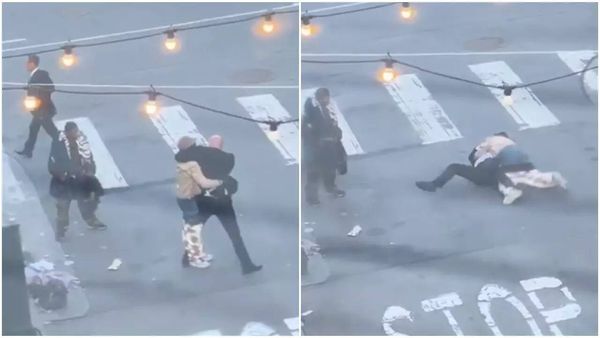
A brief scuffle with a protester ensued.
Anti-Gimenez protesters were much more plentiful in blue Miami-Dade, where 52 percent of residents are foreign-born. Hillary Clinton won Miami-Dade with 64 percent of the vote _ including one from Gimenez, despite his Republican affiliation.
Maria Bilbao, a domestic worker and North Miami Beach resident who said she secured her green card the day Trump was inaugurated, said Miami-Dade shouldn't add to the hardships of immigrants living here illegally.
"I was undocumented for 16 years," said Bilbao, a native of Argentina. "I know what it's like to be in fear. This is terrible."
The Migration Policy Institute has estimated that about 150,000 undocumented immigrants live in Miami-Dade and Monroe counties. Sanctuary advocates argue that fear of police cooperation with the federal government could make the undocumented think twice about reporting crimes.
Florida Democrats accused Gimenez of "caving" to the Trump administration.
"It's unconscionable that the mayor of Miami-Dade County would turn his back on immigrants because he lacks the spine to stand up to Donald Trump," Miami-Dade Democratic Party Chairman Juan Cuba said in a statement.
U.S. Rep. Keith Ellison of Minnesota, who's running for Democratic National Committee chairman, joined Friday's protest, and then a failed effort to enter County Hall.
"Sanctuary cities promote public safety," Ellison told protesters. "Look, Miami. You're not alone. We believe in what you're doing."
Ellison eventually met privately with the mayor's staff and police officials.
Gimenez's office was deluged with emails _ more than 400 by 1 p.m., Hernandez said _ most of them angry at the mayor for his decision. By 5 p.m., his aides had fielded more than 800 calls, almost all of them in opposition. About 30 percent came from non-local area codes.
Since last year, Miami-Dade has tried to shed its "sanctuary" label in anticipation of Trump's retaliation.
Gimenez's move appeared to get quick results: His office heard Friday from the office of U.S. Rep. John Culberson, a Texas Republican who chairs the appropriations subcommittee that funds the Justice Department's law-enforcement grants.
"We are dedicated to ensuring law enforcement receive the resources the federal government can provide but are adamant that applicable federal laws are complied with as the authorizing statute requires," Scott Mackenzie, a Culberson aide, wrote in an email to Gimenez's staff.