Summary
It’s just after 2am in Réunion, an island off of Madagascar where a piece of plane debris has been found – possibly an important breakthrough in the search for missing Malaysia Airlines flight MH370 – which disappeared in March 2014. We’re closing down this live blog, but check back here for continued coverage.
Here’s what we know now:
- An island maintenance worker found the plane debris on Wednesday morning. Investigators have flown into the French island to examine whether it could be from MH370 – which is thought to have disappeared somewhere over the Indian Ocean with 239 people onboard.
- Malaysia’s prime minister, Najib Razak, said it is “very likely” that the part, an aircraft wing section called the flaperon, is from a Boeing 777. MH370 is the only unaccounted for 777 in the world. The deputy prime minister of Australia, which has led search in the southern Indian Ocean, said that the debris find was “being treated as a major lead”.
- The flaperon is being flown to Toulouse for a full examination by the BEA, France’s civil aviation accident authority. A team of investigators from Malaysia will also be traveling to Toulouse for the examination. Aviation experts have said a serial number on the flaperon – BB657 – matches up with the serial number used for the part according to the Boeing 777 manual.
- Some media reported that a suitcase has become a part of the probe, but Australia deputy prime minister Warren Truss warned that there is no indication yet that it is from MH370. “It may just be rubbish and there is no attached marine life to indicate that it’s been in the water for any great time, but it will be examined,” Truss told AAP.
US media is reporting that a suitcase found off Réunion island is now a part of the debris probe, but is attributing that information to anonymous sources. While officials have been clear that it is “very likely” that the airplane wing piece is from a Boeing 777, there are far fewer certainties that a destroyed piece of luggage is from a specific aircraft.
Air crash investigators will examine the suitcase, which Australia deputy prime minister Warren Truss said was given to police on Réunion.
“It may just be rubbish and there is no attached marine life to indicate that it’s been in the water for any great time, but it will be examined,” Truss told AAP in a statement.
NBCNews has said that the identification number found on the plane debris is definitely from a Boeing 777. Earlier on Thursday, Malaysia’s prime minister Najib Razak said it was “very likely” that the debris was from that model of a plane.
There is only one Boeing 777 unaccounted for in the world – Malaysia Airlines flight MH370 – but investigators have not said whether this debris is from that flight.
JUST IN: ID number confirms plane fragment found on Reunion Island is from a Boeing 777 http://t.co/6ePgB0AKiK pic.twitter.com/qK7Hm4w81j
— NBC News (@NBCNews) July 30, 2015
Gillian Parker is reporting for The Guardian from Réunion, which has suddenly been thrust into the international spotlight as investigators and media descend on the island to learn more about a piece of plane debris possibly connected to the missing Malaysian Airlines flight MH370.
“Our newspapers only ever write about car crashes, volcano eruptions and shark attacks,” says restaurant manager Guillaune Lalot. “So maybe, this discovery will draw a different type of attention to the island.”
A shroud of mist cloaks the island’s monolithic volcanic hills, which are blanketed with emerald forests and rushing waterfalls. The residents of Réunion, a volcanic island around 370 miles east of Madagascar, seem relieved that attention may be diverted from the rash of shark attacks that have beleaguered the island’s prime locations in recent years. Only a week ago, a shark savagely bit a surfer causing him to lose his right arm.
“What could potentially see the end of a tragic incident is shining a spotlight on a relatively unknown paradise,” says textile worker, Audrey Gunther.
Residents in Réunion are hoping their remote island can play a part in unravelling a mystery that has left the relatives of the ill-fated passengers of MH370 without the answers they so desperately crave.
“I hope it will give the families some peace and ease their pain some,” says Sonia Angama, a waitress, “plus, you know, it will put this island on the map.”
A spokeswoman from Paris prosecutor’s office, Agnes Thibault-Lecuivre, told the AP that the flight containing the plane debris may leave Réunion on Friday and arrive in Toulouse on Saturday. The debris is at the Réunion airport and under French judicial authority, according to French officials.
Because Réunion is a French territory, the country is leading the investigation of the debris and cooperating with international officials. France has been actively involved in the investigation into the missing plane because four of its citizens were among the 239 people onboard.
Réunion island falls outside the MH370 search zone investigators have been focusing on in the past 15 months.
Martin Dolan, the chief commissioner of the Australian team coordinating the search, said the finding in Réunion “doesn’t rule out our current search area”.
The Guardian’s Gwyn Topham, Matthew Weaver and Julien Delarue with more on the debris analysis:
Otherwise, the debris itself, even if confirmed to have come from flight MH370, is unlikely to shed immediate light on the ultimate cause of aviation’s greatest mystery. But it would provide tangible evidence that the 777 did end its days in the Indian Ocean, confirming the hypothesis developed from an unprecedented analysis of satellite signals. To those conducting painstaking, difficult sea search, whose cost and likely success has been queried in some quarters, that evidence should deliver renewed purpose.
Though many officials and experts are confident that the debris is from a Boeing 777, the latest finding has done little to soothe the relatives of passengers on Malaysia Airlines flight MH370.
The flight went missing en route from Kuala Lumpur, Malaysia to Beijing, China in March 2014 and investigators have been searching the Indian Ocean for traces of the missing Boeing 777.
Malaysia’s prime minister Najib Razak said it is too early to speculate on whether the debris is from MH370 and results from the examination in Toulouse are expected in the next two days.
KS Narendran, whose wife of 25 years was on the missing plane, was cautious about the most recent developments in the search.
“We’ve been through this many times,” Narendran told CBS. “I think it has really not helped us to either keep expectations high or to, in a sense, hope for some quick answers.”
Najib too, expressed caution, in his statement about the discovery.
“As soon as we have more information or any verification we will make it public,” Najib said. “We have had many false alarms before, but for the sake of the families who have lost loved ones, and suffered such heartbreaking uncertainty, I pray that we will find out the truth so that they may have closure and peace.”
Updated
A volcanic eruption is “probable and imminent” on France’s Réunion island, where the plane debris was found. OVPF, the island’s volcanic observatory, detected a spike in seismic activity at Le Piton de la Fournaise, one of the most active volcanoes in the world.
The volcano has erupted twice this year and has been evacuated. It is on the eastern part of the island, south of Saint-André, where the plane debris was located. It is unclear how the imminent eruption could affect the investigation - though such evacuations are common on the island.
What we know so far
This is Amanda Holpuch in New York, taking over the live blog as investigators examine what could be the first major breakthrough in the search for the missing Malaysian Airlines flight MH370. The discovery of plane debris on an island could be tied to the only unaccounted Boeing 777 in the world, which went missing on 8 March 2014.
• Plane debris found on Réunion Island is being sent to investigators in Toulouse in an effort to determine whether its part of the missing aircraft. Malaysia’s prime minister, Najib Razak, said it is “very likely” that the part, an aircraft wing section, is from a Boeing 777.
• Malaysia has also sent a team to Réunion to survey the area where the plane debris was found and to Toulouse, where it is being examined by the French authority BEA. The agency investigates civil aviation accidents and will be joined by a team from Malaysia.
• Workers in Saint-André found a flaperon, a moveable part on the edge of a wing – on Wednesday. French newspaper Le Journal de l’ile de La Réunion published a photo that they said was of the flaperon, stamped with serial number 657-BB – which matches the Boeing 777 manual.
• Relatives of the 239 people on board the flight have expressed skepticism about the new developments. Cheng Liping, a mother-of-one whose husband, Ju Kun, was on the flight, told the Guardian: “Personally, I don’t believe it. I don’t believe that they have found it. It’s been more than a year.
We’re going to pause the live blog for now, but we’ll resume again when there’s more news about the debris.
Updated
Johnny Bègue was aware debris he found on the shore could have come from a plane, but no idea it could be wreckage from Malaysia Airlines flight MH370, writes Julien Delarue in Saint-Denis Réunion.
In Saint-André, a town on the east of the French Indian Ocean island of Réunion, Johnny Bègue and his team of eight charged with keeping the local coastline clean had begun work at 7am as usual on Wednesday morning. Bègue, a local islander who for three years had headed the team responsible for maintaining the green spaces, had a morning break just before 9am and took the chance to look along the coast for a stone to use as a pestle.
“At around 8.45am, I was walking the shoreline looking for a kalou – a stone which can be used as a pestle for grinding spices,” he said. “That was when I saw some debris washed up on the pebbles. Straight away I called over my colleagues to help me pick up the piece and place it higher up the shore.”
He said that as soon as he saw the strange piece of debris he knew it must have come from a plane. “I immediately thought it was plane debris – the length and curve of it, there were screws on it that hadn’t gone rusty.”
What we know so far
Here’s a summary of the latest developments in what is looking like the first major breakthrough in the search for Malaysia Airlines flight MH370 almost 17 months since it went missing with 239 people on board.
- An aircraft wing section washed up on the French island of Réunion in the Indian ocean is very likely to be wreckage from a Boeing 777, according to Malaysia’s prime minister, Najib Razak. MH370 is the only unaccounted-for 777 in the world. Malaysia has sent a team to Réunion to examine the area where the debris was found.
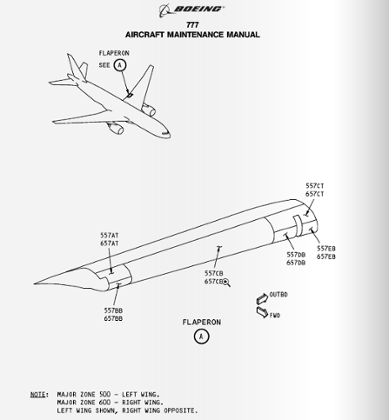
- A serial number photographed on the 2m piece of debris matches a part listed in Boeing’s 777 manual. The number – 657BB – is part of the Boeing’s flaperon, a moveable part on trailing edge of wing. This is consistent with the size and shape of the recovered debris.
- The debris, which was found by workers in Saint-André, on the east coast of Réunion island, is to be taken to Toulouse for analysis by civil aviation investigators. A team of specialised French gendarmerie investigators are on their way to Réunion, to join a Malaysian team to verify whether the debris could be from MH370.
- Relatives of the 153 missing Chinese passengers have reacted with suspicion, disbelief and shock. Cheng Liping, a mother-of-one whose husband, Ju Kun, was on the flight, told the Guardian: “Personally, I don’t believe it. I don’t believe that they have found it.”
- British government sources on their way to Malaysia as part of prime minister David Cameron’s tour of south-east Asia are working on the assumption the plane fragment was indeed part of the missing plane. Warren Truss, Australia’s deputy prime minister, said: “Clearly we are treating this as a major lead.”
Dr David Ferreira, an oceanographer at the University of Reading, said it is “perfectly possible” that the aircraft debris drifted thousands of miles from the search area off the Australia coast to Réunion.
In an email to the Guardian he said:
“To have reached Réunion from the main search area west of Australia, the piece of debris would have travelled around 3-4,000 km in the 16 months since the crash. This is on the fast side of the range of possibilities, but is still perfectly possible.
“The Indian Ocean has two dominant currents – one to the south of the suspected crash zone, which travels west to east, and one to the north, which travels east to west. If the piece of suspected wreckage found on Réunion did come from MH370, it is possible that it could have initially floated north from the crash zone, before being caught in the strong current close the equator travelling west.
“On its own, this piece of debris will not do much to narrow down the search area by very much. Put bluntly, over a 16 months period, the debris could have travelled from nearly anywhere in the Indian Ocean to Réunion. That said, some points of origin are more likely than others, and the debris found on Réunion could at least provide evidence that the search operation is in the right kind of area. Combined with other evidence, this may allow investigators to focus on a narrower patch of the ocean floor as they continue their search for more wreckage.”
Last year Ferreira produced a simulations of particle trajectories in the Southern Indian Ocean illustrating the possible fate of debris from the missing MH370 flight.
Jacquita Gonzales, whose husband Patrick Gomes was MH370’s cabin crew supervisor, said she had “been on the roller coaster many times”.
Speaking about the discovery of debris she told AFP:
“It has started all over again, staring at the handphone constantly for news.
“We have mixed feelings. If this is true, at least I know I can have peace and give my husband a proper send-off.”
But part of us still hopes they are out there alive somewhere.”

Photo of serial number on debris?
The Réunion news site Clicanoore has published a photograph purporting to show a detail of the debris showing the serial number 657BB which would link it to the missing Boeing.
The image is suspiciously close up and it doesn’t appear to show material that has been floating in the ocean for almost 17 months.
Photo du numéro de série de la pièce Boeing 657-BB #MH370 (via @Clicanoore ) #ReunionIsland #LaReunion pic.twitter.com/DDHNpbI2h4
— Julien Delarue (@delarue_julien) July 30, 2015
Updated
Here’s the 260-page manual showing the serial numbers to the numerous parts of the Boeing 777. It includes this diagram of a flaperon with the part number 657BB said to have been seen on the debris washed up on Réunion.
Updated
This map underlines how far the debris is from the search area. Oceanographers say it could have drifted that far west.
The serial number found on the flaperon should, in theory, rapidly allow investigators to confirm whether the part did originate from a Boeing 777, writes the Guardian’s transport correspondent, Gwyn Topham.
While there is some confusion over the reported number - BB670, according to the Australian deputy prime minister, Warren Truss, but 657BB according to reports from Reunion - the part number appears to match that of the flaperon on the Boeing 777.
The number is normally attached to a larger aeroplane part on a small metallic plate and should register not only the generic part number, but an individual serial number that allows the history of that particular part to be traced. That should tally with the records held by the manufacturer and the airline. Individual parts could have been swapped since original construction, and are labelled to allow aircrafts engineers to track if and when they need maintenance or replacement.
That simple record check means investigators, Malaysian Airlines and Boeing should already be confident whether the numbered part could have come from flight MH370 - if they have been provided with a full and accurate serial number. However, with the history of false starts and confusion in the long and emotive search for the missing airliner, few officials would want to confirm the lead before viewing the physical evidence on Reunion directly, experts say.
David Gleave, an air accident investigator, said: “The serial number information should be fairly easily accessible - but we should be cautious.
“It’s not unknown for very strange things to occur during crash investigations, and you would want to eliminate all possibilities. It’s a big international investigation - and it is possible to buy these parts should you wish to confuse things. You want to be able to track the complete history to establish that exact part came from that plane.”
Gleave added: “A lot of aircraft parts look very similar to other aircraft parts, and these things take time to confirm - given the amount of grief we really must make sure.”

Updated
Debris to be examined in Toulouse

Malaysia’s prime minister Najib Razak, has confirmed that the debris found on Réunion is “very likely” to be from a Boeing 777, but it is still too early to speculate whether it is from MH370.
In a statement he said the debris will be taken to the French city of Toulouse for examination by civil aviation investigators.
He also promised relatives of passengers that Malaysia will not give up searching for the plane.
Initial reports suggest that the debris is very likely to be from a Boeing 777, but we need to verify whether it is from flight MH370. At this stage it is too early to speculate.
To find out as fast as possible, the debris will be shipped by French authorities to Toulouse, site of the nearest office of the BEA, the French authority responsible for civil aviation accident investigations.
A Malaysian team is on the way to Toulouse now. It includes senior representatives from the Ministry of Transport, the Department of Civil Aviation, the MH370 investigation team, and Malaysia Airlines.
Simultaneously, a second Malaysian team is travelling to where the debris was found on Reunion.
The location is consistent with the drift analysis provided to the Malaysian investigation team, which showed a route from the southern Indian Ocean to Africa.
As soon as we have more information or any verification we will make it public. We have had many false alarms before, but for the sake of the families who have lost loved ones, and suffered such heartbreaking uncertainty, I pray that we will find out the truth so that they may have closure and peace.
I promise the families of those lost that whatever happens, we will not give up.
Updated
AirLive.net tweets another image from the Boeing manual showing the Boeing 777 flaperon with the 657-BB code reported seen on the washed-up debris.
UPDATE Boeing 777 maintenance manual can be read on http://t.co/MlhHe6Px4F (look page 235) #MH370 pic.twitter.com/Wd8MmzQhNu
— AirLive.net (@airlivenet) July 30, 2015
Note that it does not include the code 670-BB which was also reported stamped on the debris.
Updated
Code matches Boeing manual
Serial number update ...
The aviation website AirLive.net reports that one of the codes reportedly stamped on the debris matches a Boeing 777 flaperon, according to Boeing’s maintenance manual.
BREAKING 657-BB code found on wreckage is Boeing 777 flaperon according to manual /@Paris7Life http://t.co/MlhHe6Px4F pic.twitter.com/Zx1XAPNbfC
— AirLive.net (@airlivenet) July 30, 2015
BREAKING '657BB' code found on wreckage is Boeing 777 flaperon according to manual #MH370 http://t.co/MlhHe777Wd pic.twitter.com/bM9DPNW5gw
— AirLive.net (@airlivenet) July 30, 2015
A mechanic from the Réunion-based airline Air Austral told local journalists the debris was stamped with 657-BB. Other reports said the number was BB670.
Updated
Relatives of the missing Chinese passengers have reacted with suspicion, disbelief and shock, writes Tom Phillips in Beijing.
There were 153 Chinese passengers on the Beijing-bound Boeing 777 when it disappeared on 8 March last year after leaving Kuala Lumpur and many of their families continue to harbour hopes that they might one day return.
Reports that debris of a Boeing 777 had been found on Réunion, east of Madagascar, did little to change their minds.
Cheng Liping, a mother-of-one whose husband, Ju Kun, was on the flight, told the Guardian: “Personally, I don’t believe it. I don’t believe that they have found it. It’s been more than a year. If they were able to find it they would have already found it. Why now and why just a small piece of debris?”
Jack Song, whose sister Song Chunling was lost, agreed. “Nobody believes it. If it belongs to 370, where are the other things like the seats, the cargo?” he said.
News that one of the most baffling mysteries in aviation history could have moved a step closer to resolution came to the Chinese families in the early hours of Thursday.
Shortly after midnight, one relative posted reports of the find on social media. Minutes later another relative, whose mother was on the plane, sent an anxious reply. “Who has more information?” When did they find it?” the message said.
By daybreak, relatives were still struggling to make sense of the development.
(This is Matthew Weaver taking over live blog hosting duties from Claire).
Updated
What we know so far
Here is the latest summary of what we know – and what we don’t – following the discovery of plane wreckage on Réunion island in the southern Indian Ocean:
- Malaysia’s deputy transport minister says it is “almost certain” that the debris belongs to a Boeing 777 – the same aircraft as missing MH370, and the only 777 missing in the world. Deputy transport minister Abdul Aziz Kaprawi said:
It is almost certain that the flaperon is from a Boeing 777 aircraft. Our chief investigator here told me this.
- Warren Truss, deputy prime minister of Australia, which is heading the seabed search for MH370, said photographs showed a part “not inconsistent with a Boeing 777”, although he said there are “other possibilities”:
Clearly we are treating this as a major lead.

- The 2m (6ft) piece of wreckage was found by workers in Saint-André, on the east coast of Réunion island, on Wednesday.
- The debris has been identified as a flaperon, a hinged part on an aircraft wing that can be lowered to control the roll and bank of a plane.
- A team of specialised French gendarmerie investigators are on their way to Réunion, to join a Malaysian team to verify whether the debris could be from missing Malaysia Airlines flight MH370.
- The team includes experts from Malaysia’s department of civil aviation and Malaysia Airlines, who would be joined by representatives from Boeing, Kaprawi said:
We expect in two days we can complete the verification.
- A mechanic from the Réunion-based airline Air Austral told local journalists the debris was stamped with 657-BB, a number that could be used to identify a part, although other reports said the number was BB670.
- If the flaperon is proven to be from a Boeing 777 – and we do not yet have that confirmation – it is almost certain to be MH370, the only aircraft of that type to be missing and the only 777 to have crashed in the southern hemisphere.
- Local police on the ground have confirmed reports that remnants of a badly damaged suitcase have been found at Saint-André, close to where the plane debris was recovered. It is unclear whether the case has any connection to the flaperon or MH370.
Une valise découverte au même endroit que le débris d'aile (photo Ludovic Laï-Yu @Clicanoore ) #MH370 #LaReunion pic.twitter.com/QoEKtKrvbw
— Julien Delarue (@delarue_julien) July 30, 2015
- British government sources on their way to Malaysia as part of prime minister David Cameron’s tour of south-east Asia are working on the assumption the plane fragment was indeed part of the missing plane.
- Relatives of the 153 Chinese passengers on board MH370 called for clarity, saying:
We don’t ever again want information that is 99% positive … We want 100% positive.
I am handing over this live blog now to my colleague Matthew Weaver in London.
Thanks for reading.
Réunion officials: 'Nothing can be ruled out'
French authorities have said that no hypothesis could be ruled out with regard to plane debris found on Réunion, but that its origin had not yet been identified, after a Malaysian minister said he was almost certain it was from missing flight MH370.
In a joint statement, the Réunion prefecture and the French justice ministry said:
No hypothesis can be ruled out, including that it would come from a Boeing 777.
Julien Delarue sends this latest update from Réunion:
The Journal de L’île de la Réunion said expert analysis of photos of the debris has identified the type of crustaceans on it.
The paper said the species was Lepas anatifera (also known as goose barnacle), which lives ‘in temperate or warm waters’ and grows by 1cm to 2cm a year.
Marine biologist Joseph Pouplin from the French naval academy in Brest told the newspaper that these crustaceans could have attached themselves to the debris for several months or a year.

Barnacles on the debris could help to identify the wreckage’s origins, giving an indication of how long it has been in the ocean, Australian officials have said.
Local news site L’info à La Réunion has interviewed the municipal workers who spotted the debris while working on the beach at Saint-André in the east of the island on Wednesday.
The workers did not immediately realise what they had found, L’info reports, quoting the men as saying they had originally thought to bring the debris on to dry land in order to display it as a “decoration” for visitors to the island.
They later realised the piece could be a highly significant find.
Julien Delarue, a journalist with Journal de L’île de la Réunion, says local police on the ground have confirmed reports that remnants of a badly damaged suitcase have been found at Saint-André, close to where the plane debris was recovered.
But investigators would now have to assess whether there could be any possible connection to the debris, he said. The chances are high that this is a coincidence.
Info @Linfore : un des jardiniers a retrouvé une valise abimée ce matin à Saint-André, au meme endroit que le bout d'aile. #LaReunion
— Antoine Forestier (@a_forestier) July 30, 2015
However, pictures of the suitcase don’t immediately appear to show something that has been in water for nearly 17 months:
Photo de la valise retrouvée ce matin à Saint-André, près de là où l'aile a été vue hier. (photo @Linfore) #LaReunion pic.twitter.com/Dp23nq0U4l
— Antoine Forestier (@a_forestier) July 30, 2015
Barnacles on the debris could help to identify the wreckage’s origins, giving an indication of how long it has been in the water, Australian officials have said:
Beijing is “closely observing the situation” with regard to the discovery of debris on Réunion, according to Xinhua, China’s official news agency, Tom Phillips writes from Beijing.
“We have noticed the reports and are wasting no time in obtaining and checking the information,” Hong Lei, a foreign ministry spokesperson, said in a statement.
And my colleague Angelique Chrisafis reports from France:
A team of specialised French gendarmerie investigators are on their way from Paris to La Réunion, to join a Malaysian team.
Australia, which has led the seabed search, has said that investigations into the debris will be headed by French and Malaysian officials.
La Réunion is an overseas département of France.

The British prime minister, David Cameron, is on his way to Malaysia today, as part of a tour of south-east Asia. Earlier this week, it looked as if his visit would be dominated by corruption allegations levelled at Malaysian PM Najib Razak.
But now it seems attention will be on whether the missing Malaysia Airlines plane has finally yielded its first tangible clue.
The Guardian’s political editor, Patrick Wintour, who is travelling with Cameron, reports that British government sources on their way to Malaysia are working on the assumption the plane fragment was genuinely part of the missing plane.
Updated
Julien Delarue, a journalist with Journal de L’île de la Réunion, sends this update from the island:
A mechanic from the Réunion-based airline Air Austral told local journalists he had studied the debris with French military officials and concluded with 99.9% certainty that it originated from a Boeing 777.
He said the debris was stamped with 657-BB, a number that could be used to identify a part and the plane to which it belonged.
(This number is different to that cited by Australia’s deputy PM just now; he mentioned BB670. Once we have clarity on that, I’ll update.)
A number stamped on the aircraft debris could be the key to a quick identification of its origin.
Warren Truss, Australia’s deputy prime minister, said the number was not a serial number but could be some sort of maintenance number that could help with identification.
Truss said the number was BB670.
This kind of work is obviously going to take some time although the number may help to identify the aircraft parts – assuming that’s what they are – much more quickly than might otherwise be the case.
My colleague Tom Phillips has sent from Beijing the full statement that Chinese relatives of missing MH370 passengers have put out in response to today’s news:
We will follow the developments, and we hope to have an officially verified conclusion as soon as possible. We don’t ever again want information that is 99% positive information that is given by some officials. We want [the information] to be 100% positive.
We care more about where our families rather than where the plane’s wreckage is. Did the plane land somewhere in the middle of the flight? No one has ever confirmed that all passengers boarded the plane.
Whether or not the wreckage belongs to MH370, it should not affect the promise given by all parties, which is to not stop or give up the search effort.
We hope the Malaysian government and Malaysia Airlines will reopen the aid centre for Chinese families, restore information communication and psychological support and provide emergency expenses reimbursement. In such an urgent situation the families don’t know where to get confirmed information, and hence the Malaysian government and Malaysia Airlines’ responsibilities cannot be substituted by media reports.
Apart from the search, we are also concerned about the development of the criminal investigation into the case. An investigation without third-party involvement can never find the real causes for the disappearance of the plane and can never provide reliable evidence to help the search effort. This is a crime against the families and a crime against aviation safety.
Yannick Pitou, a journalist on La Reunion who photographed the debris, told the BBC World Service that a piece of the debris had been sent to France for analysis:
The debris is made of metal and is two metres by two metres, and as soon as they discovered it, the local workers of the beach called the police and the air transport officials were alerted.
The whole situation around this mysterious object developed quickly after that. The debris was taken out of the water and was brought to the local airport in Sainte-Marie to a secure location and a piece of it has been sent to France for further analysis and to confirm if it is aeroplane debris – although there is little doubt of that, but of course to check if it is indeed from flight MH370.
It’s big news here, of course, as well as around the world. It’s the first time that debris like this is found on the island. Everyone is asking questions and it’s put the spotlight on La Réunion.

Warren Truss briefing: summary

Warren Truss, Australia’s deputy prime minister, has just finished talking to the press about the discovery of the debris. Here’s a recap:
- While it cannot yet be confirmed that the part found in La Réunion is from MH370, Truss said photos from the scene are “not inconsistent with a Boeing 777”, although he said there are “other possibilities”:
Clearly we are treating this as a major lead.
- A number seen on the part, BB670, is not a serial number but could be a maintenance number, Truss said.
- It is a “realistic possibility” that debris from where MH370 is thought to have crashed could have drifted as far as Réunion.
- The Australian-led seabed search operation believes it is searching the right area, and will continue to do so.
Updated
Truss says he hopes some of the “wild” theories about the fate of the aircraft will be put to bed if this turns out to be a part of MH370, but he says it also won’t tell us much more about the plane’s location, beyond the fact it is in the Indian Ocean.
Truss: We still believe … that the search area is the right one.
We’ve refined the boundaries of that search on several occasions in the past, he says.
Weather conditions in the search area are currently “very poor”, he says, but search efforts will be stepped up as winter passes.
Updated
The families have waited a long time for any news, Truss says, and we still don’t have anything positive for them.
Truss: 'We are treating this as a major lead'
A piece of debris could have floated a very, very long way in 16 months and it is a very, very long way to the Reunion islands from where we think the aircraft entered the water.
Clearly we are treating this as a major lead.
The Réunion island is a French territory, Truss says, so France and Malaysia are leading on this aspect of the search. Australia, which leads the search in the waters closer to Australian territory, will continue to assist.
Truss says the investigation will take some time but the BB670 number could help to speed that up.
This is particularly stressful for the families of the people who lost their lives on MH370, he says.
He says the Australian authorities have been in touch with families affected.
Truss says photos of the wreckage suggest the debris could be the flaperon.
The photos are “not inconsistent with a Boeing 777”, he says, but there are other possibilities.
More investigation will be needed to verify that it is from a 777 and if so, which one.
He says the number on the part, BB670, could be a maintenance number. It is not a serial number, he says.
It is a “realistic possibility” that debris from where MH370 is thought to have crashed could have drifted as far as Réunion.
Australian government press conference
Warren Truss, the Australian deputy prime minister, is about to speak about the find on La Réunion.
Australia has been leading the seabed search for the missing plane.
I’ll have live updates from the press conference here.
Associated Press reports that relatives of many of the 153 Chinese passengers of MH370 have said in a statement that they want authorities to be 100% certain the part was from the missing plane.
Even if so, the families insisted, it should not dampen the resolve to find the rest of the wreckage, the whereabouts of all the passengers and the reasons for the disappearance.
The Réunion debris may finally rule out that missing passengers might still be alive, said Wang Zheng, an engineer in the southern Chinese city of Nanjing whose father and mother, Wang Linshi and Xiong Deming, were aboard the flight as part of a group of Chinese artists touring Malaysia:
All hope is truly gone now. I’m feeling very confused and emotional at the moment.

Updated
Malaysian minister: 'almost certain' debris is from Boeing 777
Malaysia’s deputy transport minister says it is “almost certain” that the debris belongs to a Boeing 777 – the same aircraft as missing MH370, and the only 777 missing in the world.
Reuters reports deputy transport minister Abdul Aziz Kaprawi:
It is almost certain that the flaperon is from a Boeing 777 aircraft. Our chief investigator here told me this.
Malaysian transport ministry statement
I’ve just received a statement from the Malaysian ministry of transport. It does appear to acknowledge that the debris is a flaperon, though it does not confirm whether it is from a Boeing 777.
It also cautions against raising “fresh hope” for relatives of those on board the missing aircraft:
A part identified as a flaperon that could possibly belong to the Boeing 777 aircraft that was MH370 has been discovered. The flaperon was washed up on to the island of Réunion, which is located in the Indian Ocean.
We are in contact with our counterpart from Bureau d’Enquêtes et d’Analyses (BEA), the French air crash investigation agency, pertaining to this matter.
A team comprising experts from the department of civil aviation, Malaysia Airlines and the Malaysian ICAO Annex 13 safety investigation team for MH370 has been despatched to Réunion island to verify whether the flaperon belongs to the missing aircraft.
The ministry would like to state that until there is tangible and irrefutable evidence that the flaperon does belong to the missing aircraft, it would be premature to speculate at this juncture.
This is to ensure that we do not raise false hope for the loved ones of the victims of MH370. We will make the necessary announcements once details have been verified.
In May this year, Australian authorities leading the seabed search for MH370 were forced to alter search operations as the southern hemisphere winter set in.
The weather was affecting use of an automated underwater search vehicle, and rough seas were making it difficult to launch and recover drones.
Australia’s joint agency coordination centre (JACC) said a decision had been made to suspend drone operations during winter but that plans had been modified so the search could continue and an expanded 120,000 square-kilometre area could be scoured.
“Safety of the search crews also remains a priority,” it said.
Authorities have warned that the plane might not be retrievable even if found, with a JACC official saying it was possible the Boeing 777 might not be able to be recovered if it was in an inaccessible location, such as an ocean abyss.
What is a flaperon?
Investigators suspect the debris is a “flaperon”, a mix of a flap and an aileron.
Flaps keep the aircraft flying at slower speeds, but also increase drag, so are normally raised during flight for efficiency.
They are mounted on the trailing edge (the back) of a wing and allow take off and landing at shorter distances.
An aileron, also hinged on the trailing edge, is used to roll the aircraft left and right.
Read more here:
Updated
Australia’s deputy prime minister, Warren Truss, has been speaking about the find on La Réunion.
Australia is heading the search for MH370.
Australia's Deputy PM says still believes the current #mh370 search area is "most prospective site ... no change likely to search strategy"
— Rob Taylor (@WSJRobTaylor) July 30, 2015
Australia's Deputy PM Truss on #MH370: "We still believe that the aircraft is resting in waters in the Australian search area"
— Rob Taylor (@WSJRobTaylor) July 30, 2015
Truss says the search effort has adequate resources.
What we know so far
Here is the latest summary of what we know – and what we don’t – following the discovery of plane wreckage on La Réunion island in the southern Indian Ocean:
- A 2m (6ft) piece of wreckage, which seemed to be part of a wing, was found by people cleaning a beach in Saint-André, on the east coast of La Réunion island.
- A team of investigators is on its way to the island to verify whether the debris could be part of missing Malaysia Airlines flight MH370.
- The team includes experts from Malaysia’s department of civil aviation and Malaysia Airlines, who would be joined by representatives from Boeing, maker of the 777-200 aircraft, Malaysia’s deputy transport minister, Abdul Aziz Kaprawi, said:
We expect in two days we can complete the verification.
- Aviation experts have suggested the piece could be a flaperon, a hinged part on an aircraft wing that can be lowered to control the roll and bank of a plane. A serial number – BB670 – has been reportedly spotted on the debris.
- If the flaperon is confirmed to be from a Boeing 777 – and we do not yet have that confirmation – it is almost certain to be MH370, the only aircraft of that type to be missing.

- The Australian government (Australia is heading the search for MH370) said:
In the event that the wreckage is identified as being from MH370 on La Réunion Island, it would be consistent with other analysis and modelling that the resting place of the aircraft is in the southern Indian Ocean.
- Martin Dolan, chief commissioner of the Australian transport safety bureau who is heading the seabed search, said:
It certainly looks like an aerofoil from a large aircraft …
It is entirely possible that something could have drifted from our current search area to that island.
Updated
Sara Weeks, sister of MH370 passenger Paul Weeks of New Zealand, said she was happy the debris was in the hands of French investigators in La Réunion.
She told Fairfax New Zealand:
They’ve [Malaysia] just been incompetent, so at least it’s in the hands of someone else and we may get some answers a little bit quicker.
Aviation investigators have headed to the French Indian Ocean island of La Réunion to determine whether a piece of plane wreckage that washed up on its shores is part of missing Malaysia Airlines flight MH370.
The search team includes French, Malaysian, and Australian authorities, and Malaysia has said its experts are on their way to the island. The deputy transport minister, Abdul Aziz Kaprawi, said the team included experts from Malaysia’s department of civil aviation and Malaysia Airlines, who would be joined by representatives from Boeing, maker of the 777-200 aircraft.
“We expect in two days we can complete the verification,” Abdul Aziz said.
Much of the analysis of and speculation about the debris has so far been based on photographs of the 2m (6ft) long piece of wreckage.
One witness in La Réunion said the object was “covered in shells”, indicating it had been in the water for a long period of time.
Authorities involved in the search believe the plane diverted – for reasons unknown – to the southern Indian Ocean, where it went down.
The Australian-led search operation has so far scoured more than 50,000 square kilometres (19,000 square miles) of the seafloor, about 60% of a search zone in the Indian Ocean determined via expert analysis of signals from MH370 that were detected by a satellite.
But search vessels towing 10km (6mile) cables fitted with sophisticated sonar systems have turned up no sign of MH370.
La Reunion lies about 4,000km from the area considered the most likely impact zone.
Map: from search area to La Réunion
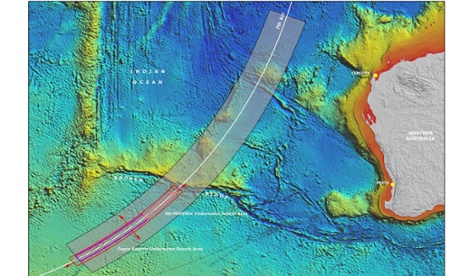
My colleague Nick Evershed has put together this graphic showing, in orange, the search area identified by the teams looking for MH370, and the location of La Réunion, the island where a piece of debris believed to be from the missing plane has washed up.
Professor Charitha Pattiaratchi, an oceanographer from the University of Western Australia, said the possibility debris from MH370 had washed up on Réunion was “entirely consistent with the area [west of Perth] that the search team is looking at – it’s entirely consistent in terms of oceanography, in terms of the modelling”, Michael Safi reports.
“It makes sense based on some of the modelling we did 12 months ago, that some time with 18 to 24 months after [the crash] this could be the area the debris would have ended up in,” Pattiaratchi said.
He said it was difficult based on photographs of the debris to ascertain how long it had been in the ocean, but said it would be “at least six months”.
Updated
My colleague Oliver Holmes sends some further details on what a flaperon – which some experts have identified as the debris found on La Réunion – actually is:
A flaperon is a mix of a flap and an aileron.
An aileron is hinged on the trailing edge (the back) of a wing and used to roll the aircraft left and right. A flap is also mounted on the trailing edge and allows take off and landing at shorter distances.
Flaps keep the aircraft flying at slower speeds but also increase drag so are normally raised during flight for efficiency. You find them on small and large aircraft.
In the photos of the debris you can see a vertical hole down the thicker edge of the flaperon. This is where the device would be connected to the main wing.
Similitudes incroyables entre le flaperon d'un #B777 et le débris retrouvé ce matin à #LaReunion... #MH370 ? pic.twitter.com/GDkzRLwi2h
— Xavier Tytelman (@PeurAvion) July 29, 2015
Tom Ballantyne, chief correspondent for Orient Aviation magazine, has been talking to CNN about the debris discovery.
He says if the piece is proven to have come from MH370, it “will give [investigators] a very good indication if searches have been going on in the right location” – though this could still mean thousands of square miles of ocean.
On the piece of wreckage itself, Ballantyne said:
It looks as if it probably broke off as it hit the ocean. It’s not dented or damaged … it looks pretty complete.
He says this might suggest the aircraft “pancaked” into the Indian Ocean, adding that the sole piece of debris, if it is indeed from MH370
is not going to answer the really important questions about why it happened and what happened. They’re going to need to find the aircraft itself.
He added, however, that if this debris is from the missing plane, he would expect other pieces to have drifted in the same direction; local beaches and ocean should be searched.
In other Malaysia Airlines news, Malaysia’s transport minister Liow Tiong Lai is in New York and has reacted to Russia’s veto of a United Nations proposal to establish an international criminal tribunal into the MH17 disaster:
Resolution 2 establish int'l criminal tribunal 4 MH17 not adopted.a Great disappointment. #UNSC #MH17 #JusticeForMH17 pic.twitter.com/fsePqbzuCk
— Liow Tiong Lai (@liowtionglai) July 29, 2015
The Malaysia Airlines plane was shot down over eastern Ukraine on 17 July last year – just four months after MH370 was lost – an hour into its flight from Amsterdam to Kuala Lumpur.
Russia has denied any involvement in the shooting, but a Dutch-led investigation due to report in October is believed to support claims Russian-backed separatists were responsible.
The resolution to establish a criminal tribunal was supported by 11 countries, with Russia – as one of five permanent members with veto power – the only nation to vote against the proposal on Wednesday.
In an unrelated incident, a Boeing 777 flight has diverted to Alaska’s Aleutian islands after smoke was spotted inside the aircraft.
The Cathay Pacific flight from Hong Kong to Los Angeles with nearly 300 people on board diverted to a remote US military airport in Alaska’s Aleutian islands on Wednesday due to smoke in the aircraft, airline officials said.
All 276 passengers and 18 crew members on board flight CX884, a Boeing 777-300ER, were safe.
You can read that story here:
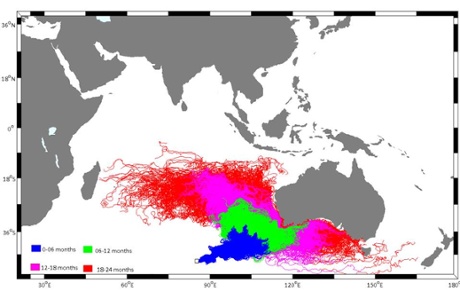
Charitha Pattiaratchi, professor of coastal oceanography at the University of Western Australia, produced this model of the possible drift of wreckage last year, after it was determined that MH370 had probably crashed somewhere in the southern Indian Ocean.
The model indicates that by around 18 months after a crash – MH370 disappeared on 8 March 2014, nearly 17 months ago – debris could have reached the ocean to the east of Madagascar, close to Réunion island.
Updated
Azharuddin Abdul Rahman, director-general of Malaysia’s department of civil aviation, says his agency will meet today with the country’s transport ministry, foreign ministry and Malaysia Airlines to discuss “next steps”, Agence France-Press reports.
But first we need to verify whether this part belongs to MH370. We have to look at it.
Malaysian authorities could not offer an estimate of when experts might be able to definitively determine whether the part is from MH370.
Malaysia is overall coordinator of an investigative effort that includes Boeing, the US National Transportation Safety Board, and other agencies.
The initial search for MH370 was marked by a series of false leads and contradictory statements by Malaysian authorities, and the news of the discovery stirred painful emotions in next of kin frustrated by the lack of evidence, reports AFP.
Jacquita Gonzales, whose husband Patrick Gomes was the flight’s cabin crew supervisor, said:
We have been on the rollercoaster many times and have managed to settle, but now this.
We have mixed feelings. If this is true, at least I know I can have peace and give my husband a proper send-off. But part of us still hopes they are out there alive somewhere.

Updated
What we know so far
Time for a round-up of what we know – and what we don’t – following the discovery of plane wreckage on Réunion Island:
- A 2m (6ft) piece of wreckage, which seemed to be part of a wing, was found by people cleaning up a beach in Saint-André, on the east coast of La Réunion island in the Indian Ocean.
- Malaysia has sent a team to verify whether the debris could be part of missing Malaysia Airlines flight MH370. Malaysia Airlines and Boeing are assisting in the analysis of the wreckage.
- Aviation experts have suggested the piece could be a flaperon, a hinged part on an aircraft wing that can be lowered to control the roll and bank of a plane.
- If the flaperon is confirmed to be from a Boeing 777 – and we do not yet have that confirmation – it is almost certain to be MH370, the only aircraft of that type to be missing.
- Something that could be a serial number – BB670 – has been reportedly spotted on the debris*.
- The Australian government (Australia is heading the seabed search for MH370) said:
In the event that the wreckage is identified as being from MH370 on La Réunion Island, it would be consistent with other analysis and modelling that the resting place of the aircraft is in the southern Indian Ocean.
- Martin Dolan, chief commissioner of the Australian transport safety bureau who is heading the seabed search for MH370, said:
It certainly looks like an aerofoil from a large aircraft …
It doesn’t rule out our current search area if this were associated with MH370. It is entirely possible that something could have drifted from our current search area to that island.
[*Edit: I previously wrote that BB670 would reportedly not match a Boeing 777; this is not yet clear so has been removed.]
Updated
Here are some closer views of the wreckage, which some experts believe could be a flaperon from the Boeing 777 MH370:
Could plane wreckage washed up on an Indian Ocean island be from #MH370? http://t.co/uUKprCOySh pic.twitter.com/2JNXw7FkRW
— BBC News (World) (@BBCWorld) July 29, 2015
Un bout d'aile d'avion retrouvé à Saint-André à #LaReunion. (photo @Linfore) Certains pensent au #MH370 ?? pic.twitter.com/TNLR9H2cTr
— Antoine Forestier (@a_forestier) July 29, 2015
And some detail of how the debris found could compare to the flaperon on a Boeing 777 aircraft:
Close-up of 'flaperon' on 9M-MRO. Boeing says the only missing plane of that type is the B777 #MH370 that disappeared pic.twitter.com/Q5gPamFyPx
— RadarBox24 (@RadarBox24) July 29, 2015
Updated
Until we hear official confirmation that the aircraft piece is from MH370 – or indeed from a Boeing 777 – it is simply not possible to say with certainty that this is a significant breakthrough in the search for the missing plane.
Various aviation and transport experts, though, have been talking about the likelihood of this being part of the Malaysia Airlines plane, and – if it is – what that might tell us about the aircraft’s fate.
Could the debris have made it to east Africa?
Robin Beaman, a marine geologist at Australia’s James Cook University, said there is precedence for large objects travelling vast distances across the Indian Ocean. Last year, a man lost his boat off the Western Australia coast after it overturned in rough seas. Eight months later, the boat turned up off the French island of Mayotte, west of Madagascar 4,600 miles (7,400km) from where it disappeared.
“I don’t think we should rule anything out, that’s for sure,” Beaman said. “The Indian Ocean is a big ocean, but the fact that a boat can go that distance and still be recoverable on the other side of the ocean … the possibilities are there.”
Beaman believes experts could analyse ocean currents to try to determine where the plane entered the water, though given the time that has elapsed and the vast distance the debris may have travelled, it would be very difficult.
If it is from MH370 will it help us find the rest of the plane?
It was well understood after the aircraft disappeared that if there was any floating debris from the plane, Indian Ocean currents would eventually bring it to the east coast of Africa, said aviation safety expert John Goglia, a former member of the US National Transportation Safety Board.
But the debris is unlikely to provide much help in tracing the oceans currents back to the location of the main wreckage, he said.
“It’s going to be hard to say with any certainty where the source of this was,” he said. “It just confirms that the airplane is in the water and hasn’t been hijacked to some remote place and is waiting to be used for some other purpose.
“We haven’t lost any 777s anywhere else.”
Will it help us learn the reason for the plane’s disappearance?
If the part belongs to Flight 370, it could provide valuable clues to investigators trying to figure out what caused the aircraft to vanish in the first place, said Jason Middleton, an aviation professor at the University of New South Wales in Sydney.
The nature of the damage to the debris could help indicate whether the plane broke up in the air or when it hit the water, and how violently it did so, he said.
The barnacles attached to the part could also help marine biologists determine roughly how long it has been in the water, he said.
(I’ve taken the quotes from Associated Press.)
Updated
Malaysia Airlines statement
Malaysia Airlines has just released a brief statement saying they are working with the relevant authorities to verify the discovery but warning it would be too early to draw any conclusion, reports Beh Lih Yi:
With regards to the reports of the discovery of an aircraft flaperon at Réunion Island, Malaysia Airlines is working with the relevant authorities to confirm the matter.
At the moment, it would be too premature for the airline to speculate the origin of the flaperon.
Malaysia’s transport minister, Liow Tiong Lai, who is in New York, has said Malaysia is sending a team to identify the wreckage.
Liow was speaking at the United Nations for a security council vote for the setting up of a tribunal into the downing of a separate Malaysia Airlines flight, MH17, which was shot down over eastern Ukraine on 17 July last year, an hour into its flight from Amsterdam to Kuala Lumpur, killing all 298 passengers and crew.
Updated
Tom Phillips and Luna Lin in Beijing have been talking to relatives of passengers missing on MH370, who say they have not been contacted by officials from Malaysia airlines or the Chinese or Malaysian governments:
Steve Wang, whose 57-year-old mother was on flight MH370, said he had seen the news on Weibo, China’s answer to Twitter, a few hours ago but had not yet received any official contact from Malaysia Airlines or the Malaysian or Chinese authorities.
“I just heard that some of the debris was found yesterday but nobody knows whether it is the lost MH370 or not.
“This has happened several times before. I just want to wait for the final announcement by the government, by Malaysia Airlines, by the officials.”
Wang said other families were also anxiously awaiting further updates.
“We are just telling each other to wait, just wait. We are not experts. We do not know whether the debris is from a 777 or not.”
Other Chinese relatives – who have been intensely critical of Malaysia’s handling of the disaster – are reacting with suspicion and frustration this morning.
Cheng Liping, whose husband Ju Kun was on MH370, said: “Personally, I don’t believe it. I don’t believe that they have found it. It’s been more than a year. If they were able to find it they would have already found it. Why now and why just a small piece of debris?
“Since I don’t believe it, I’m not thinking too much about it and the news has not affected my mood much,” added Cheng, whose husband was a well-known film stuntman.
Cheng, who has refused to accept the official narrative about the crash, said the find appeared to be an attempt to trick relatives.
“They [the governments and Malaysia Airlines] might want to distract us and to bring the whole thing to an end with this small find.”
Jack Song, whose sister Song Chunling was lost, said: “Nobody believes it. If it belongs to 370, where are the other things like the seats, the cargo?”

Updated
Martin Dolan, chief commissioner of the Australian transport safety bureau who is heading the seabed search for MH370, says the aircraft debris – if it proves to be from the missing plane – would not necessarily alter the search area.
Dolan said he had seen detailed photographs of the find and “it certainly looks like an aerofoil from a large aircraft”.
If it were from MH370, he told Associated Press, it would be consistent with the theory that the plane missing crashed within the 120,000 square kilometer (46,000 square mile) search area 1,800km (1,100 miles) southwest of Australia.
It doesn’t rule out our current search area if this were associated with MH370.
It is entirely possible that something could have drifted from our current search area to that island.
Dolan said search resources would be better spent continuing the seabed search with sonar and video for wreckage, rather than reviving a surface search for debris.
Confirmation that the wing part was the first trace of MH370 would finally disprove theories that the airliner might have disappeared in the northern hemisphere, he said.
The seabed search jointly funded by Australia and Malaysia has so far scoured 55,000 square kilometers (21,000 square miles) of remote seabed.
Australian government: 'This would be consistent with our analysis of resting place of MH370'
The Australian government (Australia is heading the seabed search for MH370) has put out a statement by deputy prime minister Warren Truss on the Réunion discovery:
The debris is being examined by experts to determine its origin. Malaysia is responsible for the investigation and is managing this examination with the assistance of Boeing, the BEA (Bureau d’Enquêtes et d’Analyses pour la Sécurité de l’Aviation Civile), the National Transportation Safety Bureau (US) and the Australian Transport Safety Bureau.
In the event that the wreckage is identified as being from MH370 on La Réunion Island, it would be consistent with other analysis and modelling that the resting place of the aircraft is in the southern Indian Ocean.
Any new evidence will be used to further inform and refine ongoing search efforts.
Updated
MH370 was supposed to be flying to Beijing, and two-thirds of the passengers aboard were Chinese. My colleague Tom Phillips sends this dispatch from Beijing:
News of the possible discovery reached China – from where 153 of MH370’s passengers came – in the early hours of Thursday when one family member posted reports of the find on social media.
“Who has more information?” one relative, whose mother was on the plane, responded. “When did they find it?”
The discovery is likely to fuel further conspiracy theories among relatives, many of whom have refused to accept claims that the plane’s occupants were killed when it crashed into the Indian Ocean.
Hello, this is Claire Phipps taking over the live blog from Michael Safi.
I’ll continue to bring you the latest developments as we have them.
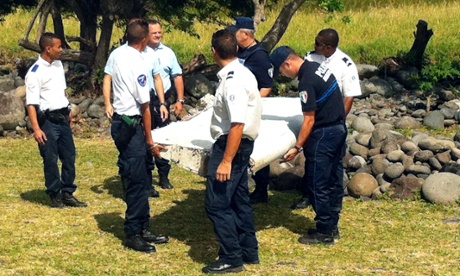
We are getting more images from Réunion Island, where the debris that could be a clue to the fate of flight MH370 washed up. It’s possible to see that the two-metre-long aircraft piece – which could be a flaperon from a 777, according to some aviation experts, although this is not confirmed – is encrusted with barnacles.

Updated
My colleague Rory Carroll has been in touch with Boeing, who are understandably playing it safe:
In a brief statement the company said it remained committed to supporting the search for the airplane.
‘We continue to share our technical expertise and analysis. Our goal, along with the entire global aviation industry, continues to be not only to find the airplane, but also to determine what happened – and why.
‘In accordance with international protocol governing aviation accident investigations, inquiries relating to an active investigation must be directed to the investigator in charge.’
Updated
Could the debris have drifted that far west?
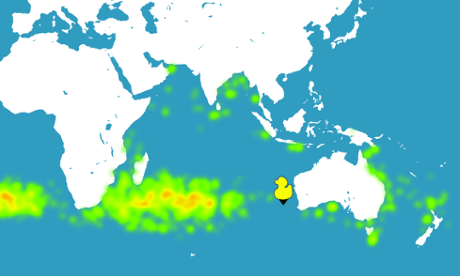
Oceanographers have created a remarkable current simulator showing how debris or plastics can drift across the ocean over months and years.
I’ve placed the rubber duck very roughly near the zone west of Perth where investigators believe the plane might have hit water. As you’ll see, it travels directly west towards Réunion. Hardly conclusive, but it does suggest that in theory the debris of MH370 could have drifted that far.
Updated
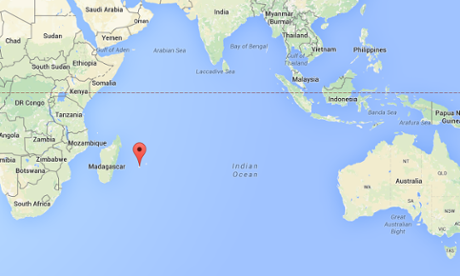
Above is where Réunion Island sits on the map – as you can see it’s quite a westward drift from the zone west of Perth that investigators have been scouring for the past year, pictured below.
Updated
Serial number on debris would make it "relatively easy" to identify
Wired is quoting a former National Transport Safety Bureau investigator, Greg Feith, who says the existence of a serial number on the debris would make it “relatively easy” to identify whether or not it’s linked to a Boeing 777.
From photographs, Xavier Tytelman, a French aviation expert, claims he can see two letters and three numbers, BB670, on the debris. Now, that could be part of a serial number, but would not match that of a Boeing 777. Which is yet another reminder to be cautious about speculation around this possible development.
Read the full Wired story here
Updated
French aviation specialist Xavier Tytelman here highlights the similarities between the “flaperon” (part of the trailing edge of the aircraft’s wing) of the Boeing 777 and the debris on Réunion.
Similitudes incroyables entre le flaperon d'un #B777 et le débris retrouvé ce matin à #LaReunion... #MH370 ? pic.twitter.com/GDkzRLwi2h
— Xavier Tytelman (@PeurAvion) July 29, 2015
Good morning. There’s been a possible breakthrough in the search for Malaysia Airlines flight MH370, the aircraft that vanished on 8 March last year carrying 239 passengers.
Police on the island of Réunion, in the French Indian Ocean, are examining what appears to be a piece from an aircraft found washed ashore on Wednesday.
An unnamed US official told Associated Press on Wednesday that air safety investigators have a “high degree of confidence” that the debris is of a wing component unique to the Boeing 777 — the same model as MH370.
The official claims that investigators — including a Boeing air safety investigator — have identified the component as a “flaperon”, part of the trailing edge of a 777 wing.
The hopes of passengers’ families have been raised and dashed before, but the wing found Wednesday is the most exciting clue in more than a year to a mystery that has captivated the world.
As investigators work to confirm the origin of the debris, we’ll be posting any updates here.
Updated