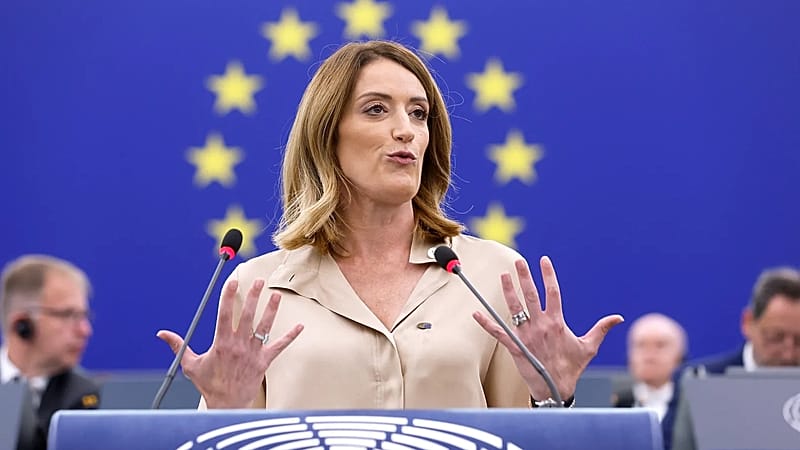
Momentum is building behind a third term for conservative European Parliament President Roberta Metsola, a prospect set to disrupt an informal agreement among centrist political forces and to put the Socialists and Democrats (S&D) on the back foot.
The Maltese politician from the European People's Party (EPP), who is currently serving her second term as president, is clearly the frontrunner, despite not having announced whether she will seek another mandate.
This scenario is concerning for the centre-left S&D group, which should be entitled to the presidency in the second half of the legislature but lacks the political clout to push through its own candidate.
“We should not accept Metsola, and we will not do it. But it seems to me quite obvious it will be her again,” a Socialist MEP told Euronews, speaking on condition of anonymity and summarising the mood among fellow lawmakers.
While negotiations over the presidency will only get into full swing after the summer break, discussions within the groups have already begun, and the Socialists appear boxed into an uneven contest, unable to put forward a credible challenger.
An ambiguous deal
The European Parliament's president is elected every two and a half years by MEPs through a secret ballot. But the decision is usually settled beforehand through backroom deals among the political groups.
The main European political families – conservatives, socialists and the liberal Renew Europe – usually settle on a candidate beforehand to avoid a showdown in the chamber. This is part of a broader agreement on the EU's top jobs, which include the presidents of the Commission and the Council, as well as the high representative for foreign affairs.
The latest deal, struck in June 2024, saw conservative Ursula von der Leyen confirmed as Commission president, socialist António Costa appointed president of the European Council, and liberal Kaja Kallas as high representative for foreign affairs.
In Parliament, the deal usually splits the legislature into two halves, as has been the case over the past four terms, with EPP and S&D members alternating as president.
Several MEPs have confirmed the agreement to Euronews, but its wording regarding Parliament's presidency deliberately leaves some room for ambiguity.
“It says that the groups aim for a balanced distribution of the Parliament's top positions,” which include vice-presidents and committee chairs, an MEP from another group told Euronews.
This leaves room for manoeuvre for Metsola's EPP, which is by far the largest political force in Parliament and could find allies to its left or right to impose its preferred candidate.
The Socialists' dilemma
The election's rules play in the EPP's favour.
In the secret ballot, the European Parliament's president could be elected by an absolute majority of votes cast in any of the first three rounds. If no candidate secures that majority, the election goes to a final run-off between the two candidates who received the most votes in the previous round.
If the EPP insists on another mandate for Metsola – as many MEPs expect – there is therefore little chance of stopping it.
With this prospect more and more likely, the S&D would face a lose-lose dilemma: challenge Metsola from a position of weakness or accept her re-election and grin and bear it.
The heads of Socialist parties’ delegations discussed their strategy in one of the last meetings before the summer break.
According to people in the room, some pushed to strike a backroom deal with the EPP, backing Metsola in exchange for concessions. These concessions include additional committee chairs or a stronger commitment to draft legislation exclusively with the centrist majority established at the beginning of the mandate.
Others were more inclined to pick a candidate and mount a challenge in the ballot, with German MEP Katarina Barley’s name floated in the discussions. Despite having virtually no chance of success, this move would force the EPP to breach the informal deal explicitly.
Centre-right conservatives have the upper hand in the vote. However, they prefer to maintain the appearance of unity and present Metsola as the product of a deal among pro-European forces, rather than get the president elected with the votes of far-right parties.
“Socialists should have moved earlier to call the EPP's bluff by tabling a candidate before the summer,” another MEP from a different political group told Euronews. “Now, if the EPP has the first move and it picks Metsola, they are cornered.”
A president for all seasons
Metsola remains silent, ready to step into the ring.
Her cabinet does not want to speculate on the possibility at this stage, stressing that any candidate must first be nominated by their political group.
She was re-elected with a broad cross-party majority in July 2024 and could become the first person in history to serve three terms as president.
“She knows how to keep colleagues on her side,” a senior lawmaker not belonging to the EPP told Euronews, citing Metsola's ability to cultivate relationships beyond the conservative camp.
“I do not see any better choice. She has also built a public image that is very appreciated,” another MEP said, referring to Metsola's profile on the international stage.
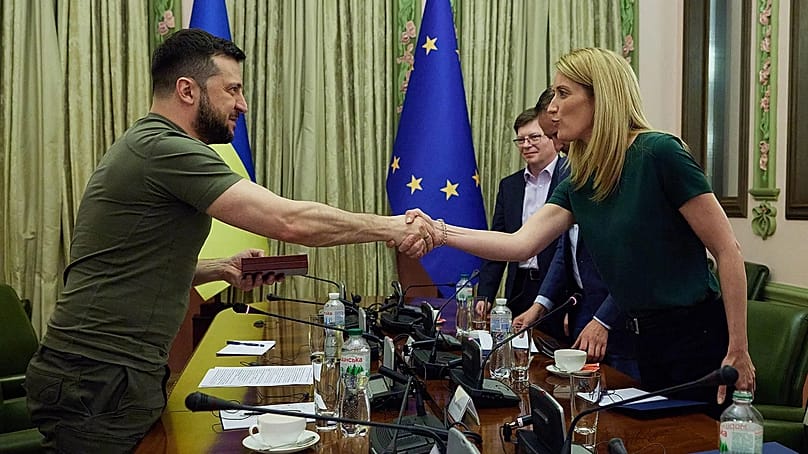
The current president has sought to project a strong international profile, particularly on Ukraine and Iran. She was the first European leader to travel to Kyiv in April 2022, less than two months after Russia's full-scale invasion; the whirlwind visit caught everyone by surprise, including officials in Brussels.
It was mostly a symbolic gesture, but one that paved the way for subsequent visits by Commission President Ursula von der Leyen, French President Emmanuel Macron, former German Chancellor Olaf Scholz, former Italian Prime Minister Mario Draghi, and other European leaders.
Metsola has also been at the forefront of the European Parliament's hard line towards Iranian leadership, supporting dissidents' protests, calling for regime change and banning all Iranian diplomats from the Parliament.
She also pushed for Iran's Islamic Revolutionary Guard Corps to be placed on the EU terrorist list, which happened a few weeks after her call.
At that time, her activism sparked speculation among MEPs about possible future ambitions for the European Commission’s presidency. But with the way cleared for her to remain at the helm of the Parliament, moving to another Brussels institution’s building is unlikely to happen anytime soon.