Metapolis is something more than metropolis. It's a place "beyond the suburb and the agglomeration... urban developments that were never given a name". Brussels-based Charleroi/ Danses - Plan K Company, under the direction of Frédéric Flamand, travels through this sprawling "metapolis", attempting to make something of it.
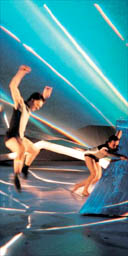
The result is a vast, ever-changing cityscape of ideas and technical wizardry. Scenes shift from drama to abstraction, light to dark, speed to static, with an angular fluency reflected in a weighty geometric dance style. Flamand pours state-of-the-art film and light technology over his choreography; the design is by architect Zaha Hadid. Fourteen dancers dash through an incredible journey, flying along urban highways, passing through a filmic world that juxtaposes apartment dwellings and African huts and works against a soundtrack that looks for emotion amid the alienation.
There are impressive, thoughtful elements in this piece. But it all seems to go past in a bit of a blur. Despite its density, something is missing. Opening with the building of a tall, fragile fence, the scene moves quickly to a spirograph web of light accompanying men in black shorts. The music here is in a slinky, avant-garde 1960s style. A couple cross a bridge slowly, while a group of dancers get caught in a block of light.
Out of nowhere, a man in a long greatcoat glides out on pointes, and directs a scene of violence against a backdrop of photos of ordinary people. And so the conveyor belt of discordant life goes on. For the next hour the images and ideas keep coming. A video cameraman follows the dancers, projecting film from specially fabricated costumes on to the back wall with a technique called "blue screen". Buildings and trees and people move on film cut out of dancers' dresses.
The set also plays an active part. Hadid's trio of silver movable bridges, poised like giant spider legs, but fitting together as if they were a set of occasional tables, adds complexity to the shape of the dance. The dancers push and pull them, glide over and under them. Her fashionably crafted costumes are a mix of spacesuit cling-ons, strange wraps and Gap-style casuals.
Metapolis gives a wired version of urban life as we know it and will, perhaps, know it in the future. In that it succeeds. But in extrapolating their vision into performance Flamand and Hadid have themselves been caught in the dehumanising force of the metapolis; they have allowed their work to be swallowed up by its technological temptations.