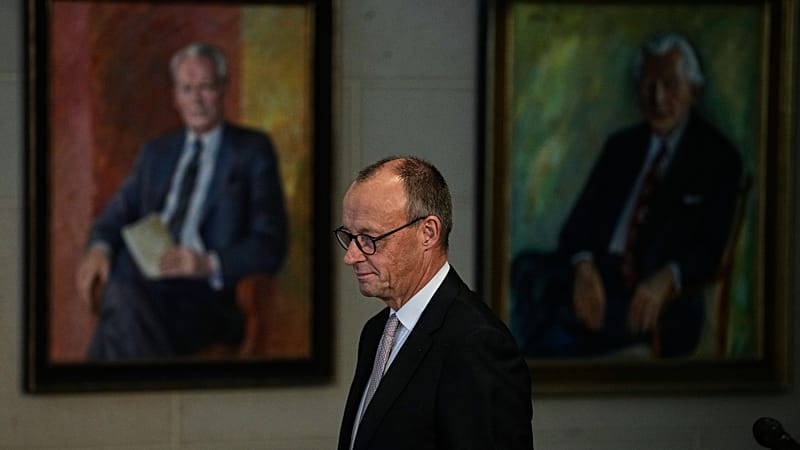
German Chancellor Friedrich Merz spoke on the phone with the President of the Palestinian Authority, Mahmoud Abbas, on Saturday. According to government spokesperson Stefan Kornelius, the conversation took place in a friendly atmosphere.
Merz reaffirmed Germany's support for US President Trump's peace plan and praised the cooperative attitude of the Palestinian Authority. At the same time, he urged urgently needed reforms to enable the authority to play a constructive role in a possible post-war order. The goal remains a negotiated two-state solution that can create long-term security for Israelis and Palestinians.
Delayed inaugural visit
Merz, of the Christian Democratic Union (CDU) party, begins his inaugural visit to Israel and Jordan this weekend. His first stop is the Jordanian capital Amman, where he will meet King Abdullah II. In the evening, he will then be received in Jerusalem by Israeli President Izchak Herzog, followed by talks with Prime Minister Benjamin Netanyahu on Sunday. Meetings with civil society representatives and a visit to the Yad Vashem Holocaust memorial are also planned - a regular feature of German inaugural visits to Israel. Merz also wants to meet released Hamas hostages and relatives of those killed.
The visit to Israel is comparatively late. While Angela Merkel and Olaf Scholz travelled to Israel just a few months after taking office, Merz has waited seven months. The background to this is the Gaza war, which was triggered by the Hamas attack on Israel on 7 October 2023. On that day, according to Israeli figures, around 1,200 people were killed and hundreds taken hostage.
According to the local health authority, the subsequent Israeli military offensive in the Gaza Strip claimed around 70,000 victims - while a new estimate by the Max Planck Institute puts the death toll in Gaza as high as 126,000. The ongoing fighting and the tense security situation had effectively ruled out diplomatic travel to the region for a long time.
However, a ceasefire between Israel and Hamas has officially been in place since 10 October; during this phase, Education Minister Karin Prien and Foreign Minister Johann Wadephul (both CDU) visited Israel.
Israel and Hamas are currently accuse each other of violating the ceasefire in the Gaza Strip.
According to Hamas, the Israeli army has shifted the so-called “yellow line,” behind which troops were supposed to withdraw under the agreement, further west. Local hospitals also reported that late in November more than 20 people were killed and over 50 injured in renewed Israeli strikes.
US peace plan at the centre
The talks are likely to focus on stabilising the ceasefire in the Gaza Strip, which has now been in place for almost two months, as well as efforts to enter a second phase of the peace process. This envisages, among other things, the disarmament of Hamas and an international peacekeeping force. The German government has so far left open whether and to what extent Germany could participate in this.
Arms policy issues are also likely to play a role. A fortnight ago, the temporary partial embargo on arms exports to Israel, which had put a considerable strain on bilateral relations, was lifted. Israel is now hoping for authorised deliveries from Germany again - including gearboxes for Merkava tanks.
Dispute over aid payments to the Palestinian Authority
In addition to possible pledges of support for Israel, financial support for the Palestinian Authority (PA) will also play a central role during the trip. Germany and the EU have been helping the PA for years to secure basic state structures in administration, education and health - an important part of international efforts to achieve stabilisation and political prospects.
This aid is now coming under increased pressure because doubts remain as to whether the PA has actually ended its controversial support programmes for prisoners and families of killed assassins, the so-called "martyr payments".
Israel and EU experts assume that these payments will continue. Tel Aviv speaks of sums of hundreds of millions of euros and has presented the EU with corresponding findings.
This is particularly explosive in view of the fact that the EU has pledged 1.6 billion euros for the reconstruction of Gaza and Germany is planning an additional 30 million euros. However, both sides emphasise that their aid is subject to strict controls and may not flow into these programmes.
Nevertheless, the EU recently confirmed a payment under the old system - precisely the form of support that the PA actually wanted to have discontinued. Israeli services also assume that there are other channels through which funds could flow. The PA officially denies this, but at the same time refers to its political obligation to the families of prisoners and victims.
The EU is now pressing for comprehensive clarification and is linking additional aid to reforms of the Palestinian social system. Germany does not want to resume regular payments until all outstanding issues have been clarified.
Merz faces balancing act
For Merz, the visit will therefore be a diplomatic balancing act: German support for the Palestinian Authority is also likely to be discussed in Jerusalem - as are the accusations that some of the aid money may have been channelled into controversial programmes.
At the same time, it remains to be seen how the German government intends to deal with the international arrest warrant against Prime Minister Netanyahu. After taking office, Merz signalled that he was in theory open to a visit by Netanyahu to Germany; however, the practical implementation of this position remains unclear.